

Highlights
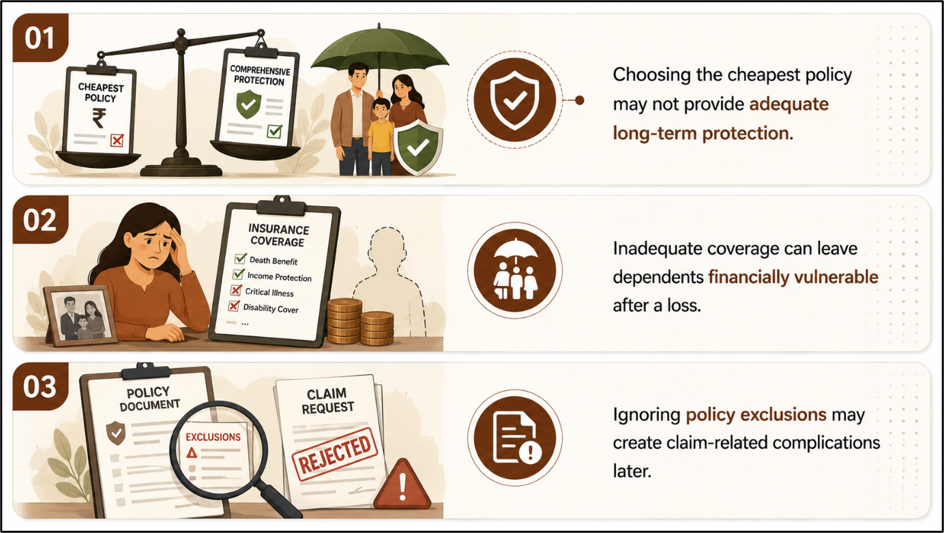
- Choosing the cheapest policy may not provide the best protection.
- Inadequate coverage can leave dependents financially vulnerable.
- Incorrect disclosures can create claim-related complications later.
Term insurance is widely regarded as one of the simplest financial protection products available. In exchange for a premium, policyholders receive life cover designed to provide financial support to their families in the event of an unforeseen death.
However, despite its straightforward nature, many buyers continue to make avoidable mistakes while selecting a policy. Focusing on advertisements, premium discounts, or marketing features without evaluating core policy aspects can affect the effectiveness of the coverage. Experts advise that buyers should look beyond headline premiums and assess whether the policy adequately addresses their family's long-term financial needs.
 Source: Analysis by Kalkine
Mistake 1: Selecting a Policy Solely Based on Low Premiums
One of the most common mistakes is choosing the policy with the lowest premium.
While affordability is important, the cheapest option may not necessarily offer the most suitable protection. Buyers should evaluate factors such as the insurer's service standards, claims assistance process, policy features, and overall reliability rather than focusing only on annual premium costs. A lower premium may appear attractive initially but may not be the most appropriate choice when long-term family protection is the objective.
Mistake 2: Choosing an Inadequate Sum Assured
Many individuals select coverage amounts based on commonly advertised figures rather than their actual financial responsibilities.
The required life cover should ideally take into account existing loans, household expenses, future education costs, lifestyle requirements, and the number of years dependents may need financial support. Insurance experts frequently note that generic coverage figures may not reflect a family's real financial needs. As a result, underinsurance remains a significant risk for many policyholders.
Mistake 3: Ignoring Policy Exclusions and Conditions
Buyers often focus heavily on benefits while overlooking exclusions, waiting periods, and policy conditions.
Every insurance contract contains circumstances under which claims may be delayed, restricted, or denied. High-risk activities, undisclosed medical conditions, and incorrect information provided during the application process can create complications at the time of claim settlement.
Carefully reviewing policy documents and ensuring complete disclosure during application can help minimize future disputes. Transparency during policy purchase remains one of the most important responsibilities of the policyholder.
Mistake 4: Adding Riders Without Assessing Actual Needs
Insurance companies frequently offer optional riders such as critical illness cover, accidental death benefits, and waiver-of-premium features.
While some riders may provide useful additional protection, not every rider is necessary for every individual. Adding multiple riders without understanding their purpose can increase premiums without delivering proportional benefits.
Experts recommend evaluating personal financial obligations, health risks, and existing insurance coverage before deciding which riders are genuinely required. The objective should be to enhance protection rather than accumulate unnecessary add-ons.
Mistake 5: Relying Only on Claim Settlement Ratios
Claim settlement ratios are often used as a benchmark when comparing insurers. However, relying exclusively on this metric can be misleading.
A claim settlement ratio provides only one aspect of an insurer's performance and may not fully reflect customer experience during the claims process. Factors such as claims support, documentation assistance, responsiveness, and service quality also play an important role for families navigating difficult circumstances.
Industry experts suggest evaluating the broader claims experience rather than focusing solely on a single statistical measure.
The Importance of Full Disclosure
Another critical aspect of term insurance is ensuring that all information submitted during the application process is accurate.
Non-disclosure of smoking habits, medical conditions, lifestyle risks, or financial details can create difficulties during claim assessment. Buyers should personally review application forms and verify all declarations before submitting them to the insurer. Complete and accurate disclosure helps reduce the likelihood of claim-related disputes in the future.
Conclusion
Term insurance plays an important role in protecting a family's financial future, but the effectiveness of that protection depends on informed decision-making. Choosing coverage solely on price, purchasing insufficient cover, ignoring exclusions, selecting unnecessary riders, and relying only on claim settlement ratios are among the most common mistakes made by buyers.
A careful assessment of coverage needs, policy terms, and insurer support mechanisms can help ensure that the policy serves its intended purpose when it is needed most.
Key Risks
- Insufficient coverage may not meet family financial needs.
- Incorrect disclosures can create claim settlement complications.
- Excessive riders can increase premiums unnecessarily.
- Overreliance on premium cost may overlook policy quality.
Summary
Term insurance offers financial protection at relatively affordable costs, but buyers often make mistakes that can reduce its effectiveness. Common errors include selecting policies based solely on low premiums, choosing inadequate coverage, ignoring exclusions, purchasing unnecessary riders, and focusing only on claim settlement ratios. Careful evaluation of policy features, disclosures, and family needs can help ensure meaningful long-term protection.
FAQs
Q: Why is choosing the cheapest term insurance policy risky?
A: Lower premiums may not always provide the most suitable coverage, service quality, or claims assistance.
Q: How should buyers determine the appropriate life cover amount?
A: Coverage should consider loans, family expenses, future goals, and the financial needs of dependents.
Q: Are all insurance riders necessary with a term insurance policy?
A: No, riders should be selected based on individual requirements and existing financial protection arrangements.