

Highlights
- Government apps help citizens access services without visiting physical offices.
- Digital platforms simplify document storage, payments, and public service access.
- Apps like UMANG and DigiLocker integrate multiple services into one system.
India’s digital governance ecosystem has expanded significantly, offering citizens multiple mobile applications that reduce the need for paperwork and physical visits to government offices. These apps are designed to simplify access to essential services such as identity documents, financial transactions, healthcare records, and administrative procedures. With increasing adoption, they are becoming an important part of everyday digital life.
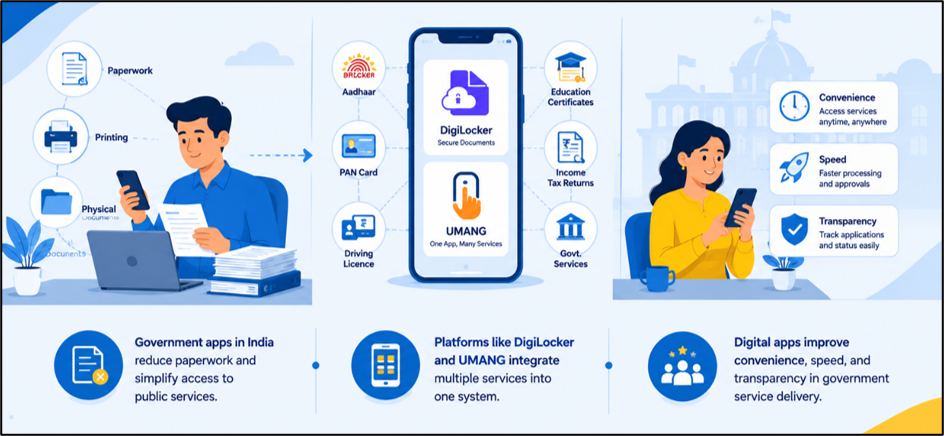
Source: Analysis by Kalkine
DigiLocker: Digital Storage for Official Documents
DigiLocker is a cloud-based platform that allows users to store and access important government-issued documents digitally. These include driving licences, Aadhaar cards, PAN cards, academic certificates, and vehicle registration documents. Since documents stored in DigiLocker are issued or verified by government authorities, they are widely accepted as legally valid in many official processes. This reduces the need to carry physical copies and helps avoid document loss or duplication.
UMANG: One App for Multiple Government Services
UMANG (Unified Mobile Application for New-age Governance) acts as a single platform that brings together a wide range of central and state government services. Through this app, users can access services related to EPFO, pension schemes, tax filing information, utility bill payments, healthcare services, and more. Instead of visiting multiple websites or offices, citizens can complete several tasks in one place, making it a central tool for digital governance access.
BHIM: Simple Digital Payments Using UPI
BHIM is a government-backed UPI-based payment application that enables users to send and receive money directly through their bank accounts. It supports QR code payments and peer-to-peer transfers, making digital transactions accessible even without advanced financial tools. The app is widely used for everyday payments and promotes cashless transactions across the country.
ABHA: Digital Health Record Management
ABHA (Ayushman Bharat Health Account) allows users to create a unique digital health ID that stores and manages personal health records. It enables seamless access to medical history across hospitals and healthcare providers. This reduces the need for carrying physical medical documents and helps streamline healthcare services, especially for patients undergoing long-term treatment.
mAadhaar: Mobile Access to Aadhaar Services
mAadhaar is the official mobile application developed to provide access to Aadhaar-related services. Users can carry a digital version of their Aadhaar card, update personal details, and generate virtual IDs for authentication purposes. It helps reduce dependency on physical Aadhaar copies and simplifies identity verification across various services.
How These Apps Improve Governance Access
These government-backed apps collectively reduce dependency on manual paperwork and physical visits to offices. They integrate services across sectors such as finance, healthcare, identity verification, and public administration into mobile platforms. This shift supports faster service delivery, improved transparency, and greater convenience for citizens across urban and rural areas.
Risks to Watch
- Data privacy concerns if mobile devices are compromised.
- Fake or duplicate apps may lead to information theft.
- Internet dependency may limit access in low-connectivity areas.
- Incorrect document uploads can cause verification issues.
Summary
Government-backed apps like DigiLocker, UMANG, BHIM, ABHA, and mAadhaar are transforming how citizens access essential services in India. These platforms reduce paperwork, improve service delivery speed, and enable digital access to key documents and systems. While they offer convenience and efficiency, users must remain cautious about data security and app authenticity.
FAQs
Q: What is the main purpose of government-backed apps in India?
A: These apps aim to simplify access to public services, reduce paperwork, and minimize visits to government offices.
Q: Is DigiLocker legally valid for official document use?
A: Yes, documents issued or verified through DigiLocker are accepted in many government and private processes.
Q: Can all government services be accessed through one app?
A: UMANG provides access to many services, but some processes may still require separate departmental procedures.