

Highlights
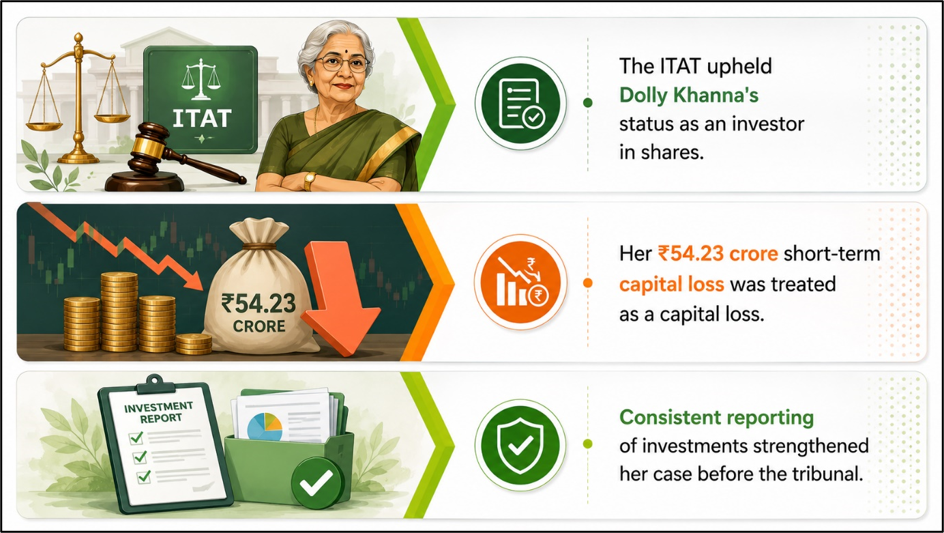
- ITAT upheld Dolly Khanna's status as an investor in shares.
- Rs 54.23 crore short-term capital loss was treated as a capital loss.
- Frequent share transactions alone do not automatically indicate trading activity.
The classification of an individual as an investor or a trader has long been a subject of dispute in income tax assessments. The distinction is important because gains and losses from investments are taxed differently from business income and losses.
In a recent ruling, the Chennai bench of the Income Tax Appellate Tribunal (ITAT) provided further clarity on this issue while deciding a case involving well-known investor Dolly Khanna. The tribunal's observations may have implications for taxpayers who actively participate in equity markets while continuing to maintain investment portfolios.
Background of the Case
The dispute arose after tax authorities challenged the manner in which Dolly Khanna reported her share transactions.
According to the case details, Khanna reported a short-term capital loss (STCL) of Rs 54.23 crore under the head "Capital Gains." However, the Assessing Officer argued that the volume and frequency of her share transactions suggested trading activity and therefore sought to classify the loss as a business loss instead.
The tax department contended that the scale of transactions reflected a commercial trading operation rather than investment activity. As a result, the treatment of gains and losses became the central issue in the dispute.
 Source: Analysis by Kalkine
ITAT Upholds Investor Status
The tribunal ultimately ruled in favour of Dolly Khanna and rejected the tax department's attempt to reclassify the loss.
ITAT observed that Khanna had consistently treated her shareholdings as investments over a long period. The tribunal noted that she had been reporting gains and losses under the capital gains head for more than two decades and that this approach had been accepted by the tax authorities in earlier assessment years.
Based on this consistency and the nature of the holdings, the tribunal concluded that she should continue to be treated as an investor rather than a trader. Consequently, the Rs 54.23 crore short-term capital loss was allowed to be treated as a capital loss and carried forward under the applicable provisions of the Income Tax Act.
Frequency of Transactions Not the Sole Test
One of the significant aspects of the ruling is the tribunal's emphasis that frequent buying and selling of shares does not automatically convert an investor into a trader.
Tax authorities often examine factors such as transaction volume, holding period, source of funds, accounting treatment, and taxpayer intent while determining whether an activity constitutes investment or business. The ITAT's decision reinforces the principle that no single factor should be viewed in isolation.
The ruling highlights that consistent conduct over the years can play a critical role in determining the correct tax treatment of share transactions.
Implications for Market Participants
The judgment may be relevant for individual investors who actively manage their portfolios and execute multiple transactions during a financial year.
Many investors engage in frequent portfolio rebalancing, profit booking, and strategic allocation changes. The ruling suggests that such activity alone may not be sufficient to classify them as traders if the overall facts indicate an investment approach.
At the same time, taxpayers should maintain proper documentation and ensure consistency in accounting and tax reporting practices to support their position in case of scrutiny.
Importance of Consistent Tax Reporting
Tax experts often emphasize that consistency remains a key factor in disputes involving the investor-versus-trader question.
When taxpayers repeatedly classify securities as investments in their books, financial statements, and tax returns, and the same treatment is accepted by authorities over several years, it may strengthen their case if classification is later challenged.
The Dolly Khanna ruling reinforces the significance of maintaining a clear and consistent approach to reporting share transactions.
Key Risks
- Frequent trading may still attract scrutiny from tax authorities.
- Inconsistent reporting can weaken an investor's tax position.
- Classification disputes may lead to prolonged tax litigation.
- Documentation gaps can create challenges during assessments.
Summary
The Chennai ITAT ruled in favour of investor Dolly Khanna in a case involving the classification of share transactions. The tribunal held that her Rs 54.23 crore short-term capital loss should be treated as a capital loss and not a business loss. The ruling emphasized that frequent share transactions alone do not establish trading activity and that long-term consistency in reporting remains an important factor when determining investor status.
FAQs
Q: What was the key issue in the Dolly Khanna ITAT case?
A: The dispute concerned whether her share transactions should be taxed as investment activity or business trading activity.
Q: What did the ITAT decide regarding the Rs 54.23 crore loss?
A: The tribunal treated it as a capital loss and allowed carry-forward under capital gains provisions.
Q: Does frequent share trading automatically make someone a trader for tax purposes?
A: No, the ITAT stated that transaction frequency alone is not sufficient to determine trader status.