

Highlights
- First-time investors should align mutual fund choices with financial goals and risk appetite.
- SIPs can help investors build investment discipline and reduce timing concerns.
- Asset allocation and diversification remain important for long-term investing success.
Mutual funds have become a popular investment option for individuals seeking exposure to financial markets without directly selecting and managing individual securities. Through mutual funds, investors gain access to professionally managed portfolios that may invest in equities, debt instruments, hybrid assets, or a combination of these investments.
For first-time investors entering the market in FY27, understanding the basics of mutual fund investing can help create a structured approach rather than making decisions based solely on market movements or short-term trends.
 Source: Analysis by Kalkine
Start With Financial Goals
Before selecting any mutual fund, investors should identify the purpose of investing.
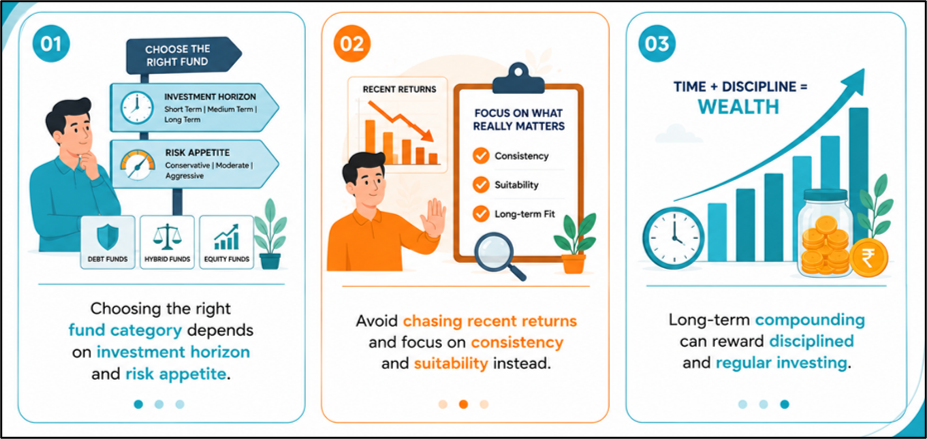
Different goals may require different investment approaches. Short-term objectives such as building an emergency fund or saving for a planned purchase may have different requirements than long-term goals such as retirement planning, children's education, or wealth creation.
Defining the investment horizon and expected financial outcome can help narrow the range of suitable fund categories.
Assess Your Risk Appetite
Risk tolerance is a key factor when choosing mutual funds.
Conservative Investors
Individuals who prefer lower volatility may consider debt-oriented funds or conservative hybrid funds, depending on their financial objectives and investment horizon.
Moderate Investors
Investors willing to accept some market fluctuations may explore balanced or hybrid fund categories that combine equity and debt exposure.
Aggressive Investors
Those with longer investment horizons and higher tolerance for market volatility may consider equity-oriented funds, understanding that returns can fluctuate significantly in the short term.
Choosing investments that match risk tolerance can help investors remain invested during periods of market uncertainty.
Building Investment Discipline
A Systematic Investment Plan (SIP) allows investors to contribute fixed amounts at regular intervals instead of making a large one-time investment.
This approach encourages disciplined investing and can make wealth creation more manageable over time.
Managing Market Timing Risk
Many first-time investors worry about entering markets at the wrong time. SIPs help distribute investments across different market levels, reducing dependence on a single entry point.
Supporting Long-Term Compounding
Regular investments made over extended periods can benefit from the power of compounding.
The concept highlights how investment growth can accelerate when returns themselves begin generating additional returns over time.
Understand Different Fund Categories
Equity Mutual Funds
These funds primarily invest in stocks and are generally suitable for investors with longer time horizons and higher risk tolerance.
Debt Mutual Funds
Debt funds invest in fixed-income securities and may appeal to investors seeking relatively lower volatility compared with equities.
Hybrid Funds
Hybrid funds combine equity and debt investments and may suit investors seeking a balance between growth potential and risk management.
Index Funds
Index funds aim to replicate the performance of a market index rather than actively selecting securities. They have gained attention among investors looking for a rules-based investment approach.
Avoid Chasing Past Performance
One common mistake among new investors is selecting funds solely based on recent returns. Past performance does not guarantee future results. Investors may benefit from evaluating factors such as investment objectives, portfolio composition, fund category, expense ratios, and consistency of performance across different market conditions.
A fund that performed well during a particular market phase may not necessarily maintain the same results in the future.
Focus On Asset Allocation
Asset allocation refers to how investments are distributed across different asset classes. For many investors, long-term outcomes are influenced not only by fund selection but also by maintaining an appropriate mix of equities, debt, and other investments.
A diversified portfolio may help manage risk while pursuing financial goals. Periodic reviews can ensure that allocations remain aligned with changing objectives and market conditions.
Keep Expectations Realistic
Mutual funds are market-linked investments. Returns can vary depending on economic conditions, interest rates, market sentiment, and portfolio performance.
First-time investors should avoid expecting guaranteed returns and instead focus on long-term investing discipline. Consistent investing and patience often play a significant role in achieving financial objectives.
Key Risks To Consider
- Market volatility can affect mutual fund returns significantly.
- Poor asset allocation may increase portfolio risk.
- Short investment horizons can limit growth potential.
- Chasing recent performance may lead to unsuitable investments.
Summary
For first-time investors in FY27, mutual funds can provide access to diversified and professionally managed investment portfolios. A structured approach involving clear financial goals, risk assessment, SIP investing, diversification, and appropriate asset allocation can help investors navigate market fluctuations. Rather than focusing on short-term returns, investors may benefit from maintaining discipline, reviewing portfolios periodically, and aligning investments with long-term financial objectives.
FAQs
Q: Should first-time investors start with SIPs or lump-sum investments?
A: SIPs are often preferred because they promote discipline and reduce dependence on market timing decisions.
Q: How do investors choose the right mutual fund category?
A: Fund selection should depend on financial goals, investment horizon, and individual risk tolerance.
Q: Are mutual funds guaranteed to generate positive returns?
A: No. Mutual fund returns are market-linked and can fluctuate based on underlying asset performance.