

Highlights
- Reviewing expenses can replace uncertainty with a clearer financial picture.
- Building an emergency fund can reduce the impact of unexpected costs.
- Planning salary allocation in advance can improve financial discipline.
Financial stress often develops gradually rather than appearing overnight. Rising living costs, loan repayments, household expenses, and uncertainty about future obligations can leave individuals feeling overwhelmed. In many cases, the anxiety comes not only from a lack of money but also from a lack of clarity about one's financial situation.
When people feel stressed about money, they may avoid reviewing bank balances, credit card statements, or outstanding debts. Unfortunately, postponing financial decisions can increase anxiety and make financial challenges feel larger than they actually are.
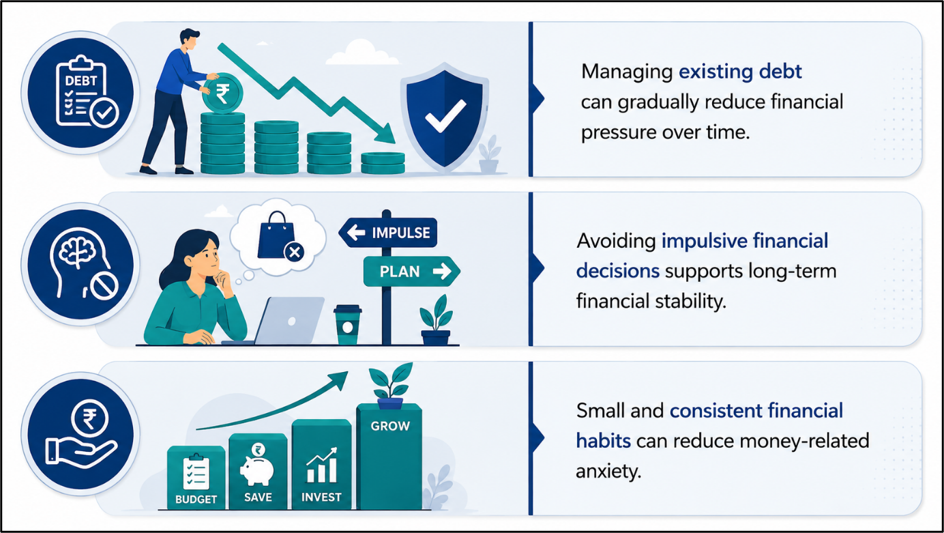
Taking small, practical steps can help individuals regain a sense of control and reduce financial pressure over time.
 Source: Analysis by Kalkine
Start With the Numbers, Not the Worry
One of the simplest ways to address financial stress is to review personal finances honestly.
This means examining bank accounts, monthly expenses, credit card statements, loan obligations, and recurring payments. The objective is not to criticize past spending decisions but to understand where money is going each month.
Many people discover that uncertainty creates more stress than reality itself. A clear view of finances can reveal opportunities to reduce unnecessary spending and improve budgeting decisions.
Build a Financial Safety Net
Unexpected expenses are one of the biggest sources of financial anxiety.
Vehicle repairs, medical emergencies, home maintenance costs, or sudden family obligations can disrupt financial plans. Without savings, even relatively small expenses may create significant stress.
Creating an emergency fund can provide a financial cushion during difficult periods. While building several months of expenses may take time, even a modest reserve can improve financial confidence and reduce dependence on credit during emergencies.
Focus on One Debt at a Time
Managing multiple loans, credit cards, and EMIs simultaneously can feel intimidating.
Rather than attempting to eliminate every liability at once, individuals may find it more practical to focus on one debt first. This could involve paying down the highest-interest debt or clearing a smaller balance to create momentum.
Seeing measurable progress often improves motivation and encourages better financial habits over the long term.
Stop Comparing Your Finances With Others
Social media and everyday conversations can create unrealistic financial expectations.
People often see vacations, new vehicles, property purchases, or investment successes without seeing the financial obligations, loans, or personal circumstances behind those decisions.
Comparing financial progress with others can increase stress and dissatisfaction. A more productive approach is to measure progress against personal goals and past financial performance rather than external benchmarks.
Give Every Paycheque a Purpose
Many individuals plan their work schedules, family commitments, and future goals but fail to plan how their salary will be used.
Before receiving the next paycheque, it can be helpful to decide how much money will be allocated toward savings, investments, debt repayments, household expenses, and discretionary spending.
This does not require complex spreadsheets or advanced financial tools. A simple allocation plan can create greater confidence and reduce uncertainty around spending decisions.
Financial Control Matters More Than Financial Perfection
Financial well-being is not solely determined by income levels. Individuals with high earnings can still experience financial stress if they lack a clear plan, while those with moderate incomes may feel more secure through disciplined money management.
The objective is not to achieve financial perfection overnight. Instead, the goal is to understand what you own, what you owe, and what actions can improve your financial position over time.
Key Risks
- Ignoring expenses can allow financial problems to worsen.
- Lack of emergency savings may increase dependence on debt.
- Multiple high-interest debts can strain monthly cash flow.
- Comparing finances with others may encourage poor decisions.
Summary
Financial stress often stems from uncertainty, debt obligations, unexpected expenses, and poor financial visibility. Practical measures such as tracking expenses, building emergency savings, focusing on one debt at a time, avoiding financial comparisons, and planning salary allocation can help individuals regain control. Financial stability is typically built through consistent habits and informed decisions rather than sudden changes.
FAQs
Q: What is one of the quickest ways to reduce financial stress?
A: Reviewing expenses and understanding cash flows can replace uncertainty with facts and improve financial decision-making.
Q: Why is an emergency fund important for financial well-being?
A: Emergency savings can help cover unexpected expenses without increasing debt or disrupting long-term financial plans.
Q: Should multiple debts be tackled simultaneously?
A: Many financial experts recommend focusing on one debt at a time to maintain motivation and track progress effectively.