

Highlights
- The Income Tax Department has revised ITR filing deadlines for different taxpayer categories.
- Salaried individuals and businesses now have separate compliance timelines for FY 2025-26.
- Taxpayers should verify documents early to avoid late filing and penalty-related issues.
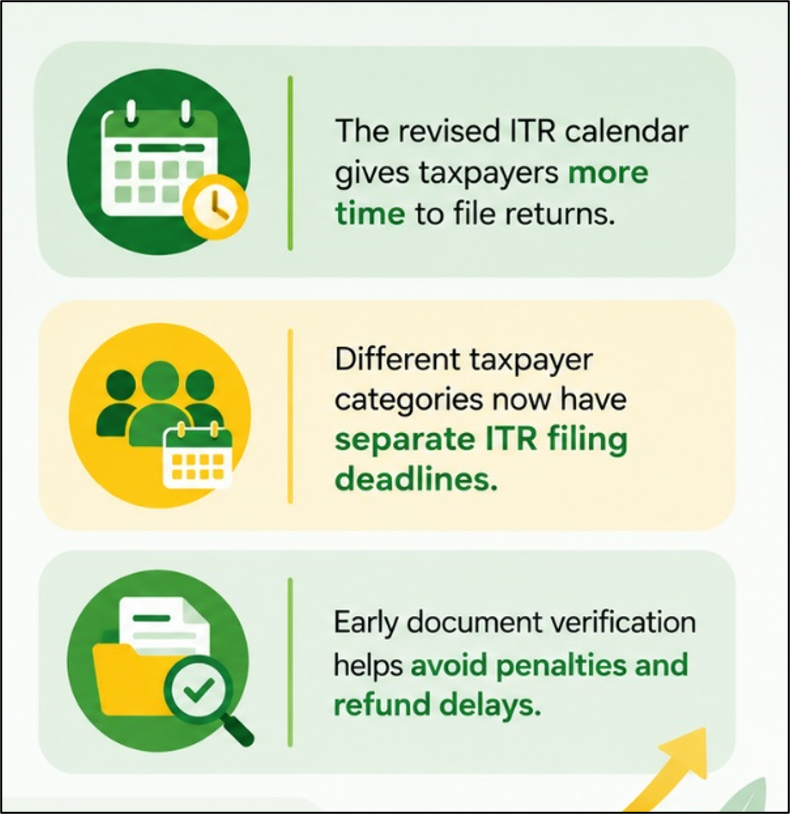
The Income Tax Department has revised the Income Tax Return (ITR) filing calendar for Assessment Year (AY) 2026-27, introducing updated deadlines for different categories of taxpayers. The revised schedule aims to provide additional time for return preparation while ensuring timely compliance for businesses, professionals, and individuals.
The updated filing calendar affects salaried employees, self-employed individuals, businesses requiring audits, and taxpayers involved in transfer pricing transactions. Understanding these timelines is important for avoiding penalties, interest, and delays in processing refunds.
Source: Analysis by Kalkine
Why Have the ITR Filing Deadlines Changed?
The revised ITR filing schedule is intended to streamline the return filing process by allowing sufficient time after the issuance of tax forms and data updates. Since taxpayers rely on documents such as Form 16, Form 26AS, Annual Information Statement (AIS), and Taxpayer Information Summary (TIS), the additional time is expected to help improve return accuracy.
The revised calendar also provides auditors and businesses with additional time to complete statutory requirements before filing returns.
Updated ITR Filing Calendar for AY 2026-27
The revised deadlines broadly apply as follows:
- Salaried individuals and taxpayers not requiring an audit have an extended filing timeline.
- Businesses and professionals requiring tax audits have separate due dates after completion of audit requirements.
- Taxpayers covered under transfer pricing regulations continue to have a later filing deadline because of additional compliance requirements.
- Updated returns can still be filed within the period permitted under the Income Tax Act, subject to applicable provisions.
Taxpayers should verify the exact deadline applicable to their category before filing their returns.
What Salaried Taxpayers Should Do
Salaried individuals should begin collecting tax documents well before the filing deadline. These generally include:
- Form 16 issued by the employer.
- Form 26AS for tax credit verification.
- Annual Information Statement (AIS).
- Taxpayer Information Summary (TIS).
- Investment and deduction proofs, where applicable.
- Interest certificates from banks and financial institutions.
Cross-checking these documents before filing helps reduce mismatches that may trigger notices or delay refunds.
Key Steps Before Filing an ITR
Taxpayers should complete a few essential checks before submitting their return.
First, verify that salary income, bank interest, capital gains, and other income sources are correctly reported. Next, ensure that tax deducted at source (TDS) reflected in Form 26AS matches employer and bank records. Eligible deductions under the applicable tax regime should also be reviewed carefully.
Finally, taxpayers should validate their bank account details to facilitate faster refund processing wherever applicable.
Consequences of Missing the Deadline
Failure to file an income tax return within the prescribed due date may lead to several consequences depending on the taxpayer's situation.
Late filing may attract statutory late fees, interest on unpaid tax liabilities, restrictions on carrying forward certain losses, and delays in processing refunds. In some cases, taxpayers may also receive notices seeking clarification or additional information.
Filing the return within the applicable deadline remains the most effective way to avoid unnecessary compliance issues.
Importance for Business Taxpayers
Businesses and professionals requiring statutory tax audits should coordinate with auditors well in advance. Financial statements, audit reports, and supporting documentation should be finalized before the applicable filing deadline.
Entities covered under transfer pricing provisions should also ensure timely preparation of required documentation to meet compliance obligations.
Risks to Watch
- Missing applicable ITR deadline may result in late filing fees.
- Incorrect income reporting can trigger tax notices or reassessment.
- Mismatch in TDS records may delay tax refund processing.
- Failure to verify returns can make filings incomplete.
Summary
The revised ITR filing calendar for AY 2026-27 provides different compliance deadlines for salaried taxpayers, businesses, audited entities, and transfer pricing cases. Taxpayers should identify the deadline applicable to their category, verify tax documents including Form 16, AIS and Form 26AS, report income accurately, and complete return verification on time. Early preparation can help reduce filing errors, avoid penalties, and improve refund processing timelines.
FAQs
Q: Who is affected by the revised ITR filing calendar?
A: Salaried individuals, professionals, businesses requiring audits, and taxpayers covered under transfer pricing provisions must follow revised filing timelines.
Q: Which documents should salaried taxpayers verify before filing?
A: Form 16, Form 26AS, AIS, TIS, bank interest certificates, and deduction proofs should be verified before filing returns.
Q: What happens if an ITR is filed after the due date?
A: Taxpayers may face late filing fees, interest, delayed refunds, and restrictions on carrying forward eligible losses under applicable provisions.