

Highlights
- Home loan eligibility depends on income, obligations, tenure, and interest rates.
- Higher salaries generally improve borrowing capacity and lender approval prospects.
- Existing EMIs can significantly reduce the maximum loan amount available.
Rising property prices have made home loan planning an important part of the home-buying process. For many aspiring homeowners, one of the first questions is how much financing they can obtain based on their income level.
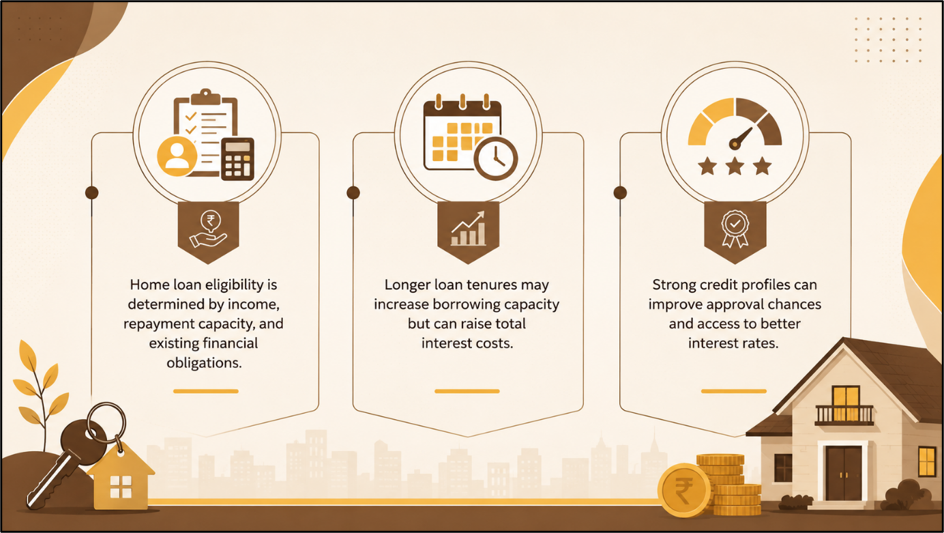
In 2026, banks and housing finance companies continue to assess loan eligibility using factors such as monthly income, repayment capacity, existing debt obligations, credit profile, and loan tenure. While income plays a major role, it is only one element in the overall lending assessment.
 Source: Analysis by Kalkine
How Lenders Calculate Home Loan Eligibility
Financial institutions typically evaluate an applicant's repayment capacity before approving a home loan. A commonly used approach is the Fixed Obligation to Income Ratio (FOIR), which measures the proportion of income that can reasonably be allocated toward loan repayments after considering existing financial commitments.
In many cases, lenders may permit total EMI obligations to account for around 40% to 60% of a borrower's monthly income, although the exact threshold varies across institutions and borrower profiles. As a result, two individuals earning similar salaries may qualify for different loan amounts depending on their existing liabilities and financial history.
Borrowing Capacity for an INR 15 Lakh Annual Salary
An individual earning approximately INR 15 lakh annually would have a gross monthly income of about INR 1.25 lakh.
Assuming limited existing liabilities and a standard home loan tenure, lenders may allow a significant portion of this income to be allocated toward housing loan repayments. Depending on interest rates, tenure, age, and repayment capacity, the potential loan eligibility could extend into the upper lakh range and may exceed INR 1 crore in some scenarios.
However, actual approval amounts vary based on the lender's internal policies and the borrower's overall financial profile.
Borrowing Capacity for an INR 20 Lakh Annual Salary
A borrower with an annual income of INR 20 lakh typically earns around INR 1.67 lakh per month before deductions.
With a higher income base, lenders generally view repayment capacity more favourably, potentially enabling larger loan sanctions. Subject to eligibility norms, tenure, and credit assessment, such borrowers may qualify for home loans that comfortably exceed the borrowing limits available to lower-income applicants.
Nevertheless, the final approved amount depends on multiple variables beyond salary alone.
Existing EMIs Can Affect Eligibility
One of the most important factors influencing home loan approval is the presence of existing debt obligations.
Personal loans, vehicle loans, education loans, and credit card EMIs reduce disposable income available for housing loan repayments. Consequently, lenders may lower the maximum loan amount even if the applicant has a relatively high salary.
Reducing outstanding debt before applying for a home loan can improve eligibility and repayment metrics.
Credit Score Remains a Key Consideration
Income alone does not guarantee loan approval. Lenders closely review credit scores and repayment history to assess a borrower's creditworthiness. A strong credit profile may improve approval prospects and potentially help borrowers access more favourable interest rates.
Conversely, delayed payments, defaults, or a weak credit history may affect both eligibility and borrowing costs.
Why Loan Tenure Matters
Loan tenure plays a significant role in determining borrowing capacity. Longer repayment periods generally reduce monthly EMI requirements, enabling borrowers to qualify for larger loan amounts. However, extended tenures may also increase the total interest paid over the life of the loan.
Borrowers often need to balance affordability and long-term borrowing costs when selecting a repayment period.
Property Value and Down Payment Requirements
Even if a borrower qualifies for a substantial loan, lenders usually finance only a portion of the property's value.
Homebuyers are generally required to contribute a down payment from their own resources. Therefore, property affordability depends not only on loan eligibility but also on available savings and upfront funding capacity.
Understanding both aspects can help buyers make realistic property purchase decisions.
Key Risks
- Existing EMIs may significantly reduce borrowing eligibility.
- Poor credit scores can affect approval and interest rates.
- Longer tenures may increase overall interest costs.
- Rising interest rates can impact repayment affordability.
Summary
Home loan eligibility in 2026 depends on more than just annual income. While individuals earning INR 15 lakh and INR 20 lakh annually may qualify for substantial borrowing amounts, lenders also evaluate existing obligations, credit history, repayment capacity, tenure selection, and property-related factors. Prospective borrowers should assess their complete financial position before determining how much home financing they can comfortably manage.
FAQs
Q: Is salary the only factor considered for home loan approval?
A: No, lenders also assess credit score, existing debts, repayment capacity, and loan tenure.
Q: Can existing personal loans affect home loan eligibility?
A: Yes, current EMIs reduce available repayment capacity and may lower eligible loan amounts.
Q: Does a longer tenure increase loan eligibility?
A: Generally, longer tenures reduce EMI obligations and may improve borrowing capacity.