

Highlights
- The 3-20-30-40 framework offers a structured approach to assessing housing affordability.
- Limiting EMIs and loan size may help preserve long-term financial flexibility.
- A larger down payment can reduce borrowing costs and overall debt burden.
Buying a home is one of the largest financial commitments most households undertake. However, the amount a lender is willing to finance may not always align with what a buyer can comfortably afford. A higher loan approval can sometimes encourage borrowers to stretch their finances, leaving little room for savings, investments, or unexpected expenses.
To address this concern, financial planners often refer to the 3-20-30-40 rule, a guideline designed to help buyers evaluate whether a property purchase fits within their broader financial goals. The framework focuses on income, loan tenure, monthly obligations, and upfront contribution rather than relying solely on lender eligibility criteria.
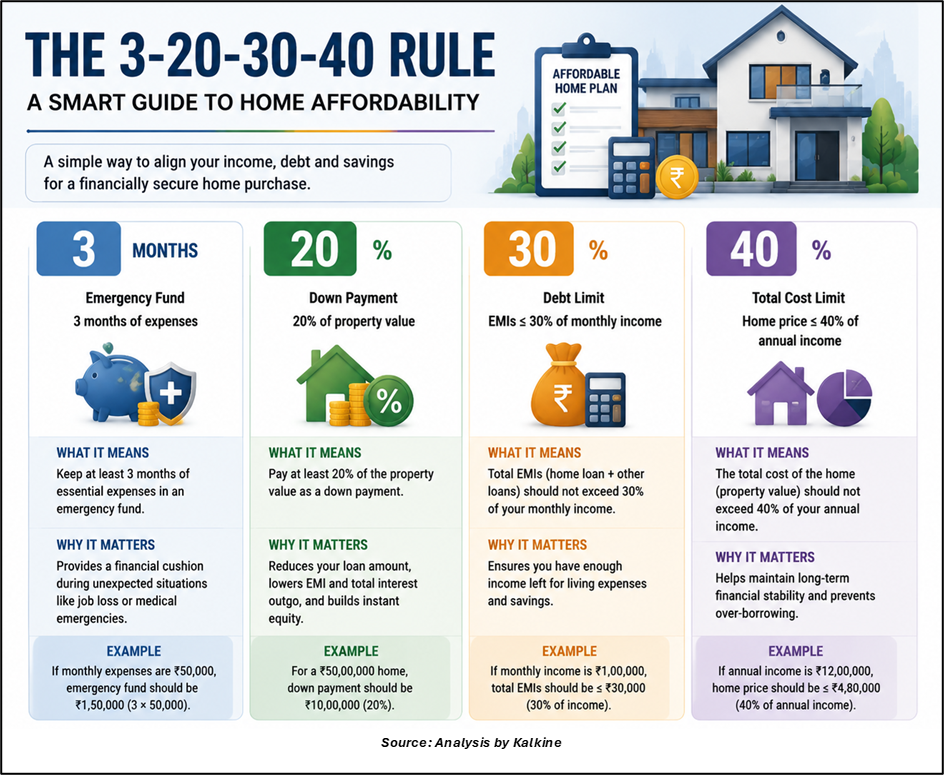
Breaking Down The 3-20-30-40 Formula
The rule consists of four components that work together to keep housing costs manageable.
3 – Property Value Relative To Annual Income
Under this guideline, the property's cost should ideally remain within three times a household's annual income. The objective is to avoid allocating a disproportionate share of financial resources to a single asset.
20 – Loan Tenure Limit
The framework recommends keeping the home loan tenure at 20 years or less. While longer tenures reduce monthly EMIs, they can significantly increase total interest payments over the life of the loan.
The Importance Of The 30% EMI Threshold
A key part of the framework suggests that total monthly EMIs should not exceed 30% of monthly income. This includes not only home loan repayments but also other debt obligations.
The rationale is straightforward. Households need sufficient cash flow for everyday expenses, insurance premiums, emergency savings, investments, education costs, and lifestyle needs. When debt repayments consume too much income, financial flexibility can decline rapidly. Financial experts often view the 30% threshold as a practical way to maintain balance between borrowing and other financial priorities.
Why A Larger Down Payment Can Make A Difference
The final component encourages buyers to contribute 40% of the property's value as a down payment. A higher upfront contribution reduces the loan amount, lowers interest costs, and decreases future EMI commitments.
Although many lenders permit lower down payments, a larger initial contribution can provide an additional margin of financial safety. It may also help borrowers build equity in the property more quickly.
Balancing Home Ownership And Other Financial Goals
One of the biggest challenges faced by prospective homeowners is balancing a property purchase with other long-term objectives. Retirement planning, children's education, emergency savings, and wealth creation often compete for the same financial resources.
Discussions among personal finance communities frequently highlight the importance of avoiding excessive leverage when buying a house. Many homebuyers view affordability frameworks as a way to prevent housing costs from overwhelming other financial goals.
Is The Rule Suitable For Everyone?
The 3-20-30-40 rule is not a regulatory requirement and should be viewed as a planning tool rather than a strict formula. Individual circumstances, career stability, existing assets, family responsibilities, and future income expectations can influence borrowing decisions.
For some buyers, especially those in high-cost property markets, meeting all four conditions may be difficult. In such situations, the framework can still serve as a useful reference point for assessing financial comfort and debt levels.
Key Risks
- Property prices may exceed affordability thresholds in many urban markets.
- Large down payments can reduce short-term liquidity.
- Longer loan tenures increase overall interest costs.
- High EMI commitments may limit future savings capacity.
Summary
The 3-20-30-40 rule offers a practical framework for evaluating housing affordability before taking on a home loan. By linking property value, loan tenure, EMI commitments, and down payment size to income, the approach aims to reduce financial strain and support long-term financial stability. While not a mandatory guideline, it can help buyers make more informed borrowing decisions.
FAQs
Q: What does the 3 in the 3-20-30-40 rule represent?
A: It suggests that a property's value should ideally not exceed three times annual household income.
Q: Why does the rule recommend limiting EMIs to 30%?
A: The limit helps preserve cash flow for savings, investments, and unexpected expenses.
Q: Is the 3-20-30-40 rule mandatory for homebuyers?
A: No, it is a personal finance guideline designed to support affordability assessments.