

Highlights
- Carpet area reflects the actual usable space available inside a home.
- Built-up area includes carpet area along with walls and certain exclusive spaces.
- Super built-up area incorporates a share of common amenities and facilities.
For many homebuyers, the size of a home is one of the most important factors influencing a purchase decision. However, property advertisements often mention different measurements such as carpet area, built-up area, and super built-up area, which can create confusion regarding the actual usable space available.
Understanding these terms can help buyers compare properties more accurately, assess value for money, and avoid paying for space that may not directly contribute to daily living.
 Source: Analysis by Kalkine
Carpet Area: The Space You Actually Use
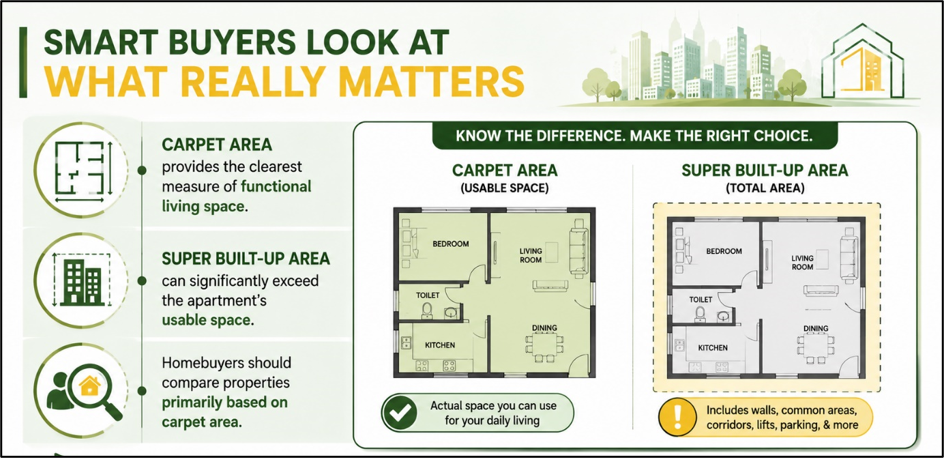
Carpet area refers to the net usable floor area inside an apartment. It represents the portion of the home where residents can place furniture, walk around, and carry out daily activities. Bedrooms, living rooms, kitchens, and bathrooms are generally included within the carpet area.
Under the Real Estate (Regulation and Development) Act, 2016 (RERA), carpet area has become the standard measurement for property disclosures and sales. Regulatory authorities have repeatedly advised buyers to focus on carpet area because it reflects the actual livable space available inside the unit.
For buyers comparing multiple properties, carpet area offers the clearest indication of how much functional space they are receiving.
Built-Up Area: Beyond the Usable Space
Built-up area includes the carpet area along with the thickness of internal and external walls. In many projects, attached balconies, utility spaces, and terraces may also be included in this measurement.
As a result, the built-up area is generally larger than the carpet area. Depending on the design and layout of a project, built-up area can be approximately 10% to 20% higher than the carpet area.
While built-up area provides a broader understanding of the apartment’s physical footprint, it does not necessarily reflect the space available for everyday use.
Super Built-Up Area: The Largest Measurement
Super built-up area is often referred to as the saleable area. It includes the built-up area plus a proportionate share of common facilities within the residential project. These facilities may include corridors, staircases, lifts, lobbies, clubhouses, gyms, landscaped areas, and other shared amenities.
Because common areas are distributed across all units in a project, the super built-up area can be significantly larger than the carpet area. In some developments, the difference may exceed 30% depending on the extent of shared amenities and loading factors.
Although developers frequently use super built-up area for marketing purposes, it may not accurately represent the actual space available within the apartment.
Why Regulators Emphasise Carpet Area
Real estate regulators have increasingly encouraged buyers to evaluate properties based on carpet area rather than super built-up area. Authorities note that carpet area provides a transparent measure of the usable living space and allows consumers to make more informed purchasing decisions.
Recent guidance from regulatory authorities has highlighted that super built-up figures can sometimes create a gap between advertised property size and the space available inside the apartment. Buyers are therefore advised to verify carpet area details before signing agreements.
Which Area Should Homebuyers Prefer?
Among the three measurements, carpet area is generally the most relevant for evaluating residential properties. Since it represents the usable portion of a home, it helps buyers compare projects on a like-for-like basis.
Built-up area can provide additional context regarding structural dimensions, while super built-up area offers insight into the extent of shared facilities available within a project. However, when assessing value and livability, carpet area remains the most practical benchmark.
Before finalising a purchase, buyers should review project documents, compare carpet-area costs across properties, and ensure all measurements disclosed by the developer align with regulatory filings.
Key Risks
- Comparing properties solely on super built-up area may be misleading.
- High loading factors can reduce actual usable living space.
- Buyers may overestimate apartment size based on advertisements.
- Project amenities can significantly inflate saleable area figures.
Summary
Property size can be measured using carpet area, built-up area, or super built-up area, but each reflects a different aspect of the home. Carpet area represents the usable living space, built-up area includes walls and attached sections, while super built-up area incorporates shared amenities. For accurate comparisons and better value assessment, homebuyers should primarily focus on carpet area before making a purchase decision.
FAQs
Q: What is the most important area measurement when buying a house?
A: Carpet area is generally considered most important because it reflects the actual usable living space available inside the home.
Q: Why is super built-up area larger than carpet area?
A: Super built-up area includes the apartment’s share of common facilities such as corridors, lifts, lobbies, and amenities.
Q: Does RERA require developers to disclose carpet area?
A: Yes, RERA mandates disclosure of carpet area, making it the standard measurement for property sales and comparisons.