

Highlights
- Bitcoin and Ethereum have shown contrasting performance trends over the past year.
- Investor focus is shifting toward adoption trends and network activity.
- Market sentiment and economic conditions remain important for crypto assets.
Digital assets have continued to attract investor attention despite recurring periods of volatility. Among the largest cryptocurrencies, Bitcoin and Ethereum remain at the center of market discussions due to their size, liquidity, and widespread adoption.
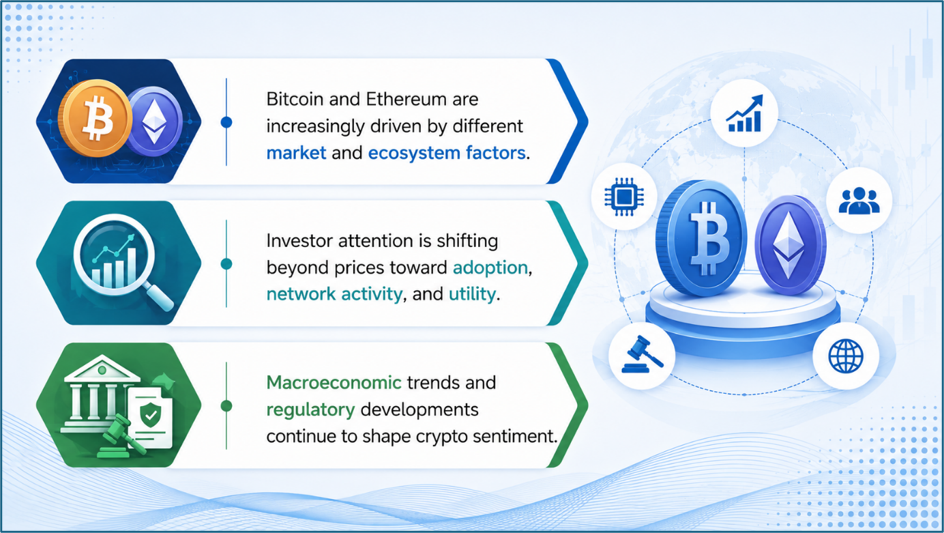
Recent market movements indicate that the two assets have not always moved in tandem. While both remain influenced by broader market conditions, their individual ecosystems, investor participation, and use cases have contributed to differing performance patterns.
As a result, investors are increasingly assessing each cryptocurrency on its own merits rather than treating the crypto market as a single investment category.
 Source: Analysis by Kalkine
Bitcoin Continues to Reflect Market Sentiment
Bitcoin is often viewed as a benchmark for the cryptocurrency market. Consequently, shifts in investor confidence, economic outlook, and institutional participation can have a noticeable impact on its performance.
Periods of uncertainty in global financial markets often lead investors to reassess exposure to risk-oriented assets. This can influence trading activity and capital flows within the cryptocurrency ecosystem.
Market participants are therefore paying close attention to indicators such as trading volumes, investor positioning, and broader financial-market developments when evaluating Bitcoin's outlook.
Ethereum Benefits From Broader Ecosystem Activity
Ethereum occupies a unique position within the digital asset market because it supports a large network of applications built on blockchain technology.
Its infrastructure is widely used for decentralized finance, digital collectibles, token issuance, and various blockchain-based services. As a result, investor interest in Ethereum is often linked not only to price performance but also to activity occurring across its network.
Growth in blockchain applications and continued developer engagement can influence perceptions regarding Ethereum's long-term relevance within the digital asset space.
Adoption Trends Remain an Important Metric
Beyond price movements, adoption continues to be one of the most closely watched indicators in the cryptocurrency market.
Investors often examine wallet growth, transaction activity, institutional participation, and technological developments to gauge market direction.
Sustained adoption may indicate growing acceptance of digital assets, while slower activity levels could affect investor expectations regarding future growth opportunities.
These indicators can provide additional context beyond short-term price fluctuations.
Macroeconomic Factors Cannot Be Ignored
Cryptocurrency markets increasingly respond to developments in the global economy.
Inflation trends, monetary policy decisions, liquidity conditions, and investor appetite for risk can all influence digital asset valuations. Changes in interest-rate expectations, in particular, have become important variables for financial markets, including cryptocurrencies.
As a result, many investors now monitor economic developments alongside cryptocurrency-specific factors when assessing market conditions.
Volatility Remains a Defining Characteristic
Despite increasing adoption, cryptocurrencies continue to experience substantial price swings.
Sharp rallies and corrections can occur within relatively short periods, creating both opportunities and challenges for investors. This volatility underscores the importance of understanding risk before allocating capital to digital assets.
Investors often focus on portfolio allocation, diversification, and investment horizons when managing exposure to cryptocurrencies.
What Investors May Watch Going Forward
Several developments could influence market direction in the coming months.
Network usage trends, institutional participation, regulatory announcements, technological upgrades, and global economic conditions are likely to remain key areas of focus.
The interaction between these factors may shape investor sentiment and contribute to future price movements across major cryptocurrencies.
Key Risks to Consider
- Cryptocurrency markets can experience extreme short-term volatility.
- Regulatory developments may affect trading activity and valuations.
- Technology-related disruptions could impact blockchain networks.
- Changes in investor sentiment may trigger rapid price corrections.
Summary
The cryptocurrency market continues to evolve as Bitcoin and Ethereum respond to different market influences. Bitcoin remains closely tied to investor sentiment and broader financial conditions, while Ethereum's network activity and blockchain ecosystem contribute to its investment narrative. Adoption trends, economic developments, regulation, and market participation are expected to remain important considerations for investors evaluating digital assets.
FAQs
Q: Why do Bitcoin and Ethereum sometimes perform differently?
A: Each cryptocurrency has distinct use cases, investor bases, and market drivers that can influence performance independently.
Q: What factors affect cryptocurrency prices the most?
A: Investor sentiment, adoption trends, economic conditions, regulations, and market liquidity can significantly impact prices.
Q: Why is volatility common in cryptocurrencies?
A: Cryptocurrency markets are relatively young and highly sensitive to changes in sentiment, demand, and external developments.