

Highlights
- Equal weight strategies reduce concentration risk within equity portfolios.
- Broader stock exposure can improve diversification across sectors and companies.
- Regular rebalancing introduces a disciplined investment approach over time.
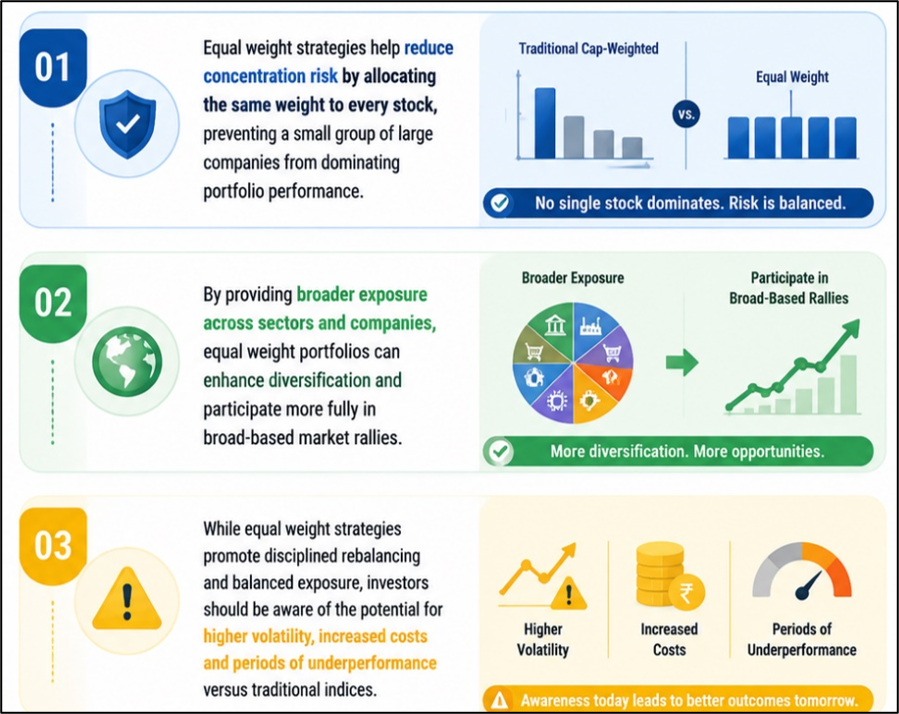
As equity markets become increasingly concentrated in a handful of large companies, investors are paying closer attention to portfolio construction methods that provide broader market exposure. One such approach is the equal weight strategy, where every stock in an index or portfolio receives the same allocation regardless of its market capitalisation. While traditional market-cap-weighted indices remain widely used, equal weight strategies are attracting interest from investors seeking diversification and reduced concentration risk.
Source: Analysis by Kalkine
Moving Beyond Market Capitalisation Bias
Most popular stock market indices are weighted according to the market value of their constituent companies. As a result, larger companies command a greater share of the index, while smaller constituents have a limited impact on performance.
An equal weight strategy takes a different approach by assigning identical weights to every stock. This ensures that no single company dominates portfolio returns. As market leadership becomes increasingly concentrated, equal weighting can provide exposure to a broader set of businesses rather than relying heavily on a few large stocks.
Diversification Becomes More Meaningful
Diversification is one of the key reasons investors consider equal weight strategies. Although market-cap-weighted indices may hold dozens of companies, a significant portion of portfolio performance can often be driven by a relatively small group of large constituents.
Equal weighting distributes exposure more evenly across sectors and companies, reducing dependence on a handful of market leaders. This broader participation can help investors benefit when gains are spread across a larger segment of the market rather than being concentrated in a few stocks.
Rebalancing Creates a Disciplined Process
Equal weight portfolios require periodic rebalancing to maintain their allocation structure. As some stocks outperform and others lag, the portfolio is adjusted to restore equal weights.
This process naturally results in trimming positions that have appreciated significantly and increasing allocations to stocks that have underperformed. The approach introduces a systematic buy-low, sell-high mechanism that removes some of the emotional decision-making often associated with investing.
Potential Benefits During Broader Market Rallies
Equal weight strategies often perform differently from traditional indices because they provide greater exposure to mid-sized and relatively smaller companies within the index universe. When market gains extend beyond a small group of large-cap stocks, equal weight portfolios may benefit from broader participation across sectors and companies.
Investors who believe future market returns will be driven by a wider range of businesses rather than a handful of dominant companies may find equal weight approaches particularly relevant. Periods of broad-based economic growth have historically created opportunities for such strategies to perform competitively.
Not Without Trade-Offs
Despite their advantages, equal weight strategies are not risk-free. The increased exposure to smaller companies can result in greater volatility compared with traditional market-cap-weighted indices. These portfolios also require more frequent rebalancing, which may lead to higher transaction costs and fund expenses.
Performance can also vary depending on market conditions. During periods when a small number of large companies drive most market gains, market-cap-weighted indices may outperform equal weight strategies. Investors should therefore view equal weighting as a complementary allocation rather than a guaranteed replacement for conventional index investing.
A Role Within Diversified Portfolios
Financial experts continue to emphasise diversification and disciplined asset allocation as important elements of long-term investing. Equal weight strategies align with these principles by spreading exposure more evenly across investments and reducing reliance on market concentration.
Rather than choosing between equal weight and market-cap-weighted approaches, some investors use both within their portfolios. This allows them to retain exposure to established market leaders while also participating in opportunities across a wider range of companies.
Why Investors Are Taking Notice
As market concentration periodically reaches elevated levels, equal weight strategies provide an alternative way to access equity markets. Their emphasis on diversification, balanced exposure and disciplined rebalancing has led many investors to consider them alongside traditional index strategies.
While no single investment approach is suitable for every market environment, equal weight portfolios offer a distinct method of managing concentration risk and broadening participation across the market. For investors seeking greater diversification within their equity allocation, they may represent a useful addition to a well-constructed portfolio.
Key Risks
- Higher exposure to smaller companies may increase portfolio volatility.
- Frequent rebalancing can lead to higher costs.
- Equal weight strategies may lag during mega-cap-led rallies.
- Returns can differ significantly from traditional benchmark indices.
Summary
Equal weight strategies allocate the same weight to each stock in a portfolio, reducing dependence on a small number of large companies. The approach can improve diversification, broaden market exposure and introduce disciplined rebalancing. However, it may also involve higher volatility and costs. For many investors, equal weight strategies can serve as a complementary tool alongside traditional market-cap-weighted investments.
FAQs
Q: What is an equal weight investment strategy?
A: It allocates identical portfolio weights to each stock regardless of market capitalisation.
Q: Why do investors use equal weight strategies?
A: They help reduce concentration risk and provide broader exposure across companies.
Q: Are equal weight portfolios risk-free?
A: No, they may experience higher volatility and can underperform in certain market conditions.