

Highlights
- A demat account is essential for holding shares in electronic form.
- Opening a demat account has become a largely digital process.
- Understanding costs and account features can help avoid common mistakes.
For many first-time investors, entering the stock market can appear complicated. Terms such as demat account, trading account, brokerage charges, and settlement cycles often create confusion before the investment journey even begins.
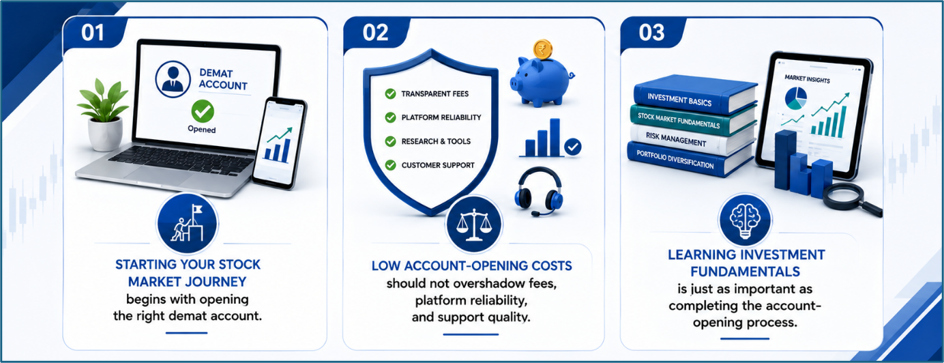
However, getting started is much simpler than many people assume. The first requirement for investing in listed shares is a demat account, which acts as a digital repository for securities purchased by an investor. Today, opening a demat account can usually be completed online within minutes through a registered stockbroker.
Source: Analysis by Kalkine
What Is a Demat Account?
A demat, or dematerialised, account stores financial securities electronically. Instead of receiving physical share certificates, investors hold stocks, exchange-traded funds, bonds, and other eligible securities in digital form.
The system was introduced to simplify ownership records and reduce risks associated with paper-based certificates, such as loss, damage, forgery, or transfer delays. Today, virtually all stock market transactions in India are settled through demat accounts.
Demat Account vs Trading Account
New investors often confuse a demat account with a trading account.
A trading account is used to place buy and sell orders in the stock market. A demat account, on the other hand, stores the securities purchased through those transactions. Both accounts are generally linked to a bank account to facilitate fund transfers.
Think of the trading account as the transaction platform and the demat account as the storage location for your investments.
Documents Required Before Applying
Investors typically need a few basic documents before starting the application process.
These generally include:
- PAN card
- Aadhaar card linked to a mobile number
- Bank account details
- Passport-size photograph
- Signature image or scanned signature
Some brokers may also request additional verification depending on regulatory requirements.
Step-By-Step Account Opening Process
The account opening process has become largely digital.
Choose a Registered Broker
Investors should begin by selecting a broker registered with the Securities and Exchange Board of India (SEBI). Factors such as brokerage charges, platform usability, customer support, and available investment products are commonly evaluated before making a decision.
Complete KYC Verification
Applicants must provide identity and address proof through an online Know Your Customer (KYC) process. Aadhaar-based authentication has simplified this step for many investors.
Upload Documents
Required documents are uploaded digitally through the broker's platform. Investors should ensure that all details match official records to avoid delays.
Verify and E-Sign
The final step generally involves completing verification and electronically signing the application. Once approved, the demat and trading accounts become operational.
Understanding Common Charges
While many brokers advertise low-cost account opening, investors should understand the various charges associated with investing.
These may include account maintenance charges, brokerage fees, transaction charges, and statutory levies. The fee structure varies across brokers and may influence overall investment costs over time.
Reading the complete pricing schedule before opening an account can help avoid unexpected expenses.
Common Mistakes New Investors Make
Many beginners focus exclusively on account-opening offers while overlooking important aspects such as platform reliability, transparency of charges, and ease of use.
Investor discussions frequently highlight the importance of understanding fee structures, reviewing service quality, and avoiding decisions based solely on promotional offers.
Another common mistake is rushing into stock purchases without understanding risk, diversification, or long-term investing principles.
What Happens After the Account Is Opened?
Once the account becomes active, investors can begin exploring available investment options.
Many beginners start by understanding market basics, tracking companies, learning about diversified investment products, and gradually building familiarity with the investment process before increasing exposure to equities.
The focus should remain on learning, risk management, and developing a disciplined investment approach rather than chasing short-term market movements.
Key Risks to Consider
- Stock prices can fluctuate significantly over short periods.
- Brokerage and transaction costs may affect overall returns.
- Investing without research can increase portfolio risk.
- Market volatility can lead to temporary capital losses.
Conclusion
Opening a demat account is often the first step toward participating in India's capital markets. While the process has become increasingly simple and digital, investors should understand account features, charges, and risks before getting started. A well-informed approach can help beginners build confidence as they begin their investment journey.
Summary
A demat account enables investors to hold securities electronically and is essential for stock market participation in India. The account-opening process is largely online and requires basic KYC documentation. Before opening an account, investors should evaluate costs, platform features, and service quality. Understanding investment basics and maintaining a disciplined approach can help first-time investors navigate the stock market more effectively.
FAQs
Q: Is a demat account mandatory for investing in stocks?
A: Yes, listed shares in India are held electronically, making a demat account necessary for stock ownership.
Q: How long does it take to open a demat account?
A: Many brokers complete the digital process within a day, subject to successful verification and documentation.
Q: Can I open a demat account without buying shares immediately?
A: Yes, investors can open and maintain a demat account even without making immediate stock purchases.