

Highlights
- EPFO aims to speed up PF transfers, but basic errors can still cause delays
- KYC mismatches and incomplete Aadhaar linking remain major processing issues
- Multiple UANs and incorrect employment records often slow settlement timelines
The Employees’ Provident Fund Organisation (EPFO) is working toward faster and more automated provident fund transfer systems as part of its ongoing digital improvements. The intention is to reduce manual intervention and make fund access more efficient for salaried employees across India.
However, even with increasing automation, PF transfer delays continue to occur in several cases. These delays are often not caused by system limitations but by inconsistencies in employee records, KYC details, and employer submissions.
Source: Analysis by Kalkine
Digital PF Transfer System and Its Functioning
EPFO’s upgraded system relies heavily on digital verification using Aadhaar, PAN, and bank account linking with the Universal Account Number (UAN). When all details are correctly updated and verified, PF transfer requests can be processed with minimal manual intervention.
The system is designed to match employment history, verify identity, and process claims based on pre-validated data. Despite this, any mismatch in records can interrupt automated processing and push the claim into manual review.
Common Reasons for PF Transfer Delays
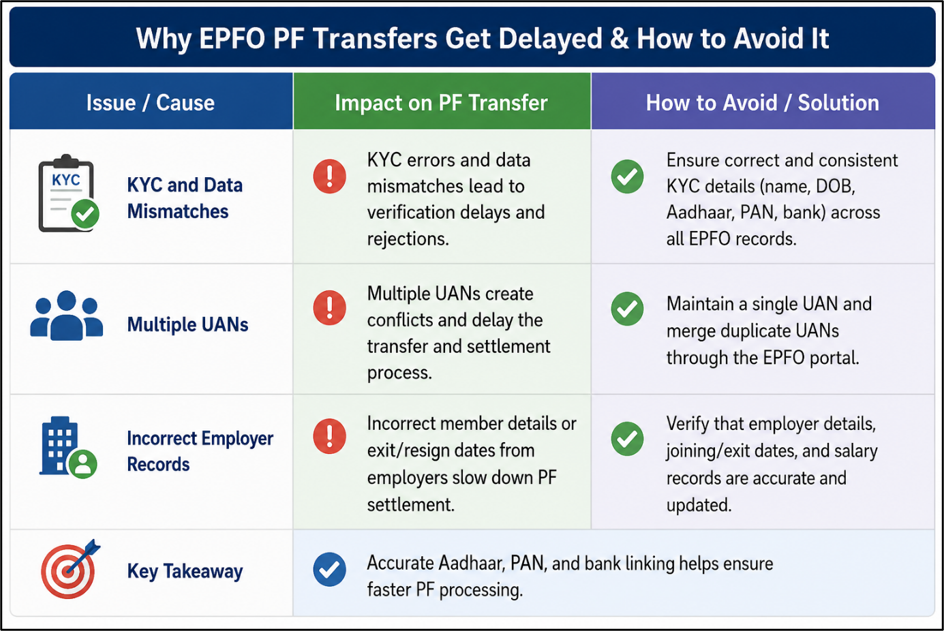
One of the most frequent reasons for delay is incorrect or outdated personal information. Even minor differences in name spelling across Aadhaar, UAN, and bank records can trigger verification issues.
Another major issue is the existence of multiple UANs for a single employee. This usually happens when employees change jobs without transferring or merging their old PF accounts, leading to duplicate records that require reconciliation before processing.
Employer-related delays also contribute to slower transfers. In many cases, exit dates are not updated on time or required approvals are not completed, which prevents the system from processing the transfer automatically.
KYC and Data Mismatch Issues
KYC compliance is central to PF transfer processing. Aadhaar, PAN, and bank account details must be properly linked and verified with the UAN. If any of these links are incomplete or inconsistent, the system may reject or pause the claim.
Data mismatches between EPFO records and employer submissions can also lead to additional verification requirements. This extends processing time as manual checks are required to resolve discrepancies.
Administrative and System-Level Delays
Although most PF transfers are processed digitally, some cases still require intervention from EPFO field offices. High claim volumes, record corrections, or inter-office coordination can create delays even in a digital environment.
In cases where employees have worked in multiple regions or under different EPFO offices, transfer processing may involve additional validation steps, which increases overall settlement time.
Importance of Accurate Records
The efficiency of PF transfers depends largely on the accuracy of employee data. Even when systems are automated, incorrect or incomplete records prevent straight-through processing.
Ensuring that all employment details, KYC documents, and bank information are updated reduces the likelihood of delays and avoids the need for manual intervention.
Risks to Watch
- Incorrect personal or bank details can lead to rejection or processing delays
- Multiple UANs may create duplicate records requiring consolidation
- Aadhaar or PAN mismatch can block automated verification
- Employer delays in updating exit records can slow claim settlement
Summary
EPFO’s digital framework is designed to make provident fund transfers faster and more automated. However, the system still depends on accurate employee and employer records. Issues such as KYC mismatches, duplicate UANs, and incomplete employer updates continue to cause delays. Maintaining correct and updated information is essential for smooth PF processing under the current system.
FAQs
Q: Why are PF transfers delayed even with digital processing?
A: Delays usually occur due to incorrect KYC details, mismatched records, or incomplete employer updates requiring manual verification.
Q: How do multiple UANs affect PF transfer?
A: Multiple UANs create duplicate records, which must be merged before the PF balance can be transferred or settled.
Q: What is the role of KYC in PF processing?
A: KYC ensures identity verification through Aadhaar, PAN, and bank details. Any mismatch can pause or reject the claim process.