

Highlights
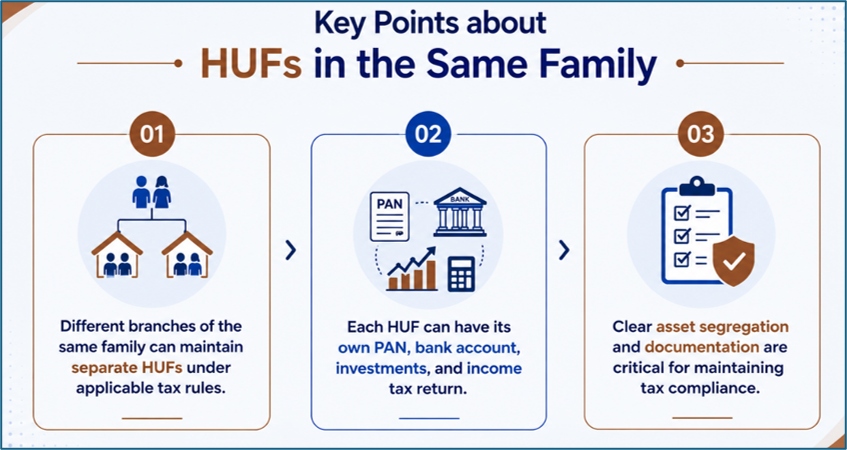
- Multiple family branches may maintain independent HUF structures under applicable rules.
- Separate HUF entities can hold assets, investments, and file tax returns.
- Documentation and ownership clarity remain important for tax compliance.
The Hindu Undivided Family (HUF) continues to be one of the distinctive features of India's tax framework. While many taxpayers are familiar with the concept of an HUF as a separate taxable entity, fewer understand how HUF structures can evolve as families grow across generations.
As children marry and establish their own households, questions often emerge regarding the possibility of creating separate HUF entities and the tax implications associated with such arrangements.
Source: Analysis by Kalkine
Understanding the Family-Based Tax Entity
An HUF is recognized as a separate entity under the Income Tax Act. It can own assets, operate bank accounts, earn income, and file income tax returns independently from individual family members.
Unlike an individual's tax profile, an HUF is built around a family unit and derives its existence from members descended from a common ancestor. This unique structure allows certain family assets and investments to be managed collectively.
How HUF Structures Can Expand Over Time
Family structures rarely remain static. As generations grow, different branches of a family may establish their own financial arrangements while continuing to remain part of a larger ancestral lineage.
For example, a family headed by grandparents may have one HUF managing ancestral assets. Over time, married children with their own families may establish separate HUF units for assets and investments belonging to their respective family branches.
This can create multiple HUF entities within the broader family network, each operating independently for taxation and financial management purposes.
Separate Identity, Separate Compliance
Where legally valid, each HUF may maintain:
- Independent PAN registration
- Separate bank accounts
- Distinct investment portfolios
- Independent accounting records
- Individual income tax filings
The existence of multiple HUFs does not automatically create tax advantages. Each entity must maintain a genuine financial identity supported by proper documentation and ownership records.
Why Asset Segregation Matters
One of the most important aspects of HUF management is maintaining clear separation between personal assets and HUF assets.
Confusion regarding ownership can lead to compliance challenges, disputes among family members, or questions during tax assessments. Financial experts often recommend maintaining detailed records of asset transfers, gifts, inherited property, and investment holdings linked to an HUF.
Clear segregation helps establish the independent nature of each family entity.
Tax Planning Considerations
Families exploring HUF structures often evaluate several factors before creating or managing separate entities.
These may include:
- Nature of family assets
- Inherited property holdings
- Investment objectives
- Succession planning needs
- Long-term wealth management goals
However, tax planning should always be aligned with legal requirements rather than being driven solely by tax-saving considerations.
Changing Family Dynamics and HUF Relevance
The role of HUFs has evolved alongside changing family structures. While traditional joint families remain common in some regions, modern households increasingly use HUFs for managing inherited assets and family investments.
As a result, understanding how different family branches can maintain separate financial identities has become an important aspect of tax and estate planning discussions.
Key Risks
- Improper asset transfers may create ownership disputes.
- Inadequate documentation can affect tax treatment.
- Mixing personal and HUF funds may complicate compliance.
- Succession disagreements can impact asset management.
Conclusion
HUFs continue to play a role in family-based financial planning in India. As families expand across generations, separate HUF entities may emerge to manage assets and investments belonging to different family branches. While such structures can operate independently, maintaining proper records, ownership clarity, and regulatory compliance remains essential for effective administration.
Summary
The HUF framework allows family-based financial management through a separate taxable entity. As generations expand, different family branches may maintain independent HUF structures with separate assets, records, and tax filings. Proper documentation, asset segregation, and compliance are critical to ensuring that each HUF retains its independent identity and functions within the applicable legal framework.
FAQs
Q: Can different branches of the same family maintain separate HUFs?
A: Yes, separate family branches may establish independent HUF entities subject to applicable legal and tax requirements.
Q: Can an HUF own investments and property?
A: Yes, an HUF can hold assets, investments, bank accounts, and other eligible financial holdings.
Q: Why is documentation important for HUFs?
A: Proper records help establish ownership, maintain compliance, and support separate tax treatment of HUF assets.