

Highlights
- Digital platforms allow investors to open fixed deposits within minutes.
- Higher FD rates may come with additional conditions and limitations.
- Investors should review withdrawal rules and deposit protection carefully.
Digital fixed deposits (FDs) have made investing in fixed-income products significantly more convenient. Through fintech platforms and investment apps, investors can compare rates across multiple institutions, complete KYC formalities online, and open FDs without visiting a branch or even maintaining a savings account with the issuing bank.
The growing popularity of digital FDs reflects a broader shift toward online investing. However, while the onboarding process may be simple, investors should carefully examine the underlying terms and conditions before committing funds. Convenience alone should not be the basis for an investment decision.
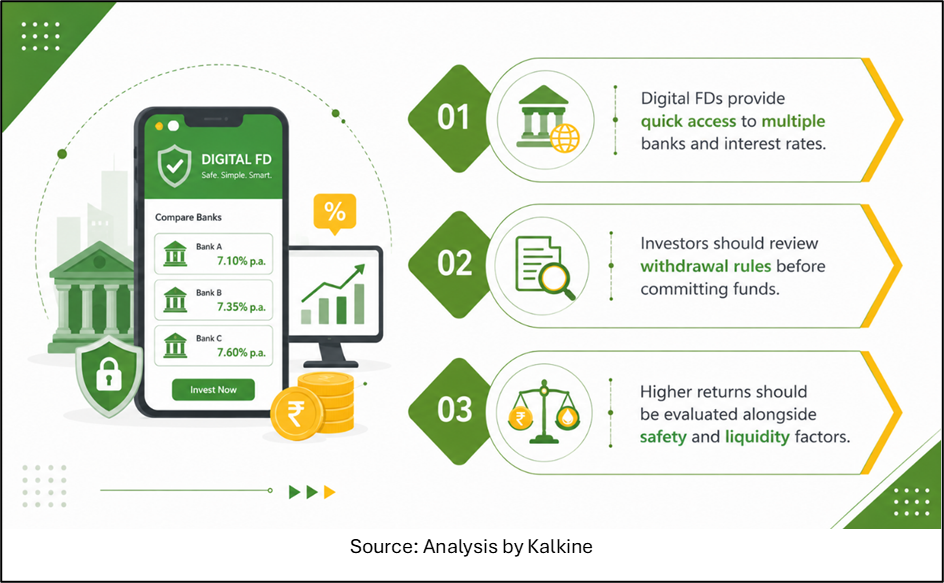
Why Digital FDs Are Gaining Attention
Digital investment platforms have simplified the FD booking process by allowing investors to access multiple banks and financial institutions through a single interface. Users can compare interest rates, track maturity dates, and monitor investments without managing separate accounts across institutions.
Another attraction is that some platforms provide access to small finance banks and other institutions that may offer higher interest rates than traditional large banks. This enables investors to evaluate a broader range of options from one location.
Convenience Should Not Replace Due Diligence
Although opening an FD online may take only a few minutes, investors still need to understand where their money is being placed.
Check The Issuing Institution
Many digital platforms act as intermediaries and marketplaces rather than deposit-taking entities. The actual FD is issued by a bank or financial institution. Investors should therefore evaluate the institution offering the deposit rather than focusing solely on the platform facilitating the transaction.
Interest rates can differ significantly across institutions, and a higher rate should be assessed alongside factors such as financial strength, reputation, and deposit protection limits.
Understand Deposit Insurance Coverage
Investors should be aware of deposit insurance limits when placing funds with banks. Diversifying deposits across institutions may help manage concentration risk, particularly when larger investment amounts are involved.
The availability of higher interest rates should not automatically outweigh considerations related to capital protection and liquidity.
The Importance Of Reading Withdrawal Rules
Premature Withdrawal May Not Be Seamless
One area often overlooked by investors is the premature withdrawal process. While opening a digital FD is generally straightforward, exiting before maturity may involve additional procedures, processing time, or penalties depending on the institution and product terms.
Some investors have reported that withdrawal experiences may differ from expectations, particularly when funds are required urgently. Community discussions have also highlighted the importance of understanding premature closure conditions before investing.
Interest Rate Adjustments
Many FDs apply revised interest calculations when deposits are closed before maturity. Investors should review these provisions carefully because actual returns may differ from headline rates if funds are withdrawn early.
Comparing More Than Just Interest Rates
A common mistake is selecting an FD solely on the basis of the highest advertised return.
Consider Post-Tax Returns
FD interest is taxable according to an investor's applicable income tax slab. Therefore, evaluating post-tax returns can provide a more realistic picture of actual earnings.
Review Operational Features
Investors should also examine nomination facilities, customer service support, maturity instructions, auto-renewal provisions, and the ease of accessing funds when required. These practical considerations can become important throughout the investment lifecycle.
Digital FDs Can Play A Role In Savings Plans
Digital fixed deposits can offer a convenient method for parking surplus funds and accessing multiple institutions through a single platform. The ability to compare rates and manage investments digitally has improved accessibility for many investors.
However, investors should balance convenience with careful evaluation of withdrawal rules, insurance coverage, issuer quality, and taxation. Reviewing the fine print before investing can help avoid surprises later and support better-informed financial decisions.
Key Risks
- Premature withdrawal may reduce expected returns.
- Higher rates may involve additional risk considerations.
- Deposit concentration can increase exposure to one institution.
- Taxation can lower effective FD returns.
Summary
Digital fixed deposits have simplified access to fixed-income investments by allowing investors to compare rates and open FDs online. While the process is convenient, investors should examine the issuing institution, deposit insurance coverage, withdrawal conditions, taxation, and operational features before investing. Understanding these details can help ensure that convenience does not come at the expense of informed decision-making.
FAQs
Q: Can I open a digital FD without having a savings account with that bank?
A: Yes, several digital FD platforms allow investments without opening a savings account with the issuing bank.
Q: Are digital fixed deposits different from traditional bank FDs?
A: The deposit structure is similar, but the investment and management process is conducted digitally.
Q: Why should investors review premature withdrawal conditions carefully?
A: Early closure may involve penalties, revised interest calculations, or processing delays depending on the product.