

Highlights
- Higher FCNR(B) deposit rates have attracted attention from investors and families.
- Resident Indians using NRI accounts may face tax and compliance challenges.
- Regulatory intent and ownership of funds remain important considerations.
Foreign Currency Non-Resident (Bank) or FCNR(B) deposits have returned to the spotlight following recent policy measures aimed at attracting foreign currency inflows. As banks offer more competitive rates on these deposits, discussions have emerged around whether resident Indians can indirectly benefit from these opportunities through NRI relatives or acquaintances.
While the idea may appear attractive at first glance, financial and regulatory experts caution that such arrangements involve several legal, tax, and compliance considerations. Understanding these issues is essential before exploring any structure linked to NRI banking facilities.
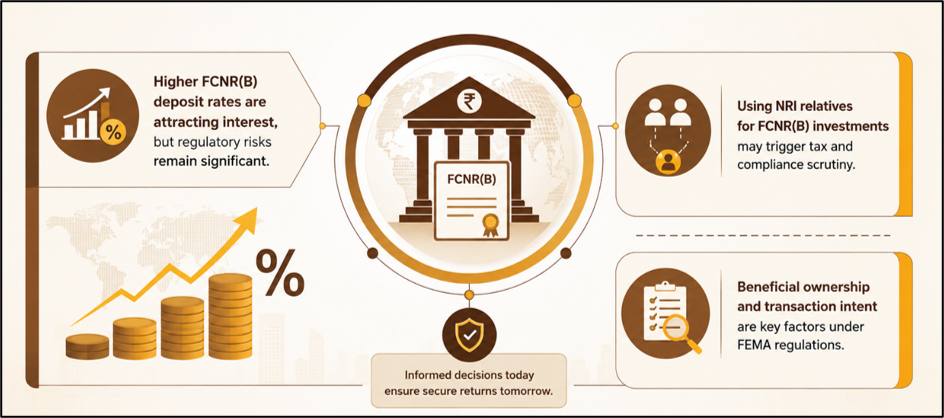
Source: Analysis by Kalkine
Why FCNR(B) Deposits Are Drawing Attention
FCNR(B) deposits are foreign currency fixed deposits available to eligible non-resident Indians. These accounts allow funds to be maintained in designated foreign currencies while earning interest over a fixed tenure.
Recent policy support has encouraged banks to attract additional foreign currency deposits, leading some institutions to offer comparatively higher interest rates on FCNR(B) accounts. This has naturally increased investor interest, particularly among individuals looking for foreign currency exposure alongside deposit income.
The higher rates have also prompted questions from resident Indians seeking ways to participate in these opportunities despite not being directly eligible for such accounts.
Interest in Family-Based Funding Arrangements
One approach being discussed involves residents transferring money to NRI relatives as gifts. The recipient may then choose to place those funds into an FCNR(B) deposit.
Although gifting money to relatives abroad is permitted under existing remittance regulations, the broader circumstances of the transaction remain important. Authorities may examine whether the transfer was a genuine gift or part of an arrangement designed to provide a resident individual with access to investment benefits that are otherwise restricted.
This distinction becomes particularly relevant when evaluating compliance with foreign exchange regulations and banking rules.
Tax Implications Should Not Be Ignored
Apart from regulatory concerns, taxation issues can influence the overall attractiveness of such arrangements.
When resident Indians remit funds overseas beyond specified thresholds, additional tax collection requirements may apply. While such amounts may often be adjusted against future tax liabilities, the initial cash outflow can still affect liquidity and investment planning.
For larger transfers, this factor may significantly reduce the perceived advantage of pursuing indirect exposure to FCNR(B) deposits.
As a result, investors need to assess both the return potential and the associated tax obligations before making any decisions.
Understanding the Regulatory Perspective
Financial regulations generally focus not only on the movement of money but also on the purpose behind a transaction.
A genuine gift made without conditions differs from a transfer structured with the expectation that the funds will ultimately benefit the original contributor. If regulators believe an NRI account is being used merely as an intermediary for a resident investor, additional scrutiny may follow.
Banks are also required to monitor transactions and verify compliance with applicable rules. Therefore, account activity that appears inconsistent with regulatory requirements may attract closer examination.
Why Beneficial Ownership Matters
A key consideration in such situations is beneficial ownership. Regulators may seek to determine who effectively controls the funds and who ultimately benefits from the investment.
If the NRI account holder independently owns and controls the deposited money, the arrangement differs substantially from one where another individual retains an economic interest in the funds.
This distinction often plays a significant role in assessing whether a transaction complies with regulatory expectations.
Potential Consequences of Non-Compliance
Failure to comply with applicable foreign exchange regulations can result in financial and administrative consequences.
Depending on the nature of the violation, authorities may impose monetary penalties, seek additional documentation, or initiate further investigations. In some cases, restrictions may also be placed on specific transactions or accounts.
Because of these possibilities, individuals should carefully evaluate any arrangement involving cross-border transfers and NRI banking facilities before proceeding.
Key Risks
- Regulatory authorities may question the true purpose of fund transfers.
- Tax collection requirements can reduce available liquidity.
- Beneficial ownership concerns may trigger compliance reviews.
- Regulatory breaches can result in financial penalties.
Summary
Growing interest in FCNR(B) deposits reflects the appeal of foreign currency investment opportunities and comparatively attractive deposit rates. However, resident Indians considering indirect participation through NRI relatives should carefully evaluate tax obligations, ownership issues, and regulatory requirements. The legality of a transaction often depends on its underlying purpose, making compliance and documentation important considerations before transferring funds across borders.
FAQs
Q: Who can open an FCNR(B) deposit account?
A: FCNR(B) deposits are generally available to eligible non-resident Indians and qualifying overseas account holders.
Q: Why are FCNR(B) deposits attracting attention currently?
A: Improved deposit rates and foreign currency exposure have increased investor interest in these accounts.
Q: What is the primary concern with indirect participation?
A: Regulators may examine whether the arrangement complies with foreign exchange and banking regulations.