

Highlights
- Precious metals continue attracting attention amid changing global economic conditions.
- Investor sentiment remains influenced by interest rate and inflation expectations.
- Gold and silver markets are responding differently to demand trends.
Gold and silver remain among the most closely watched asset classes as investors navigate an environment shaped by inflation concerns, monetary policy decisions, and geopolitical developments. Recent movements in precious metal markets have highlighted the importance of global economic signals in determining short-term price direction.
While many investors view gold as a traditional wealth-preservation asset, silver occupies a unique position because of its role in both investment portfolios and industrial applications. These characteristics have contributed to varying price behaviour between the two metals in recent months.
Source: Analysis by Kalkine
Safe-Haven Demand Keeps Gold Relevant
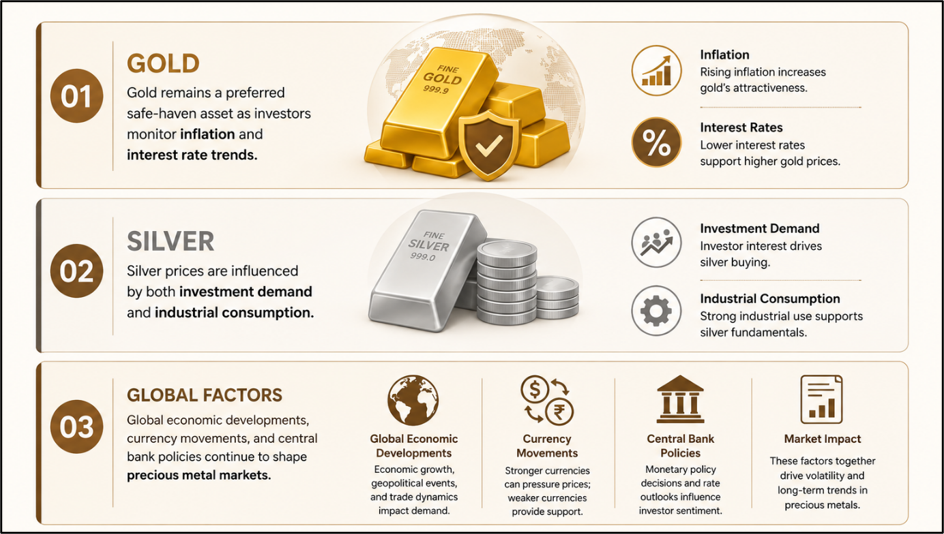
Gold often attracts investor interest during periods of economic uncertainty. Concerns related to inflation, currency fluctuations, and global financial stability can increase demand for assets perceived as stores of value.
Recent market conditions have encouraged investors to monitor gold prices closely as expectations surrounding central bank policies continue to evolve. Any shift in interest rate outlooks can influence investor allocations toward or away from precious metals.
Although gold does not generate regular income, its historical role as a defensive asset often makes it a consideration during uncertain market periods.
Silver Balances Investment and Industrial Demand
Silver's market dynamics differ from those of gold. In addition to investment demand, silver is widely used in manufacturing, electronics, renewable energy technologies, and other industrial applications.
Because of this dual-purpose nature, silver prices are often influenced by broader economic activity. Changes in industrial production, business investment, and manufacturing trends can affect demand levels and contribute to price volatility.
As a result, silver may experience larger short-term price swings than gold during periods of shifting economic expectations.
Global Factors Shaping Precious Metal Markets
A range of international developments continues to affect precious metal valuations.
Interest rate decisions by major central banks remain one of the most significant influences. Higher borrowing costs can impact investor appetite for non-yielding assets, while expectations of lower rates may improve sentiment toward bullion.
Currency movements also play a major role. Since precious metals are generally priced in US dollars internationally, fluctuations in the currency can affect domestic pricing across global markets.
In addition, geopolitical tensions, inflation trends, and economic growth forecasts continue to shape investor behaviour within the bullion segment.
Domestic Market Trends Remain Important
Within India, precious metal prices are influenced by both global benchmarks and local market conditions.
Import costs, taxation policies, transportation expenses, and regional demand patterns can all contribute to variations in market prices. Seasonal demand associated with weddings, festivals, and investment buying may also affect purchasing activity throughout the year.
Consequently, market participants often track both international developments and domestic demand indicators when evaluating price movements.
Considerations for Buyers and Investors
Individuals purchasing gold jewellery or investing in precious metals often look beyond daily price changes.
Factors such as purity standards, certification, storage costs, making charges, and long-term investment objectives can play an important role in the overall value proposition. Understanding these considerations may help buyers make more informed decisions rather than focusing solely on short-term market fluctuations.
Investors may also consider diversification objectives when evaluating precious metals as part of a broader portfolio strategy.
Key Risks
- Global economic events can rapidly affect bullion prices.
- Interest rate changes may alter investor demand patterns.
- Currency fluctuations can impact domestic market pricing.
- Silver may experience greater volatility than gold.
Summary
Gold and silver continue to attract attention as investors assess economic uncertainty, inflation trends, and monetary policy developments. Gold retains its traditional appeal as a store of value, while silver's industrial uses add an additional layer of demand dynamics. With global and domestic factors influencing market direction, investors and buyers are closely monitoring developments that could affect precious metal prices in the months ahead.
FAQs
Q: Why do investors consider gold during uncertain periods?
A: Gold is often viewed as a store of value during economic and financial uncertainty.
Q: What makes silver different from gold as an investment?
A: Silver is influenced by both investment demand and industrial consumption across multiple sectors.
Q: Which factors most influence precious metal prices?
A: Interest rates, inflation expectations, currency movements, and geopolitical developments significantly impact prices.