

Highlights
- Fixed deposits continue to offer stability amid market fluctuations and uncertainty.
- Predictable returns make FDs useful for short-term financial goals and emergencies.
- A balanced portfolio can benefit from combining FDs with growth-oriented investments.
Fixed deposits (FDs) have long been a preferred savings option for Indian investors seeking certainty and capital protection. While the investment landscape has expanded significantly with mutual funds, equities, bonds and alternative assets, FDs continue to occupy a meaningful position in many portfolios. In 2026, despite growing interest in market-linked investments, fixed deposits remain relevant for investors looking for stability, liquidity and predictable income. Financial planners increasingly view FDs not as standalone wealth-creation tools but as one component of a diversified investment strategy.
Source: Analysis by Kalkine
Stability Remains Their Biggest Advantage
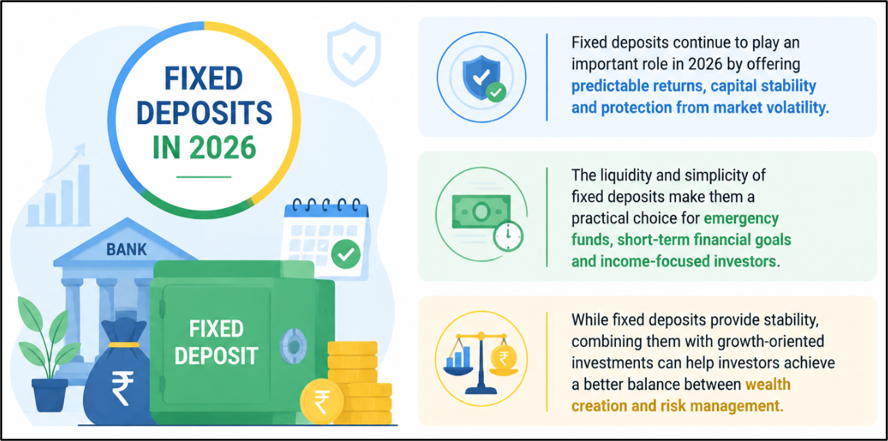
The primary appeal of fixed deposits lies in the certainty they provide. Investors know the interest rate at the time of investment and can estimate their returns with confidence. Unlike equities or market-linked instruments, FD returns are not affected by daily market movements.
This predictability becomes particularly valuable during periods of economic uncertainty or market volatility. Investors seeking to preserve capital often use FDs as a defensive allocation within their portfolios. The ability to lock in returns for a specific tenure also helps individuals align investments with future financial needs.
Interest Rates Continue to Support Depositors
The Reserve Bank of India’s recent decision to keep policy rates unchanged has contributed to a relatively stable environment for deposit rates. As banks generally align deposit pricing with broader interest rate trends, FD investors may continue to benefit from comparatively stable returns in the near term.
For investors who prioritize income visibility over return maximisation, FDs remain a convenient option. Senior citizens, in particular, often rely on deposits for regular income and may continue to benefit from preferential interest rates offered by several banks.
Liquidity Adds Practical Value
Another factor supporting the relevance of fixed deposits is accessibility. While premature withdrawals may attract penalties, investors can generally access their funds when required. This flexibility makes FDs suitable for emergency funds, planned expenses and short-term financial goals.
Unlike some long-duration investments that may involve market risk or lock-in periods, fixed deposits offer a relatively straightforward structure that many investors find easy to understand and manage.
Not a Replacement for Growth Assets
Although FDs offer security, they are not designed to deliver long-term wealth creation comparable to equity investments. Inflation can reduce the real value of returns over time, particularly when interest rates and inflation move closer together.
As a result, financial experts often suggest using fixed deposits alongside other asset classes rather than relying on them exclusively. Equities and equity mutual funds may contribute to long-term growth, while FDs can provide stability and liquidity. This combination can help investors manage risk while still pursuing wealth accumulation objectives.
The Role of FDs in Asset Allocation
Investment decisions are increasingly being guided by asset allocation rather than individual product selection. Within this framework, fixed deposits serve as a stabilising component that can reduce overall portfolio volatility.
For conservative investors, retirees and individuals with near-term financial obligations, FDs may represent a larger allocation. Younger investors with longer investment horizons may choose a smaller FD allocation while focusing more heavily on growth-oriented assets. The appropriate balance depends on financial goals, risk tolerance and liquidity requirements.
Discussions among retail investors also indicate that many continue to maintain meaningful allocations to fixed deposits for income stability and capital preservation, even when pursuing higher-return investments elsewhere in their portfolios.
Building a Balanced Approach
Rather than viewing fixed deposits as outdated, investors may find greater value in understanding their specific role within a broader financial plan. FDs can help meet short-term obligations, provide emergency liquidity and reduce portfolio risk. At the same time, other asset classes may be needed to address long-term growth and inflation-related challenges.
The key consideration is not whether to invest in fixed deposits or market-linked assets, but how to combine them effectively to meet individual financial objectives. A diversified approach can allow investors to benefit from both stability and growth potential.
Key Risks
- Inflation can reduce the real value of FD returns over time.
- Interest income may lower post-tax returns for some investors.
- Overdependence on FDs can limit long-term wealth creation.
- Falling interest rates may reduce reinvestment returns at maturity.
Summary
Fixed deposits continue to hold relevance in 2026 despite the growing range of investment alternatives available to investors. Their predictable returns, capital stability and liquidity make them useful for short-term goals, emergency reserves and portfolio diversification. However, FDs may not be sufficient for long-term wealth creation on their own. Combining fixed deposits with growth-oriented investments can help investors balance stability, liquidity and return expectations more effectively.
FAQs
Q: Why do fixed deposits remain popular despite growing investment alternatives?
A: They offer predictable returns, capital protection and easy access to funds when required.
Q: Are fixed deposits suitable for long-term wealth creation?
A: FDs provide stability but may not generate growth comparable to long-term equity investments.
Q: How can investors use fixed deposits within a portfolio?
A: They can serve as a stable allocation alongside growth-oriented assets and emergency savings.