

Highlights
- Foreign currency transactions often cost more than the displayed exchange rate.
- Forex mark-up fees and GST can increase the final transaction value.
- Paying in local currency abroad may help avoid additional conversion costs.
Many travellers and international online shoppers assume that converting a foreign currency amount into Indian rupees using a publicly available exchange rate will provide an accurate estimate of their final bill. However, when the credit card statement arrives, the amount charged is often higher than expected.
The difference usually arises from foreign currency transaction charges, commonly known as forex mark-up fees. These charges are among the least understood costs associated with international credit card usage and can significantly increase overall spending during overseas travel or cross-border online purchases.
Source: Analysis by Kalkine
What Happens When You Make an International Card Payment?
Whenever a credit card issued in India is used for a transaction denominated in a foreign currency, the amount must first be converted into Indian rupees.
The conversion is generally performed by payment networks such as Visa, Mastercard, American Express, or other card networks. After the conversion process, the issuing bank may apply an additional charge known as a forex mark-up fee. This fee is added to the transaction value before the final amount appears on the card statement.
As a result, the amount ultimately charged to the cardholder can exceed the simple exchange-rate calculation performed before making the purchase.
Understanding Forex Mark-Up Charges
Forex mark-up is essentially an additional fee imposed by card issuers on international transactions.
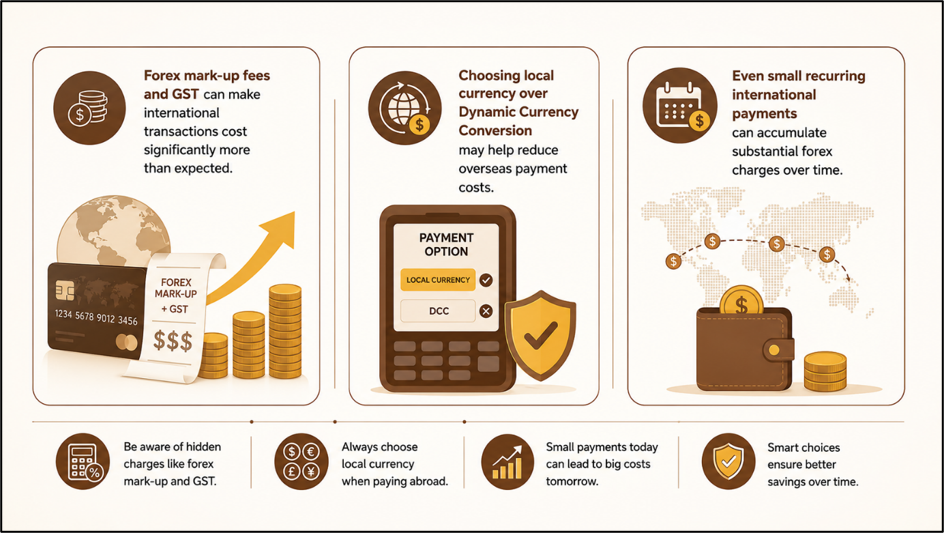
Most Indian credit cards levy a mark-up fee ranging from around 2% to 3.5%, although the exact percentage varies by issuer and card type. GST is also charged on the mark-up amount, increasing the total cost further.
For frequent travellers, students studying abroad, or individuals paying for international subscriptions, these charges can accumulate quickly over multiple transactions.
Why Exchange Rates and Final Bills Differ
A common misconception is that banks determine the exchange rate used for every foreign transaction.
In practice, payment networks typically perform the initial currency conversion. Banks then add their own fees and charges. Consequently, the rate visible on currency-conversion websites or search engines may differ from the effective rate reflected on the final statement.
This often explains why cardholders notice a gap between their expected and actual transaction costs.
The Costly Mistake Many Travellers Make
Merchants and ATMs in several countries frequently offer customers a choice between paying in the local currency or converting the transaction directly into Indian rupees at the point of sale.
While paying in rupees may seem convenient, this process—commonly called Dynamic Currency Conversion (DCC)—often uses less favourable conversion rates and may result in additional charges. Industry experts generally advise selecting the local currency whenever possible.
Consumer discussions on travel and credit-card forums also consistently highlight local-currency payments as a way to avoid unnecessary conversion costs.
International Online Purchases Are Also Affected
Foreign currency charges are not limited to overseas travel.
Online purchases from international merchants, subscription services, software platforms, and foreign e-commerce websites can also attract forex mark-up fees. Even when a transaction appears small, repeated monthly payments may gradually increase annual expenses because of these additional charges.
Consumers should therefore review card fee schedules before making recurring international payments.
How Cardholders Can Reduce These Costs
Several strategies may help minimise foreign transaction expenses.
Travellers can compare credit cards based on forex mark-up charges before travelling abroad. Some cards are designed specifically for international spending and may offer lower or zero forex mark-up fees. Paying in the local currency instead of opting for DCC can also reduce conversion-related costs.
Reviewing the fee structure in advance can help cardholders better estimate the actual cost of overseas spending.
Key Risks
- Forex mark-up fees can significantly increase overseas spending costs.
- GST applies on mark-up charges, increasing the effective transaction cost.
- Dynamic Currency Conversion may result in less favourable exchange rates.
- Small recurring international payments can accumulate substantial annual fees.
Summary
International credit card transactions often cost more than the headline exchange rate because of forex mark-up fees, GST, and conversion-related charges. These costs apply to both overseas purchases and many international online transactions. Understanding how currency conversion works, avoiding Dynamic Currency Conversion, and reviewing card fee structures beforehand can help consumers manage and reduce the hidden costs associated with foreign currency spending.
FAQs
Q: What is a forex mark-up fee on a credit card?
A: It is an additional charge imposed by card issuers on transactions processed in foreign currencies.
Q: Why is my credit card bill higher than the exchange-rate calculation?
A: Forex mark-up fees, GST, and network conversion charges can increase the final payable amount.
Q: Should travellers pay in local currency or Indian rupees abroad?
A: Paying in local currency is generally preferred to avoid costly Dynamic Currency Conversion charges.