

Highlights
- Fixed-rate loans offer EMI stability despite fluctuations in interest rate cycles.
- Floating-rate loans can benefit borrowers when lending rates move lower.
- The right choice depends on income stability, risk tolerance, and repayment plans.
Selecting a home loan often involves more than comparing lenders and loan amounts. One of the most important decisions borrowers face is choosing between a fixed and a floating interest rate. The choice can influence monthly repayments, total borrowing costs, and long-term financial planning.
In periods marked by geopolitical tensions, inflation concerns, and changing monetary policy expectations, interest rate uncertainty can become more pronounced. As a result, borrowers may find it useful to understand how both options work before making a decision.
Understanding Fixed-Rate Home Loans
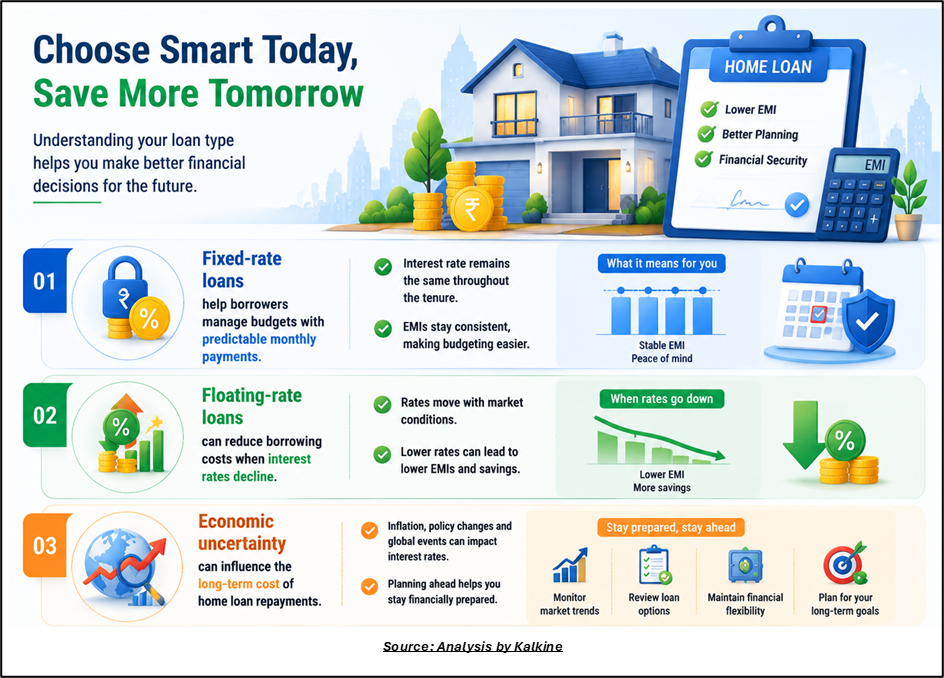
Under a fixed-rate home loan, the interest rate remains unchanged for a specified period or, in some cases, for the entire tenure of the loan. This means the borrower's EMI remains predictable regardless of changes in broader interest rate conditions.
Many borrowers prefer fixed rates because they provide visibility over future payments. Households with limited flexibility in monthly budgets may find this predictability useful when planning expenses and savings goals.
However, fixed-rate loans often begin with interest rates that are higher than prevailing floating rates. Borrowers may therefore pay more if market rates decline during the repayment period.
How Floating-Rate Loans Work
A floating-rate home loan is linked to a benchmark lending rate. As market interest rates move, the loan rate may increase or decrease accordingly.
When lending rates fall, borrowers can benefit through lower EMIs or shorter repayment periods. However, when rates rise, borrowing costs can increase, potentially affecting household cash flows.
Floating-rate loans are commonly chosen by borrowers who expect interest rates to remain stable or decline over time.
The Impact Of Economic And Geopolitical Developments
Global events can influence inflation expectations, currency markets, commodity prices, and central bank policies. These developments may eventually affect lending rates across economies.
During periods of heightened uncertainty, central banks often reassess monetary policy based on inflation and growth trends. Such adjustments can influence borrowing costs for individuals, particularly those holding floating-rate loans.
As a result, borrowers should consider not only current rates but also the possibility of future changes when evaluating loan options.
Stability Versus Flexibility
The decision between fixed and floating rates often comes down to balancing stability and flexibility.
Fixed-rate loans provide certainty regarding monthly obligations. This can help borrowers who prioritize predictable finances and wish to avoid surprises from changing interest rates.
Floating-rate loans, meanwhile, provide an opportunity to benefit from future reductions in borrowing costs. However, they also require borrowers to be comfortable with the possibility of higher repayments if rates move upward.
Factors To Consider Before Choosing
Several factors can influence the suitability of either option:
Income Stability: Borrowers with stable incomes may be better positioned to absorb changes in floating-rate EMIs.
Risk Appetite: Individuals who prefer predictable obligations may lean toward fixed rates.
Loan Tenure: Longer loan tenures increase exposure to future interest rate cycles.
Repayment Plans: Borrowers planning early repayment may weigh flexibility differently than those expecting to hold the loan for decades.
Hybrid Options Are Also Available
Some lenders offer hybrid products that combine elements of both structures. These loans may begin with a fixed rate for a limited period before transitioning to a floating-rate arrangement.
Such options can provide temporary payment certainty while allowing borrowers to participate in future rate movements. However, borrowers should carefully review the terms and conditions before selecting these products.
Key Risks
- Fixed-rate loans may become expensive if market rates decline.
- Floating-rate borrowers face uncertainty regarding future EMIs.
- Longer tenures increase exposure to interest-rate fluctuations.
- Economic developments can influence borrowing costs unexpectedly.
Summary
The choice between fixed and floating home loan rates depends on individual financial circumstances and comfort with interest-rate risk. Fixed rates offer payment certainty, while floating rates provide potential benefits if borrowing costs fall. Borrowers should evaluate income stability, repayment capacity, loan tenure, and financial objectives before selecting a structure that aligns with their long-term needs.
FAQs
Q: What is the main advantage of a fixed-rate home loan?
A: Fixed-rate loans provide predictable EMIs, making it easier for borrowers to plan long-term finances.
Q: When can a floating-rate loan be beneficial?
A: Floating-rate loans can be advantageous when market interest rates decline during the repayment period.
Q: Which home loan option carries greater uncertainty?
A: Floating-rate loans generally involve greater uncertainty because interest costs can change over time.