

Highlights
- A structured investment plan can help beginners build long-term wealth gradually.
- Diversification across asset classes may help manage investment risk.
- Regular investing and periodic reviews are important for financial goals.
Many first-time investors struggle with a common question: how should a monthly investment surplus be allocated to create long-term wealth?
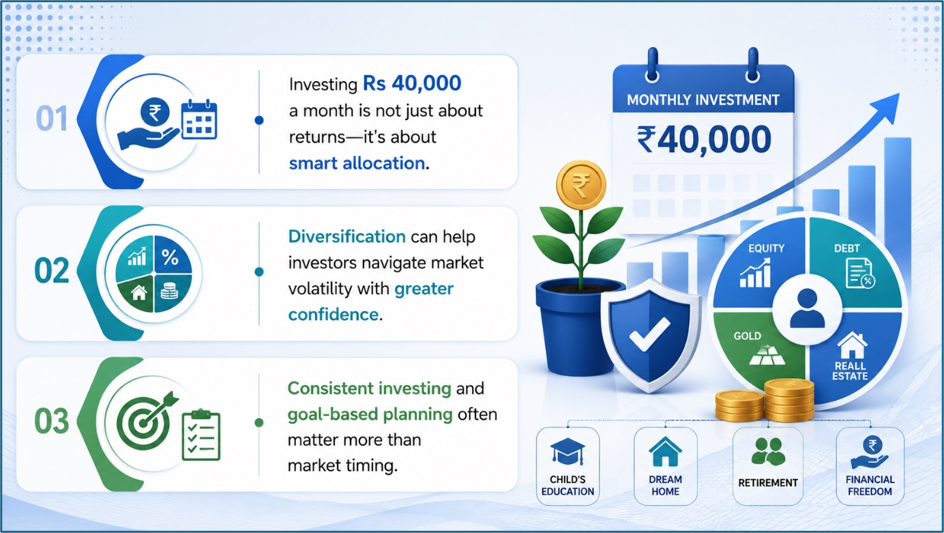
With Rs 40,000 available for investment every month, investors have an opportunity to build a diversified portfolio that balances growth potential with risk management. However, the focus should not be on finding the highest-returning asset but on creating a disciplined and sustainable investment strategy.
A structured approach can help investors navigate market fluctuations while remaining aligned with long-term financial objectives.
Source: Analysis by Kalkine
Why Asset Allocation Matters
Asset allocation refers to dividing investments across different asset classes such as equities, debt instruments, and gold. The primary objective is diversification. Different assets often respond differently to economic and market conditions, helping reduce dependence on a single investment category.
For beginners, asset allocation can be just as important as selecting individual investment products because it influences both risk and return characteristics of a portfolio.
A Sample Allocation for Rs 40,000 Per Month
While actual allocations should depend on individual goals and risk tolerance, a diversified framework may include multiple asset classes.
Equity Investments: Rs 24,000
Equities are commonly used for long-term wealth creation because they offer exposure to business growth and economic expansion.
A significant portion of the monthly investment amount may be directed toward diversified equity mutual funds or broad-market investment vehicles. Investors with longer investment horizons often use equities as the primary growth component of their portfolios.
Fixed-Income Investments: Rs 10,000
Debt-oriented investments can provide stability and help reduce overall portfolio volatility.
These investments may include debt mutual funds, fixed-income instruments, recurring deposits, or other eligible products depending on an investor's requirements and risk profile.
The allocation serves as a balancing component during periods of equity-market fluctuations.
Gold Exposure: Rs 6,000
Gold is often considered a diversification asset because its performance may differ from that of equities and fixed-income products.
Financial products such as Gold ETFs or Gold Mutual Funds provide exposure without requiring physical ownership. A modest allocation can help diversify the portfolio without creating excessive concentration.
The Role of Systematic Investing
One of the advantages of investing a fixed amount every month is the ability to benefit from rupee-cost averaging.
Under this approach, investors purchase more units when prices are lower and fewer units when prices are higher. Over time, this can reduce the impact of market volatility on overall investment costs.
Consistent investing also encourages financial discipline and helps avoid the temptation to time the market.
Increasing Investments Over Time
A common mistake among investors is maintaining the same investment amount for many years despite growth in income.
Periodic increases in monthly investments can significantly affect long-term wealth accumulation. Even small annual increases may contribute meaningfully to portfolio growth over extended periods.
Investors often review contributions after salary revisions, business income growth, or major changes in financial circumstances.
Keeping Financial Goals in Focus
Investment planning should begin with clearly defined goals rather than return expectations alone.
Retirement planning, home purchases, children's education, emergency funds, and other financial objectives may require different investment horizons and risk levels.
Aligning investments with specific goals can help investors make more informed allocation decisions and remain committed during periods of market uncertainty.
Why Regular Portfolio Reviews Matter
A portfolio created today may not remain suitable indefinitely.
Changes in income, financial obligations, risk tolerance, and market conditions may necessitate adjustments over time. Periodic reviews help ensure that investments continue to align with evolving objectives.
However, reviewing a portfolio does not necessarily mean making frequent changes. The objective is to assess suitability rather than react to every market movement.
Key Risks to Consider
- Equity markets can experience short-term volatility.
- Inflation may reduce the purchasing power of investment returns.
- Asset allocation may become unsuitable as goals evolve.
- Concentration in one asset class can increase portfolio risk.
Summary
A monthly investment budget of Rs 40,000 can be deployed across equities, fixed-income instruments, and gold to create a diversified portfolio. Asset allocation helps manage risk while supporting long-term financial objectives. Investors should focus on disciplined investing, goal-based planning, and regular portfolio reviews rather than attempting to predict short-term market movements. Gradually increasing investments as income rises may further support wealth creation over time.
FAQs
Q: How should beginners divide a Rs 40,000 monthly investment budget?
A: Many investors use a diversified allocation across equities, debt investments, and gold based on risk tolerance.
Q: Why is diversification important in investing?
A: Diversification reduces dependence on a single asset class and may help manage overall portfolio risk.
Q: Should investors increase investment amounts over time?
A: Periodic increases aligned with income growth may improve long-term wealth accumulation potential.