

Highlights
- Early EPF withdrawals can reduce the benefits of long-term compounding.
- A Rs 1 lakh withdrawal today may translate into a much larger opportunity cost later.
- Retirement corpus growth depends on time, contributions and accumulated returns.
Employees' Provident Fund (EPF) savings are often viewed as a source of emergency funds. While partial withdrawals are permitted under specific conditions, withdrawing money early can have a significant impact on long-term retirement wealth.
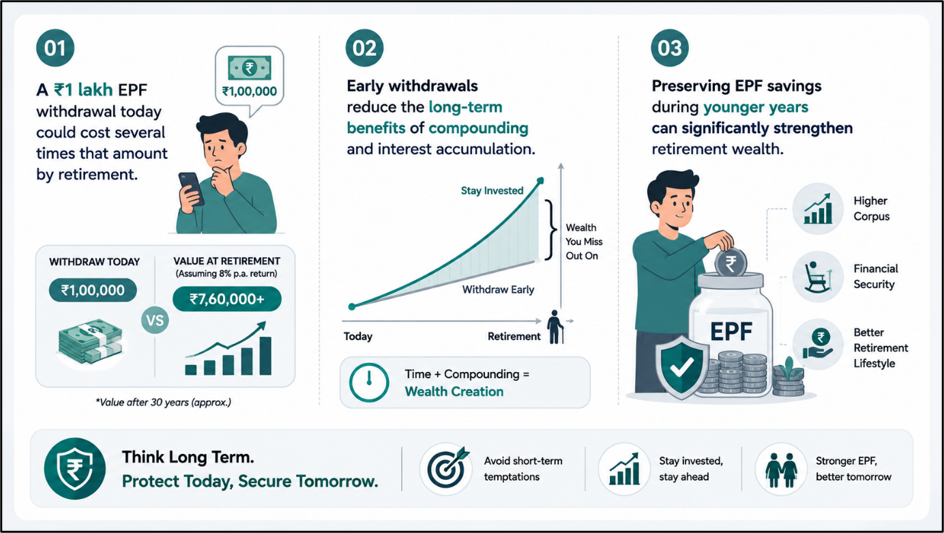
A seemingly modest withdrawal of Rs 1 lakh at the age of 28 may appear manageable in the short term. However, the long-term impact can be much larger because the withdrawn amount loses decades of potential growth through compounding.
Source: Analysis by Kalkine
Why Compounding Matters
Compounding allows savings to generate returns, which in turn earn additional returns over time. The longer money remains invested, the greater the potential effect of compounding.
For retirement-focused instruments such as EPF, time is one of the most important factors influencing wealth accumulation. Funds withdrawn during the early years lose the opportunity to participate in future growth over several decades.
As a result, even a relatively small withdrawal can create a sizeable difference in the final retirement corpus.
Understanding the Long-Term Impact
Consider a scenario where an individual withdraws Rs 1 lakh from an EPF account at age 28 and retires at age 58. The withdrawn amount would no longer earn annual EPF interest during the remaining investment period.
Over a 30-year horizon, the loss is not limited to the original Rs 1 lakh. The individual also forgoes the returns that could have accumulated on that amount year after year.
This illustrates why retirement planners often caution against withdrawing long-term savings unless absolutely necessary.
EPF's Role in Retirement Planning
The EPF serves as a retirement savings vehicle for millions of salaried employees. Regular contributions from employees and employers, combined with annual interest credits, help build a retirement corpus over time.
Because contributions continue throughout an employee's career, maintaining accumulated balances can contribute meaningfully to retirement readiness.
Frequent withdrawals may interrupt this accumulation process and reduce the benefits of long-term participation in the scheme.
Situations Where Withdrawals Are Allowed
EPF rules permit withdrawals under specific circumstances, including:
- Medical emergencies.
- Home purchase or construction.
- Higher education expenses.
- Marriage-related requirements.
- Certain employment-related situations.
While these provisions provide financial flexibility, individuals may still benefit from evaluating the long-term consequences before accessing retirement funds.
Balancing Immediate Needs and Future Goals
Financial emergencies and major life events can create legitimate funding requirements. However, retirement savings are designed to support financial needs after employment years.
Before making a withdrawal, individuals may consider:
- Availability of alternative savings.
- Emergency fund balances.
- Cost of other financing options.
- Long-term retirement objectives.
A careful assessment can help determine whether accessing EPF funds is necessary or whether other resources may be available.
The Importance of Staying Invested
One of the advantages of retirement-oriented savings is the ability to remain invested over long periods. Maintaining contributions and avoiding unnecessary withdrawals allows balances to continue benefiting from annual interest credits and compounding.
For younger employees, preserving retirement savings during the early years can be particularly important because those funds have the longest potential investment horizon.
Key Risks to Watch
- Early withdrawals reduce the power of long-term compounding.
- Lower EPF balances may affect retirement preparedness.
- Rebuilding withdrawn savings can take many years.
- Frequent withdrawals may weaken long-term wealth accumulation.
Summary
A Rs 1 lakh withdrawal from an EPF account at age 28 may appear insignificant in the short term, but the long-term opportunity cost can be substantial. Retirement savings benefit from decades of compounding, and funds withdrawn early lose the chance to generate future returns. Before accessing EPF balances, individuals should evaluate immediate financial needs against the potential impact on retirement corpus growth.
FAQs
Q: Why does an early EPF withdrawal affect retirement savings?
A: Withdrawn funds stop earning future interest, reducing the benefits of long-term compounding over several decades.
Q: Can EPF money be withdrawn before retirement?
A: Yes. EPF rules allow withdrawals for specific purposes such as medical needs, housing, education and marriage.
Q: Should employees avoid all EPF withdrawals?
A: Not necessarily. Withdrawals may be appropriate in eligible situations, but long-term retirement implications should be considered.