

Highlights
- A higher fitment factor could significantly increase salary and pension payouts.
- Government finances may influence the final fitment factor recommendation.
- Over one crore employees and pensioners may be impacted by revisions.
The fitment factor has emerged as one of the most closely watched aspects of the 8th Pay Commission discussions. It serves as the multiplier used to revise the basic pay of central government employees and pensioners. As expectations of a salary revision grow, the debate has shifted to whether the government can support a substantially higher fitment factor without affecting fiscal stability.
The issue is significant because any increase in the fitment factor directly affects salaries, allowances, pensions, and other retirement-related benefits linked to basic pay.
Source: Analysis by Kalkine
Why the Fitment Factor Matters
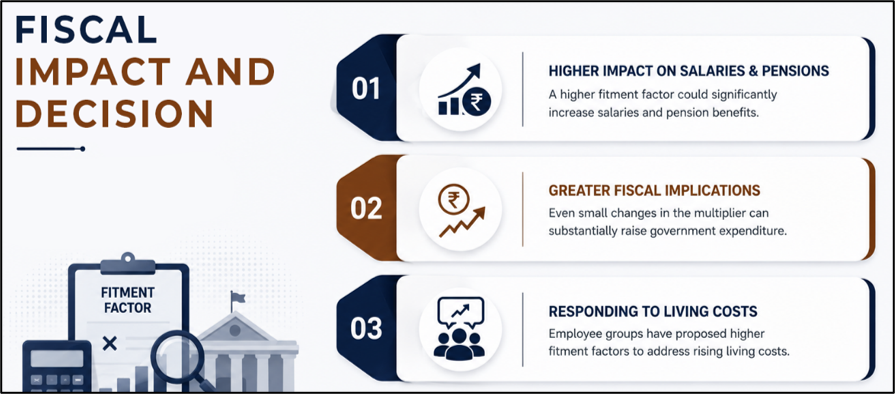
A fitment factor determines the revised basic salary by multiplying the existing basic pay. Even a small change in the multiplier can result in a substantial increase in salary expenditure for the government.
Under the 7th Pay Commission, a fitment factor of 2.57 was adopted. Various employee organizations have proposed higher multipliers for the 8th Pay Commission, with some recommendations ranging from 3.0 to above 3.0.
A higher multiplier would increase take-home salaries and pension benefits but would also raise the government's recurring expenditure commitments.
Fiscal Challenges Facing the Government
The government must balance employee welfare with broader fiscal objectives. A sharp increase in salaries and pensions could place additional pressure on public finances, particularly when expenditure commitments across infrastructure, welfare schemes, and debt servicing remain substantial.
Experts have noted that a significantly higher fitment factor could create a sizeable financial burden. The impact would not be limited to salary payments alone, as pension obligations and employer contributions under retirement schemes would also rise.
Given the large number of serving employees and pensioners covered by the commission's recommendations, even modest adjustments can have major budgetary implications.
Pension Liabilities Add Another Layer
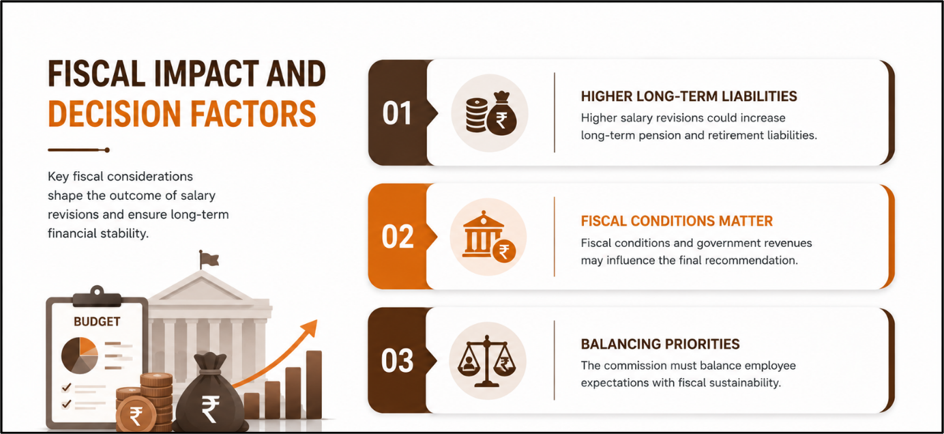
Apart from salaries, the government must consider the long-term impact on pension-related commitments. Any increase in basic pay generally results in higher pension calculations and greater contributions toward retirement benefit structures.
The financial effect therefore extends beyond immediate salary revisions and may influence future expenditure obligations for several years.
Employee Expectations Remain High
Employee associations and staff representatives have submitted various proposals regarding salary revision and fitment factors. Several groups have argued that higher living costs and inflation justify a larger revision in pay structures.
Some organizations have recommended fitment factors around 3.0 or higher, while other estimates suggest a lower range may be more practical from a fiscal standpoint.
The final recommendation is expected to emerge after consultations with stakeholders and a review of economic conditions.
What Could Influence the Final Decision?
Several factors are likely to shape the commission's recommendations, including inflation trends, government revenue collections, fiscal deficit targets, economic growth, and future expenditure requirements.
The commission may also examine historical pay revisions, employee welfare considerations, and the sustainability of long-term commitments before arriving at a suitable fitment factor.
 Source: Analysis by Kalkine
Balancing Expectations and Fiscal Prudence
The 8th Pay Commission faces the challenge of balancing employee expectations with fiscal responsibility. While a higher fitment factor could lead to a meaningful rise in salaries and pensions, the government must also consider its ability to absorb the resulting expenditure.
The eventual recommendation is expected to reflect both employee concerns and the broader economic environment. Until an official decision is announced, discussions around the ideal fitment factor are likely to continue among policymakers, employee groups, and financial experts.
Key Risks
- Higher salary bills may increase pressure on government finances.
- Rising pension liabilities could elevate long-term expenditure commitments.
- Fiscal deficit targets may become harder to maintain.
- Future economic uncertainties could affect implementation decisions.
Summary
The fitment factor remains a central issue in the 8th Pay Commission discussions. While employee organizations are seeking larger salary revisions through a higher multiplier, the government must evaluate the fiscal implications of such a move. Increased salary, pension, and retirement-related costs could significantly impact public finances. The final recommendation is expected to balance employee expectations with economic sustainability and budgetary considerations.
FAQs
Q: What is the fitment factor in the 8th Pay Commission?
A: It is a multiplier used to calculate revised basic pay and pension under the new pay structure.
Q: Why is a higher fitment factor important for employees?
A: A higher fitment factor can increase basic pay, allowances, pension benefits, and overall compensation levels.
Q: What factors could affect the final fitment factor recommendation?
A: Inflation, fiscal conditions, government revenues, expenditure obligations, and economic growth may influence the final decision.