

Leading jewellery companies in India are intensifying efforts to encourage consumers to exchange unused household gold, as the industry looks for ways to reduce dependence on expensive imports and improve domestic gold circulation.
Major organised jewellers are now expanding gold exchange programmes, promoting gold monetisation initiatives, and introducing customer-focused strategies aimed at bringing idle gold holdings back into the formal economy.
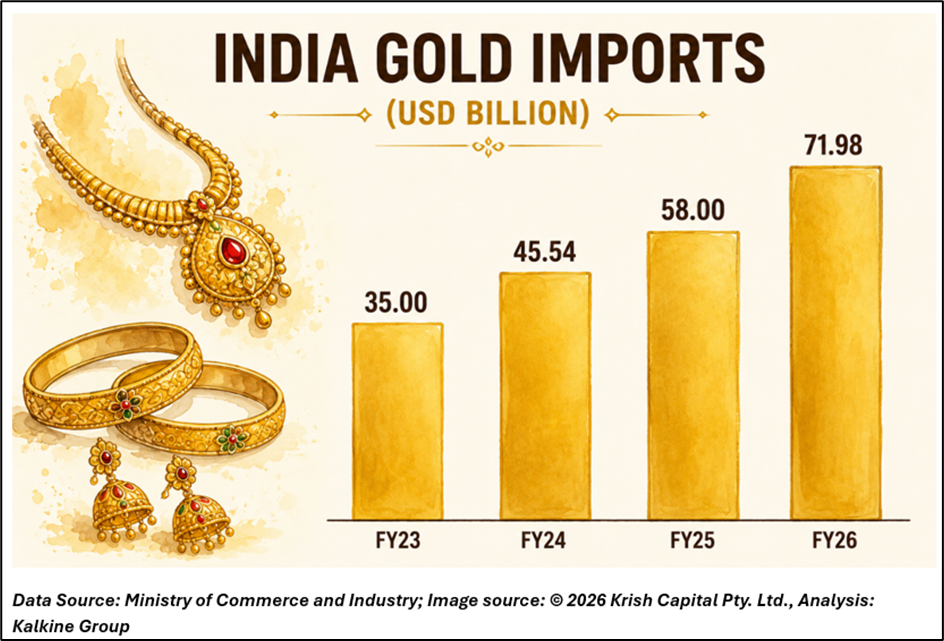
The renewed focus comes amid a sharp rise in India’s gold imports, which climbed more than 24% year-on-year to a record $71.98 billion during FY26, highlighting the country’s growing appetite for the precious metal.
Jewellers Focus on Unlocking Idle Gold
India is estimated to hold one of the world’s largest household gold reserves, much of which remains stored in homes for long periods without entering the financial system.
To tap into this vast reserve base, jewellery companies are strengthening exchange and recycling initiatives that allow customers to trade old jewellery for new purchases, cash value, or investment-linked products.
Industry leaders believe a larger domestic gold recycling ecosystem could help reduce import dependency, improve supply efficiency, and support long-term sector sustainability.
Organised Players Expand Exchange Initiatives
Several major jewellery brands are actively pushing initiatives focused on old gold mobilisation:
- Titan Company Limited (NSE:TITAN) continues to expand its old gold exchange programme across stores.
- Kalyan Jewellers India Limited (NSE:KALYANKJIL) has introduced a multi-point strategy aimed at encouraging customers to monetise unused gold holdings.
- Malabar Gold & Diamonds has reportedly suggested improvements to India’s gold monetisation framework to improve participation and efficiency.
Industry participants believe organised jewellers are likely to benefit as consumers increasingly prefer transparent valuation, certified purity testing, and structured exchange mechanisms.
Why Gold Recycling Matters
India remains one of the world’s largest gold-consuming nations, but heavy reliance on imports creates pressure on the trade deficit and foreign exchange outflows.
Encouraging gold recycling and exchange programmes could offer multiple benefits:
- Lower dependence on imported gold
- Better circulation of idle household gold
- Improved transparency in gold transactions
- Reduced pressure on current account deficit
- Stronger organised jewellery market growth
Analysts believe gold monetisation efforts may also gradually support formalisation within the jewellery industry.
Rising Gold Prices Drive Exchange Activity
The recent rally in gold prices has further accelerated customer interest in exchanging old jewellery. Many households are using elevated prices as an opportunity to upgrade designs or partially liquidate idle assets.
Jewellers are increasingly offering instant valuation services, purity certification, and attractive exchange bonuses to encourage participation.
Higher gold prices have also supported inventory value growth for organised jewellery retailers, although volatility in bullion prices remains a factor to watch.
Jewellery Stocks May Stay in Focus
Investors may continue tracking organised jewellery companies benefiting from rising formalisation and strong consumer demand, including:
- Titan Company Limited (NSE:TITAN)
- Kalyan Jewellers India Limited (NSE:KALYANKJIL)
- Senco Gold Limited (NSE:SENCO)
- Thangamayil Jewellery Limited (NSE:THANGAMAYL)
Market participants are expected to monitor festive demand trends, gold price movements, and policy developments related to gold monetisation schemes.
Outlook
India’s organised jewellery industry is increasingly shifting toward structured gold recycling and exchange ecosystems as companies attempt to unlock dormant household gold reserves. Rising consumer awareness, elevated gold prices, and growing trust in branded jewellers could further accelerate this transition in the coming years.
FAQs
- Why are jewellers promoting old gold exchange programmes?
Jewellers are encouraging gold exchange to improve domestic gold circulation and reduce reliance on imports.
- How do old gold exchange schemes work?
Customers can exchange old jewellery for new purchases after valuation and purity assessment by jewellers.
- Which jewellery stocks could benefit?
Organised jewellery retailers such as Titan, Kalyan Jewellers, Senco Gold, and Thangamayil Jewellery may remain in focus.