

Highlights
- July gold futures fell 0.66% to $4,814.30 an ounce in Asian trade.
• Gold has rebounded from the key support zone near $4,300 but remains below its 50-day moving average.
• Markets remain focused on U.S.-Iran peace talks, possible direct involvement from President Donald Trump, and the Senate hearing of Fed Chair nominee Kevin Warsh.
Overview
July gold futures declined 0.66% to $4,814.30 on Tuesday after touching an intraday high of $4,869.30. Gold has remained stuck in a broad range over the past two weeks as investors continue to monitor developments around the U.S.-Iran ceasefire and possible peace negotiations.
The metal has recovered from its recent support zone near $4,300, but upside momentum remains limited. Gold continues to trade below the 50-day moving average, showing that investors are still cautious despite ongoing geopolitical tensions.
At the same time, concerns over inflation and higher oil prices linked to the Middle East conflict have prevented gold from attracting stronger safe-haven demand.
Fundamental View
Markets remain uncertain over whether fresh U.S.-Iran peace talks will take place before the ceasefire expires later this week. President Donald Trump said a delegation led by Vice President JD Vance could travel to Pakistan for another round of talks, although Iranian officials have said discussions are unlikely while the U.S. naval blockade remains in place.
However, recent reports suggest that Tehran may still send a delegation to Islamabad, keeping hopes of further negotiations alive. Reports have also indicated that Trump may attend any potential U.S.-Iran peace deal signing either in person or virtually if discussions make progress.
The future of the ceasefire remains uncertain. Trump has indicated that the current agreement may not be extended beyond Wednesday, while the recent seizure of an Iran-linked vessel by the U.S. has added to concerns that tensions could rise again.
Beyond geopolitics, investors are also closely watching the Senate confirmation hearing for Kevin Warsh, President Trump’s nominee for Federal Reserve Chair. Warsh is seen as less supportive of aggressive rate cuts than markets had expected. His comments on inflation, interest rates and Fed independence may influence the outlook for gold.
Technical View
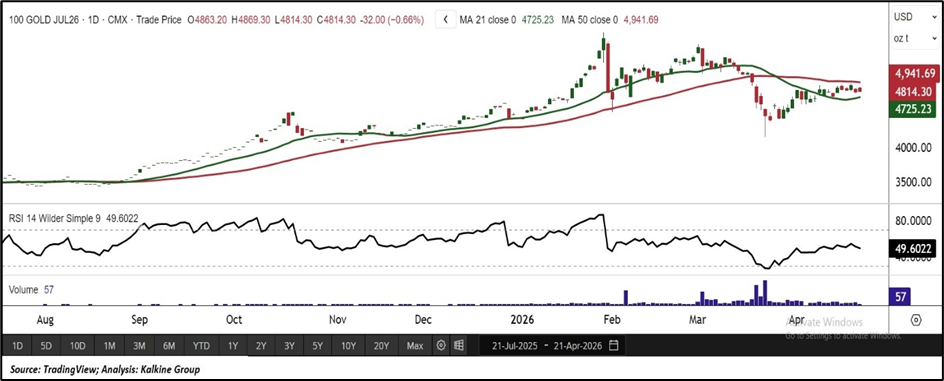
Gold futures are currently trading near $4,814, below the 50-day moving average near $4,941.69 but above the 21-day moving average near $4,725.23.
The chart suggests that gold has stabilized after rebounding from the recent low near $4,300. The recovery has improved the near-term structure, although the metal continues to remain below its 50-day moving average.
The 14-day RSI is at 49.60, indicating neutral momentum. The indicator has recovered from lower levels but remains near the midpoint, suggesting that the market is still waiting for a stronger directional trigger.
The immediate support zone is placed near $4,300, followed by a broader downside zone near $4,000. As long as gold remains above these levels, the broader recovery attempt remains intact.
On the upside, resistance is now seen near $5,100–5,500. A sustained move above the 50-day moving average could improve the possibility of gold retesting this higher range in the coming weeks.
Latest News
Recent reports suggest that Iran may participate in another round of talks in Islamabad this week, although no formal agreement has yet been reached. Reports also indicate that President Donald Trump may attend a possible peace deal signing either in person or virtually if negotiations progress.
Markets are now watching whether the ceasefire will be extended beyond Wednesday. A failure in talks could revive safe-haven demand for gold, while progress toward a deal may keep the metal trapped within its recent range.
Investors are also waiting for Kevin Warsh’s testimony before the Senate Banking Committee. Any comments suggesting a tougher stance on inflation or a slower pace of interest rate cuts may weigh on gold prices.
Key Risks
- A successful U.S.-Iran agreement may reduce safe-haven demand and limit upside in gold.
• Renewed military action in the Middle East could sharply increase volatility in bullion prices.
• A stronger U.S. dollar and higher Treasury yields may weigh further on gold.
• Hawkish comments from Kevin Warsh could pressure precious metals in the near term.
Summary
Gold has rebounded from the $4,300 support zone, but the metal remains trapped in a broad range as markets await clarity on U.S.-Iran peace talks and Kevin Warsh’s Senate hearing. The near-term outlook remains neutral, with support near $4,300 and resistance around $5,100–5,500 likely to define the next major move.
FAQs
Why is gold trading in a range?
Gold remains range-bound because investors are waiting for clarity on U.S.-Iran peace talks and the outlook for U.S. interest rates.
What are the key support levels for gold?
The main support zones are near $4,300 and $4,000.
What are the next resistance levels for gold?
Gold may face resistance in the $5,100–5,500 zone if the recovery strengthens.