

India has imposed an immediate ban on sugar exports until September 30, 2026, in an effort to stabilize domestic sugar prices and ensure adequate availability in the local market. The move comes amid concerns over lower sugar production estimates, rising food inflation, and increasing demand from both consumers and ethanol blending programs.
The government clarified that only shipments already under loading or customs processing will be permitted, while fresh export contracts will remain restricted during the ban period.
The announcement has triggered fresh discussions around the outlook for Indian sugar companies, global sugar prices, and the broader agri-commodity market.
Why India Restricted Sugar Exports
India is one of the world’s largest sugar producers and exporters. However, erratic weather conditions, concerns over cane availability, and the government’s focus on maintaining domestic supply have pressured authorities to take precautionary measures.
The export restriction is mainly aimed at:
- Controlling domestic sugar inflation
- Ensuring adequate inventory for local consumption
- Supporting ethanol blending requirements
- Preventing supply shortages ahead of the festive season
With sugar being a politically sensitive commodity in India, maintaining price stability remains a key priority for policymakers.
Impact on Global Sugar Prices
India’s export ban is expected to tighten global sugar supply conditions, particularly in Asian and African markets that depend heavily on Indian exports.
Following the announcement, international sugar prices witnessed upward momentum as traders anticipated lower export availability from India. The decision could create opportunities for other major sugar-exporting nations such as Brazil and Thailand to expand their market share globally.
Analysts believe that reduced Indian exports may keep global sugar prices elevated in the near term, especially if weather-related production concerns continue in key producing regions.
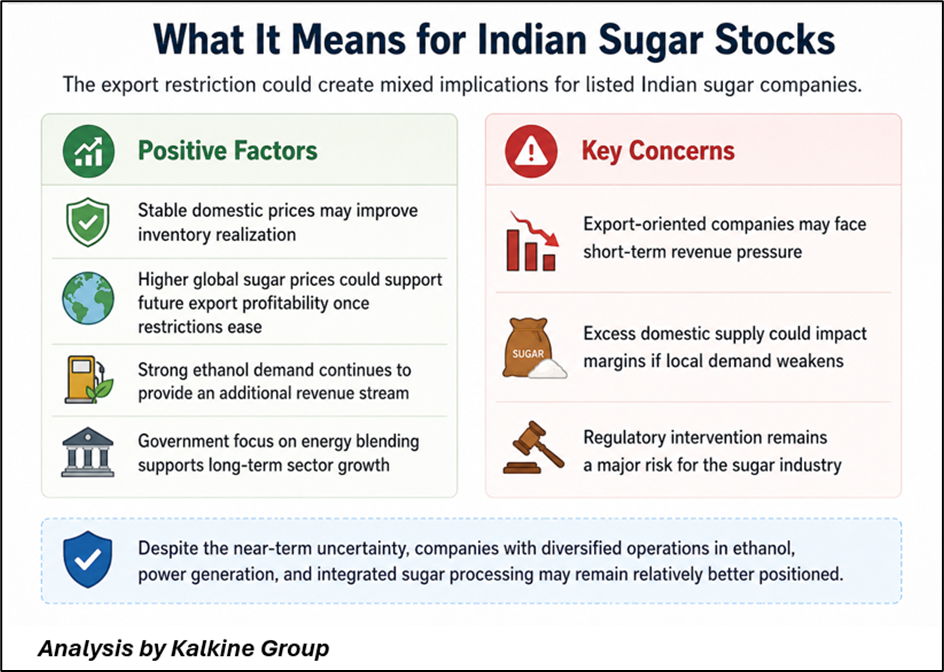
Sugar Stocks Likely to Stay in Focus
Investors may continue monitoring major sugar companies including:
- Balrampur Chini Mills Limited (NSE:BALRAMCHIN)
- Shree Renuka Sugars Limited (NSE:RENUKA)
- Triveni Engineering & Industries Limited (NSE:TRIVENI)
- Dalmia Bharat Sugar and Industries Limited (NSE:DALMIASUG)
- EID Parry (India) Limited (NSE:EIDPARRY)
Market participants are expected to closely track government policy decisions, monsoon trends, cane output forecasts, and ethanol blending targets for further sector direction.
Outlook for the Sugar Industry
India’s sugar sector continues to evolve beyond traditional sugar production, with ethanol emerging as a critical long-term growth driver. While export restrictions may temporarily impact sentiment, the sector’s structural growth story linked to renewable energy and biofuel initiatives remains intact.
The near-term outlook will largely depend on domestic production trends, government inventory management policies, and global sugar price movements.
FAQs
- Why did India ban sugar exports?
India restricted sugar exports to control domestic prices, maintain adequate local supply, and support the country’s ethanol blending program.
- How will the sugar export ban affect sugar stocks?
The impact may vary across companies. Export-focused firms could face short-term pressure, while integrated sugar and ethanol players may remain relatively resilient.
- Will global sugar prices rise after India’s export ban?
Global sugar prices may stay firm due to tighter export availability from one of the world’s largest sugar exporters.