

Jio Platforms Limited has filed its Draft Red Herring Prospectus (DRHP) with the Securities and Exchange Board of India (SEBI), marking one of the most anticipated public offerings in India’s corporate history. The proposed issue consists entirely of a fresh issue of up to 270 million equity shares, with no offer-for-sale component.
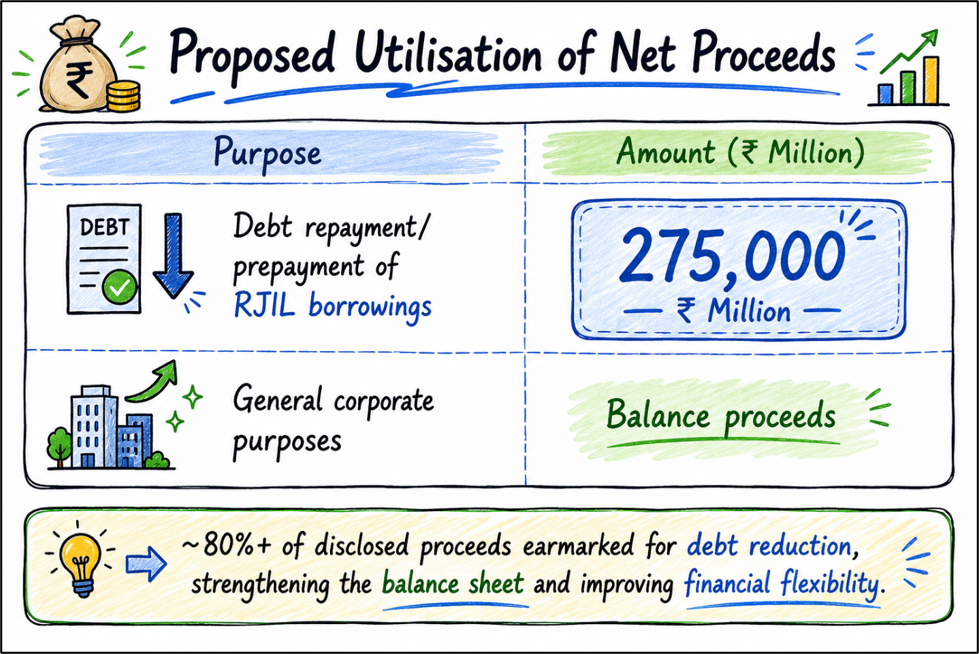
Unlike many IPOs focused on funding aggressive expansion, Jio’s proposed public offering is largely centered on strengthening its balance sheet through debt reduction. The company plans to utilize up to ₹275 billion from the net proceeds to prepay certain borrowings of its material subsidiary, Reliance Jio Infocomm Limited (RJIL), while the remaining funds will support general corporate purposes.
The move reflects management’s focus on improving financial flexibility while positioning the company for long-term investments across digital connectivity, broadband, cloud computing, artificial intelligence, enterprise solutions, and emerging technology partnerships.
Business Overview
Jio Platforms has evolved far beyond a traditional telecom operator. Today, it operates one of India’s largest digital ecosystems spanning:
- Mobile connectivity services
- Fixed broadband infrastructure
- Digital applications and content platforms
- Enterprise connectivity solutions
- Cloud and AI initiatives
- Digital commerce and technology services
- Global technology partnerships
- Digital infrastructure assets
Through Reliance Jio Infocomm and various subsidiaries, the company has built an integrated platform combining connectivity, digital services, content distribution, cloud capabilities, and enterprise technology solutions.
This ecosystem-driven model enables Jio to monetize users across multiple touchpoints while creating opportunities for cross-selling and customer retention.
Financial Performance: Strong Growth Momentum Continues
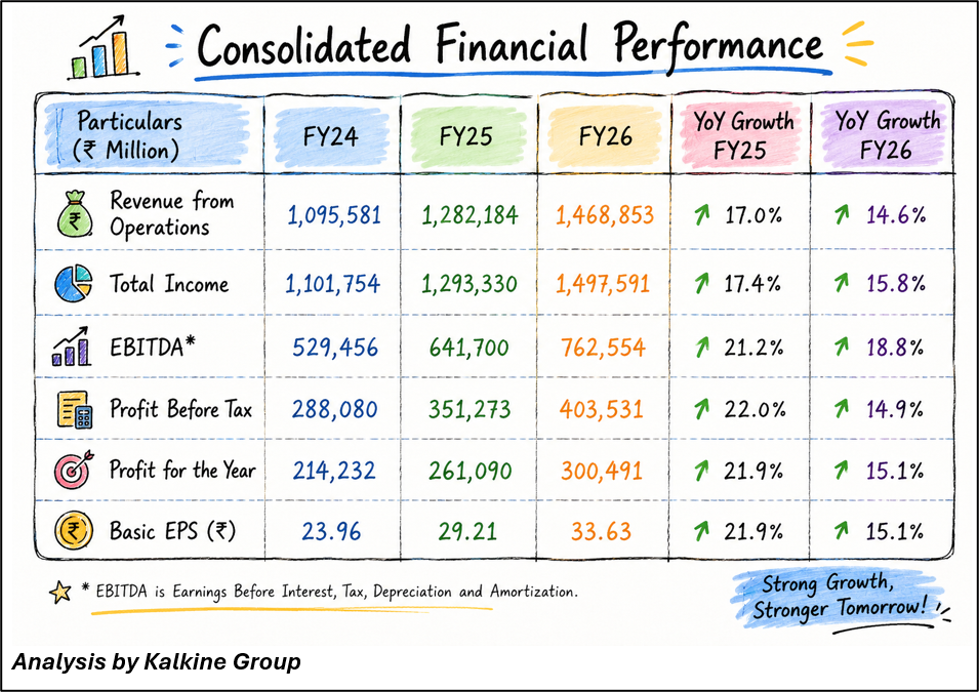
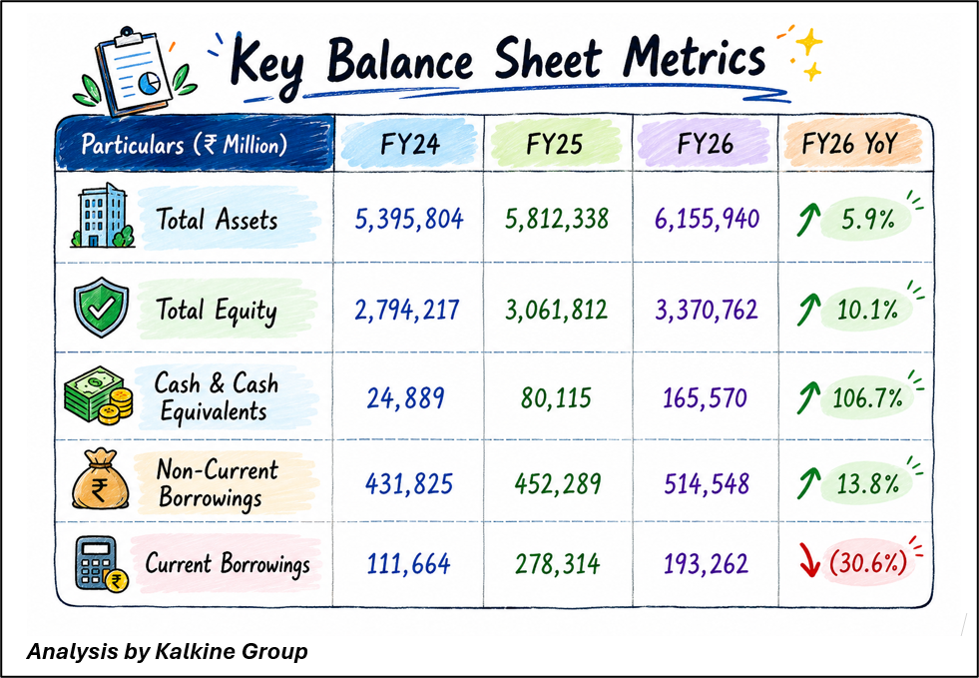
Jio Platforms reported consistent growth across revenue, profitability, cash generation and shareholder value during FY24-FY26.
Key Balance Sheet Metrics
Major Financial Changes Investors Should Track
- Revenue Expansion Remains Robust- Revenue from operations increased from ₹1.10 trillion in FY24 to ₹1.47 trillion in FY26, reflecting a two-year growth of nearly 34%. Growth was supported by subscriber monetization, broadband expansion, enterprise services and digital offerings.
- Profitability Continues to Improve- Profit for the year increased from ₹214.2 billion in FY24 to ₹300.5 billion in FY26, indicating strong operating leverage and scale benefits.
- Significant Increase in Cash Position- Cash and cash equivalents more than doubled during FY26 to ₹165.6 billion, providing additional liquidity and financial flexibility.
- Asset Base Crosses ₹6 Trillion- Total assets expanded to ₹6.16 trillion in FY26, driven by investments in network infrastructure, spectrum assets and digital platform capabilities.
- Spectrum and Infrastructure Investments Continue- Spectrum assets increased to ₹1.88 trillion in FY26 from ₹1.47 trillion in FY25, highlighting the company’s ongoing commitment toward strengthening network capacity and future-ready digital infrastructure.
IPO Proceeds: A Deleveraging-Focused Strategy
The most significant takeaway from the DRHP is the planned deployment of IPO proceeds.
Management believes the proposed debt reduction will:
- Lower net debt levels
- Reduce finance and servicing costs
- Improve leverage metrics
- Enhance net asset value
- Strengthen future borrowing capacity
- Support investments in 5G, AI, cloud and enterprise services
Rather than funding near-term operational requirements, the IPO appears designed to optimize capital structure and improve long-term shareholder value.
Why the IPO Matters
Jio Platforms enters the public market with:
- Revenue approaching ₹1.5 trillion
- Profit exceeding ₹300 billion
- Assets above ₹6 trillion
- Strong operating cash flows of ₹775.6 billion in FY26
- A rapidly expanding digital ecosystem
- Significant market leadership in connectivity infrastructure
The proposed debt reduction strategy may further strengthen the company’s financial profile while enabling continued investments across next-generation technologies.
Conclusion
Jio Platforms’ IPO represents more than a listing event. It reflects the maturation of one of India’s largest digital infrastructure businesses. While telecom remains the foundation, the company’s broader ambitions span artificial intelligence, cloud computing, enterprise technology, broadband expansion and digital services.
The planned deleveraging initiative signals a focus on improving balance-sheet efficiency before entering the public markets. For investors, the key question will not simply be subscriber growth, but whether Jio can successfully monetize its expanding digital ecosystem and translate its scale into sustained earnings growth over the coming decade.
FAQs
- What is Jio Platforms' IPO about?
Jio Platforms has filed a Draft Red Herring Prospectus (DRHP) with SEBI for an IPO comprising a fresh issue of up to 270 million equity shares. The offering does not include an offer-for-sale component.
- What will Jio Platforms do with the IPO proceeds?
A significant portion of the proceeds, up to ₹275 billion, is proposed to be utilized for repayment or prepayment of certain borrowings of Reliance Jio Infocomm Limited (RJIL), while the remaining amount will be used for general corporate purposes.
- Why is debt reduction important for Jio Platforms?
Reducing debt can lower interest costs, strengthen the balance sheet, improve leverage ratios and enhance financial flexibility for future investments across digital services, cloud, AI and network expansion.
- What businesses does Jio Platforms operate?
Jio Platforms operates a diversified digital ecosystem comprising mobile connectivity, broadband services, digital applications, enterprise solutions, cloud services, digital content platforms and technology-driven businesses.
- How has Jio Platforms performed financially?
The company reported revenue from operations of approximately ₹1.47 trillion and net profit of around ₹300 billion in FY26, reflecting continued growth in scale and profitability