

Company Overview
Multi Commodity Exchange of India Ltd (MCX) is India's largest commodity derivatives exchange, providing a regulated platform for trading futures and options contracts in commodities including bullion, metals, energy, and agricultural products. Established in 2003 and headquartered in Mumbai, MCX operates under the regulatory oversight of the Securities and Exchange Board of India (SEBI) and has consistently accounted for the lion's share of India's commodity derivatives trading volumes.
MCX's core revenue model is transactional — the exchange earns fees on every commodity contract traded on its platform, meaning revenue scales directly with market volumes. As India's commodity markets have deepened with greater retail and institutional participation, MCX has benefited from a structural expansion of its addressable market. The exchange offers contracts in gold, silver, copper, crude oil, natural gas, and agricultural commodities, providing Indian market participants with risk management tools that are essential for hedgers, traders, and speculators alike.
A significant strategic development for MCX in recent years has been the successful migration of its trading technology to a new platform, which initially caused disruption but has since positioned the exchange on a stable, scalable foundation for future product launches. The introduction of commodity options alongside futures has meaningfully expanded participation from institutional investors who prefer optionality-based risk management strategies. With 11 analysts covering the stock and a broad Buy consensus, MCX commands strong institutional research attention.
Fundamental Insights
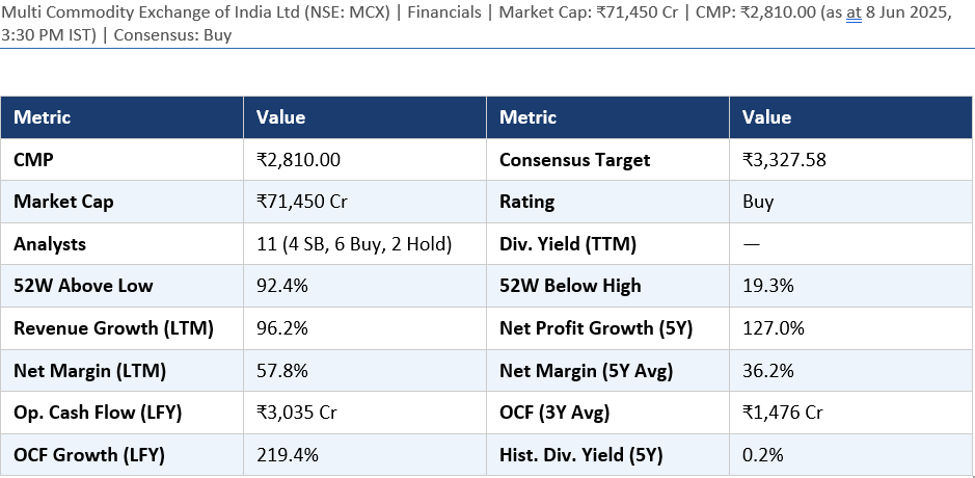
MCX's financial metrics for the latest twelve months are exceptional by any measure. Revenue grew 96.2% year-on-year — an extraordinary acceleration driven by record trading volumes in bullion, base metals, and energy contracts as domestic and global commodity markets experienced heightened volatility and price discovery activity. Net profit margin of 57.8% reflects the extraordinary operating leverage of an exchange business where incremental revenue flows almost entirely to the bottom line after fixed infrastructure costs are covered.
The five-year average net profit growth of 127.0% is a remarkable compounding figure that confirms MCX's long-term earnings trajectory, even accounting for the technology transition disruption that impacted an earlier period. The five-year average net profit margin of 36.2% is lower than the current 57.8%, confirming that the current period represents a high-water mark driven by exceptional volume environments — though the structural upward trend in margins is clear.
Operating cash flow of ₹3,035 crore in the latest fiscal year, growing 219.4% year-on-year, is a standout capital generation metric. The three-year average OCF of ₹1,476 crore provides context — the latest year's cash generation was more than double the recent average, confirming the scale of the current earnings surge. The current dividend yield of 0.3% is modest relative to earnings generation, suggesting MCX is retaining significant capital for reinvestment or strategic purposes.
Broker Views and Analyst Consensus
Eleven analysts cover MCX with a broadly constructive consensus — 4 Strong Buy, 6 Buy, and 2 Hold, producing a weighted average Buy rating. The consensus target price of ₹3,327.58 implies 18.4% upside from the current price of ₹2,810.00. The breadth and quality of analyst coverage reflects MCX's institutional importance as a pure-play on India's commodity exchange infrastructure.
Broker research highlights several key bullish catalysts: the structural growth of commodity derivatives participation in India as financial literacy improves, SEBI's active encouragement of deeper commodity markets, the potential introduction of new products including commodity indices and cross-currency contracts, and the operating leverage model where volume growth drives disproportionate earnings expansion. Analysts also note that MCX's near-monopoly status in Indian commodity derivatives creates significant pricing power and barriers to entry.
The 2 Hold ratings reflect concerns around the cyclicality of commodity trading volumes — periods of low volatility suppress transaction fees and can meaningfully impact quarterly results. The current 19.3% gap below the 52-week high also indicates recent profit-taking after the strong run from lows.
Technical Analysis
MCX has rallied 92.4% above its 52-week low — a dramatic re-rating that reflects both the earnings acceleration and renewed institutional confidence following the technology platform stabilisation. The stock now sits 19.3% below its 52-week high, suggesting it has pulled back from the peak and is in a consolidation phase.
The current price of ₹2,810.00 is well above recent moving averages, confirming the medium-term uptrend is intact. The analyst consensus target of ₹3,327.58 provides a fundamental upside reference of 12.6%. Near-term support zones are expected around ₹2,750-₹2,800 based on the consolidation structure, with stronger support at ₹2,500-₹2,550. Resistance sits at the 52-week high above current levels.
RSI is likely in a moderately elevated but not extreme zone after the pullback from the highs, leaving room for further appreciation if volume data continues to impress. Options market data for MCX — as a commodity exchange, it is itself subject to derivatives activity by market participants — can provide additional insight into institutional positioning.
Key Metrics to Monitor
MCX is a high-quality financial infrastructure business benefiting from India's deepening commodity markets. The 57.8% net margin and 219.4% operating cash flow growth confirm an exceptional earnings environment. Investors monitoring MCX should track monthly commodity trading volume data released by the exchange — this is the primary leading indicator of near-term revenue and the key variable driving analyst estimate revisions. The 18.4% upside to consensus target and broad Buy consensus support a constructive near-term view. The primary risk to monitor is a sustained decline in commodity price volatility, which suppresses trading activity and revenue.
Frequently Asked Questions
Q1: What does MCX do?
A: MCX is India's largest commodity derivatives exchange, providing a platform to trade futures and options contracts on commodities including gold, silver, copper, crude oil, and natural gas. It earns transaction fees on every contract traded on its platform.
Q2: Why has MCX's revenue grown 96% in the latest year?
A: Revenue growth of 96.2% reflects record commodity trading volumes driven by elevated global commodity price volatility, expanded product offerings including options contracts, and deeper retail and institutional participation in Indian commodity derivatives markets.
Q3: What is the analyst consensus for MCX stock?
A: 11 analysts cover MCX with 4 Strong Buy, 6 Buy, and 2 Hold ratings. The consensus target price of ₹3,327.58 implies 18.4% upside from the current price of ₹2,810.00.
Q4: What are the key risks for MCX?
A: The primary risk is commodity trading volume cyclicality — in periods of low commodity price volatility, trading activity declines and revenue compresses sharply. Competition from new exchange entrants, though historically limited, is also a structural risk.
Q5: How does MCX generate cash?
A: MCX earns transaction fees proportional to trading volumes on its exchange platform. With minimal variable costs beyond the fixed technology and regulatory infrastructure, incremental revenue largely flows to operating cash flow — hence the 219.4% OCF growth in the latest year.
Disclaimer: This article is intended for informational and educational purposes only and does not constitute investment advice or a recommendation to buy or sell any security. Past performance is not indicative of future results. Investors should conduct independent due diligence and consult a SEBI-registered investment adviser before making any financial decisions.