

The National Stock Exchange of India has officially launched live trading of Electronic Gold Receipts (EGRs), marking a significant step toward modernising India’s gold investment ecosystem.
The initiative allows investors to buy and sell gold in electronic form through the exchange platform while also offering the flexibility of physical conversion. Industry participants believe the move could improve transparency, standardisation, and efficiency in India’s traditionally fragmented gold market.
Electronic Gold Receipts are backed by physical gold deposited in SEBI-regulated vaults and are traded similarly to securities on stock exchanges.
EGRs Offer Direct Ownership of Physical Gold
One of the key distinctions of EGRs is that they provide direct ownership of underlying physical gold. Unlike several other gold-linked financial products, EGR holders have the option to convert their holdings into physical gold subject to exchange guidelines and vaulting norms.
The gold available under EGRs currently comes in purity levels of 99.9% (999) and 99.5% (995), ensuring standardised quality for investors.
This structure is expected to enhance investor confidence by combining the convenience of electronic trading with the security of regulated physical backing.
Transparent and Market-Driven Gold Pricing
Industry experts believe EGR trading can help establish a more transparent and nationally benchmarked gold pricing mechanism across India. Since trading occurs on a regulated exchange platform, pricing is expected to become more market-driven and efficient.
The exchange-traded structure may also reduce pricing inefficiencies often seen across local physical gold markets, where premiums and regional variations can impact buyers and sellers differently.
The launch aligns with broader efforts to formalise India’s gold market and improve overall ecosystem transparency.
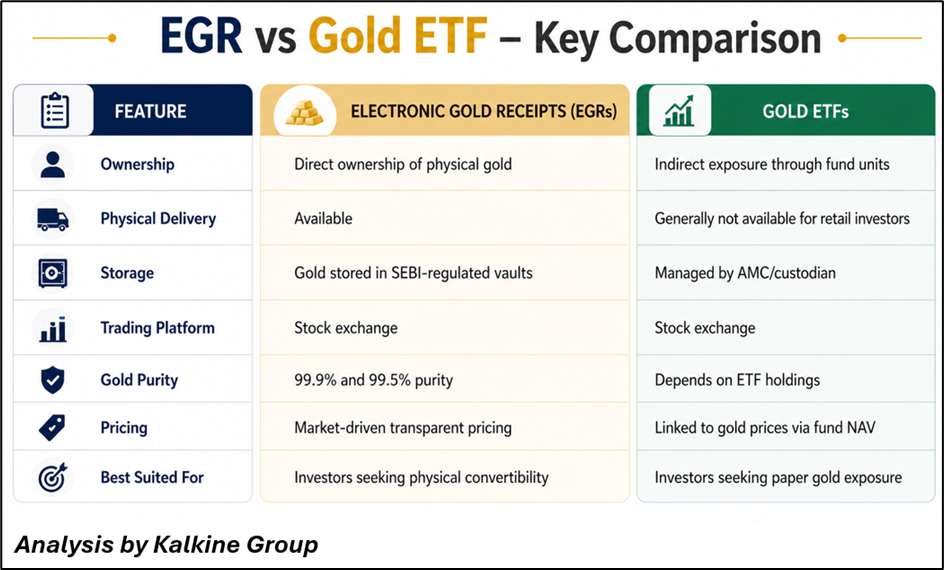
How EGRs Differ from Gold ETFs
Although both EGRs and Gold Exchange Traded Funds (ETFs) offer exposure to gold prices, their ownership structure differs significantly.
Gold ETFs primarily provide indirect exposure to gold through fund units managed by asset management companies. In contrast, EGRs represent direct ownership of physical gold stored in regulated vaults.
Another major difference is convertibility. EGR holders can potentially convert their electronic holdings into physical gold, while Gold ETFs generally do not offer direct retail physical redemption in standard formats.
This distinction may appeal to investors seeking both investment exposure and eventual physical ownership flexibility.
Potential Benefits for Investors and the Gold Ecosystem
The launch of EGR trading could benefit both retail and institutional participants by improving accessibility, reducing storage concerns, and enabling efficient gold transactions through exchange infrastructure.
The regulated framework is also expected to support better price discovery, improved liquidity, and enhanced investor protection.
As India remains one of the world’s largest gold-consuming nations, the introduction of EGRs could gradually reshape how investors participate in the gold market by bridging traditional physical ownership with modern electronic trading systems.
FAQs
- What are Electronic Gold Receipts (EGRs)?
EGRs are exchange-traded electronic instruments backed by physical gold stored in regulated vaults.
- How are EGRs different from Gold ETFs?
EGRs provide direct ownership of physical gold and allow physical convertibility, while Gold ETFs mainly offer indirect exposure to gold prices through fund units.
- What purity levels are available under EGRs?
The gold available under EGRs currently comes in 99.9% (999) and 99.5% (995) purity levels.