

Strong Returns Don’t Always Require Aggressive Bets
Multicap funds have long been regarded as one of the most flexible equity investment options available to investors. By allocating capital across large-cap, mid-cap, and small-cap stocks, these schemes aim to capture opportunities across different segments of the market while maintaining diversification.
A common perception among investors is that the best-performing multicap funds achieve superior returns by taking aggressive positions in smaller companies. However, recent performance trends suggest that successful fund management is often driven more by disciplined asset allocation and stock selection than by simply increasing exposure to high-risk segments.
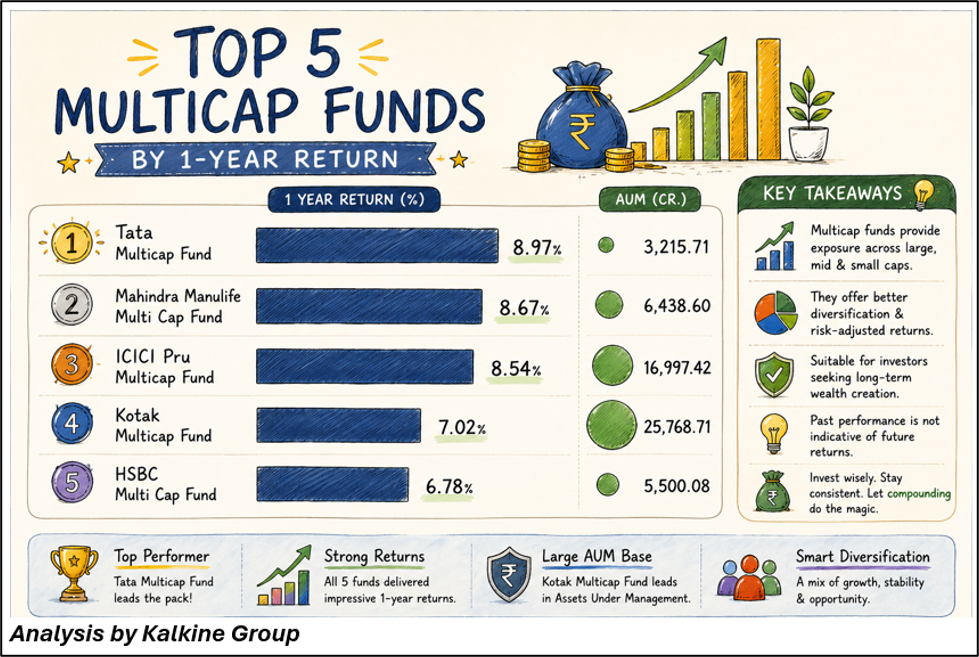
The Multicap Advantage
Unlike category-specific funds that focus on a particular market capitalization segment, multicap funds are required to maintain a minimum allocation across large-cap, mid-cap, and small-cap stocks. This structure allows fund managers to participate in growth opportunities while balancing risk across market cycles.
The flexibility offered by multicap funds enables managers to adjust allocations based on market conditions, valuations, and sector opportunities, making them suitable for investors seeking diversified equity exposure through a single investment vehicle.
Is Aggression the Key to Outperformance?
While some top-performing schemes have benefited from higher exposure to small-cap stocks during favorable market conditions, performance data indicates that aggressive positioning alone does not guarantee superior returns.
Several leading multicap funds have delivered competitive performance despite maintaining allocations close to category averages. Rather than relying solely on small-cap exposure, successful funds often focus on identifying quality businesses across market segments and maintaining balanced portfolios.
This highlights an important lesson for investors: risk-taking can enhance returns, but disciplined portfolio construction remains equally important.
Allocation Strategy Matters
The composition of a multicap portfolio plays a crucial role in determining long-term outcomes. Large-cap stocks generally provide stability and liquidity, while mid-cap companies offer growth potential. Small-cap stocks can deliver significant upside but often come with higher volatility.
The most effective fund managers seek to balance these characteristics rather than overemphasize any single segment. This approach allows portfolios to participate in market rallies while reducing the impact of sharp corrections.
As market conditions evolve, the ability to dynamically allocate capital becomes a key differentiator among multicap schemes.
Why Investors Should Look Beyond Recent Returns
Short-term performance rankings often attract investor attention, but selecting a fund based solely on recent returns can be misleading. A fund that outperforms during a small-cap rally may face greater volatility when market sentiment weakens.
Investors should evaluate multiple factors, including portfolio diversification, consistency of returns, risk-adjusted performance, investment philosophy, and fund manager experience. Understanding how returns are generated is often more important than focusing exclusively on headline performance numbers.
The Role of Multicap Funds in a Portfolio
For long-term investors, multicap funds can serve as a core equity allocation due to their diversified structure. They provide exposure to different segments of the market without requiring investors to actively manage separate large-cap, mid-cap, and small-cap investments.
This diversified approach can help navigate changing market environments while offering the potential for long-term wealth creation through disciplined investing.
Outlook
The recent performance of leading multicap funds demonstrates that superior returns are not always the result of aggressive risk-taking. While small-cap exposure can contribute to outperformance during favorable periods, successful investing often depends on maintaining a balanced portfolio and adapting to evolving market conditions.
For investors, the key takeaway is clear: sustainable wealth creation is typically driven by consistency, diversification, and prudent allocation rather than chasing the highest-risk opportunities.
Frequently Asked Questions (FAQs)
1. What is a multicap fund?
A multicap fund is an equity mutual fund that invests across large-cap, mid-cap, and small-cap stocks, offering diversified market exposure within a single portfolio.
2. Are multicap funds riskier than large-cap funds?
Generally, multicap funds carry higher risk than pure large-cap funds because they include exposure to mid-cap and small-cap stocks. However, diversification helps moderate overall portfolio risk.
3. Should investors choose the highest-returning multicap fund?
Not necessarily. Investors should consider consistency, risk-adjusted returns, portfolio composition, and investment strategy rather than relying solely on recent performance rankings.