

KOSDAQ Triggers Circuit Breaker After 8% Plunge Amid Broad-Based Market Selloff
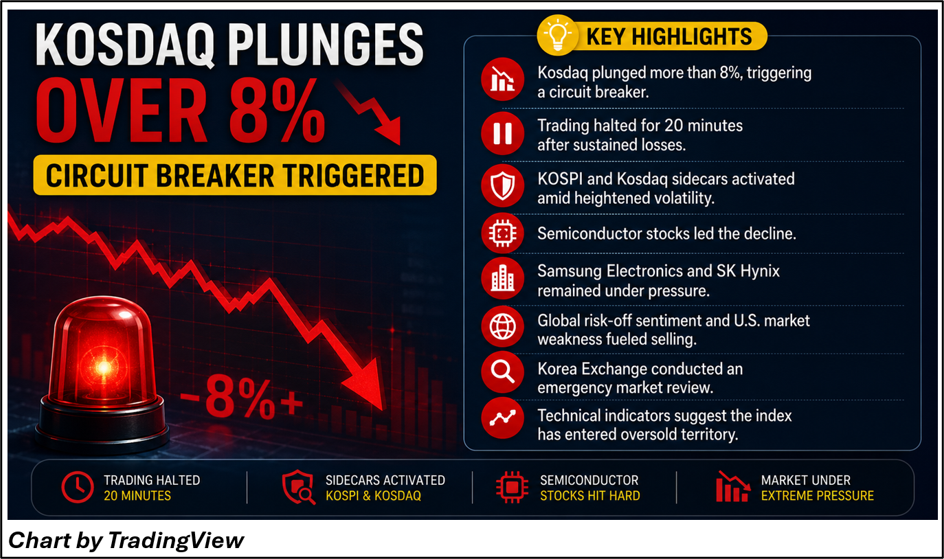
South Korea's stock market witnessed one of its sharpest declines of 2026 on Monday, as the technology-heavy KOSDAQ Index plunged more than 8%, triggering a first-stage circuit breaker and forcing a temporary halt in trading.
The selloff, widely referred to as "Black Monday" by market participants, spread rapidly across South Korea's financial markets, with both the benchmark KOSPI and KOSDAQ indices coming under intense pressure amid global risk aversion, weakness in semiconductor stocks, and profit-booking after a strong rally earlier this year.
The Korea Exchange (KRX) announced that a first-stage circuit breaker was activated on the KOSDAQ after the index remained more than 8% below the previous session's close for over one minute. Trading was suspended for 20 minutes to curb excessive volatility and restore market stability.
At the time of activation, the KOSDAQ stood at 911.39 points, down more than 90 points from its previous close of 1,002.44.
Circuit Breaker Activated as Losses Deepen
According to the Korea Exchange (KRX), the first-stage circuit breaker was triggered after the Kosdaq remained down more than 8% from the previous session for over one minute.
The index fell to 921.85 points, marking a decline of 80.59 points or 8.03% from its previous close of 1,002.44. Trading on the Kosdaq was subsequently suspended for 20 minutes under market stabilization rules designed to curb excessive volatility.
A circuit breaker serves as an emergency mechanism that temporarily halts trading during extreme market moves, providing investors time to assess conditions and helping reduce panic-driven transactions.
Semiconductor Stocks Drive Market Weakness
The selloff was largely attributed to weakness in global semiconductor stocks following sharp declines in U.S. technology shares. Investor sentiment deteriorated further as heavyweight Korean chipmakers, including Samsung Electronics and SK Hynix, came under pressure.
With semiconductor companies representing a significant portion of South Korea's market capitalization, declines in these stocks amplified losses across both the KOSPI and Kosdaq.
Analysts also noted that profit-booking activity intensified after the KOSPI's strong rally earlier this year, accelerating the downward momentum.
Sidecars Activated Across Markets
In addition to the circuit breaker, sell-side sidecars were activated on both the KOSPI and Kosdaq markets.
A sidecar temporarily suspends program trading activity for five minutes when futures prices move sharply, helping reduce sudden distortions between derivatives and cash markets.
The activation reflected the severity of the selloff and underscored heightened concerns among investors regarding global economic uncertainty, geopolitical risks, and technology-sector valuations.
Korea Exchange Monitoring Market Conditions
Earlier in the day, the Korea Exchange convened an emergency market inspection meeting to assess rising volatility in domestic and international financial markets.
Regulators indicated they would closely monitor:
- Global equity market movements
- Semiconductor sector developments
- Middle East geopolitical tensions
- Currency market fluctuations
- Foreign investor flows
Authorities also reaffirmed their readiness to implement additional market-stabilization measures if volatility remains elevated.
What Investors Should Watch
While sharp corrections often create attractive long-term opportunities, investors are likely to remain cautious in the near term. The trajectory of U.S. technology stocks, semiconductor demand trends, and global macroeconomic developments will likely determine whether the current selloff evolves into a broader market correction or remains a temporary risk-off event.
The performance of Samsung Electronics, SK Hynix, and other semiconductor leaders will be closely watched as indicators of broader investor confidence in South Korea's equity markets.
Technical Summary
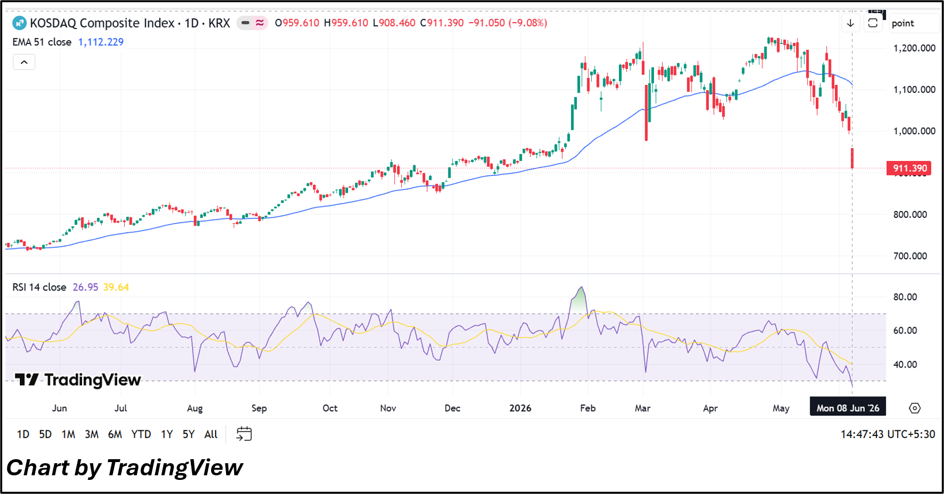
The Kosdaq Index crashed 9.08% to 911.39, decisively breaking below its 51-day EMA at 1,112.23 and confirming a strong bearish trend. RSI dropped to 26.95, entering oversold territory. Heavy selling pressure, widening downside momentum, and circuit-breaker activation indicate extreme weakness, with support near 900 and resistance around 1,000.
FAQs
- Why was the Kosdaq circuit breaker triggered?
The Kosdaq remained more than 8% below the previous session's close for over one minute, meeting Korea Exchange requirements for a first-stage circuit breaker.
- How long was trading halted?
Trading was suspended for 20 minutes under the first-stage circuit breaker mechanism.
- What caused the sharp decline?
Weakness in global technology stocks, semiconductor sector selling, profit-booking, and broader risk-off sentiment contributed to the market plunge.
- What is a sell-side sidecar?
A sidecar temporarily suspends program trading activity when futures prices fall sharply, helping stabilize market conditions.
- Is the Kosdaq technically oversold?
Yes. The RSI has fallen below 30, indicating oversold conditions, though oversold markets can remain under pressure if negative sentiment persists.
- Which stocks were most affected?
Major semiconductor companies, particularly Samsung Electronics and SK Hynix, were among the key contributors to the broader market decline.