

Key Highlights
- Wipro shares declined more than 4% after turning ex-buyback.
- The company has announced a ₹15,000 crore share buyback at ₹250 per share.
- June 5, 2026, was fixed as the record date for shareholder eligibility.
- Short-term selling pressure emerged as buyback benefits were adjusted in the stock price.
- Investors remain focused on the company’s operational outlook and IT sector demand trends.
Introduction
Shares of Wipro Ltd. witnessed significant selling pressure on June 5, 2026, falling over 4% during intraday trading as the stock turned ex-buyback. The decline came after the company’s record date for its ₹15,000 crore share repurchase program, one of the largest corporate actions undertaken by the Indian IT services major in recent years.
While the sharp drop may appear concerning at first glance, market participants note that the movement is largely technical in nature and linked to the stock's ex-buyback adjustment rather than any deterioration in the company’s fundamentals.
Understanding the Ex-Buyback Effect
A stock trades ex-buyback after the record date set by the company to determine shareholder eligibility for participating in a share repurchase program. Investors purchasing shares on or after the ex-date are not entitled to tender their shares in the buyback offer.
As a result, stocks often witness temporary price corrections once the eligibility window closes, especially when the buyback price carries a substantial premium over the prevailing market price.
For Wipro, the buyback price of ₹250 per share represented a notable premium to the market price, encouraging investors to accumulate shares ahead of the record date. Following the ex-buyback transition, some of these positions were unwound, contributing to the decline.
Wipro's ₹15,000 Crore Buyback: Key Details
Wipro's board approved a buyback of equity shares worth ₹15,000 crore through the tender offer route. The company plans to repurchase up to 60 crore shares at a fixed price of ₹250 per share.
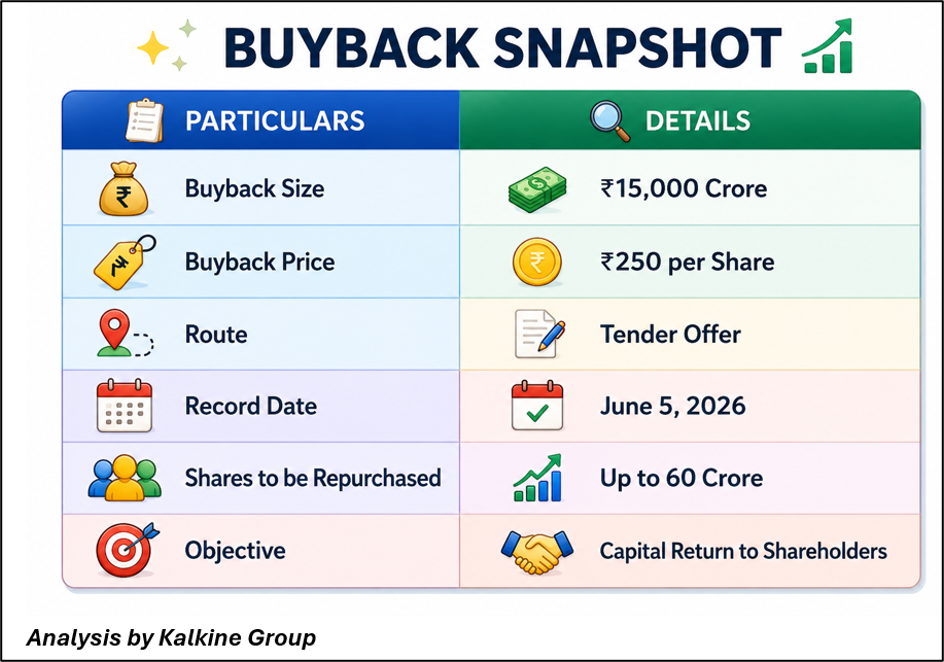
Buybacks are generally viewed as shareholder-friendly initiatives as they allow investors to monetize holdings at a premium while also reducing the number of outstanding shares.
Technical Analysis
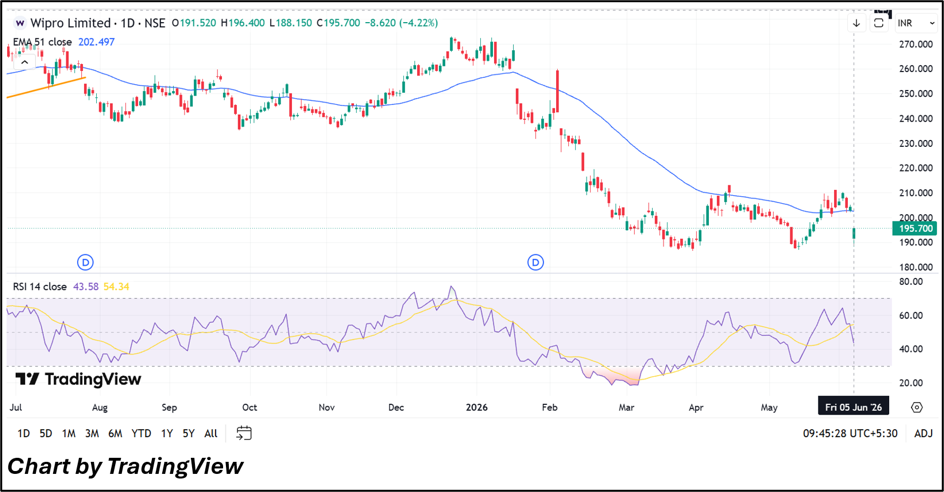
Wipro is currently trading around ₹195.70, below its 50-day EMA near ₹202.50, indicating a weak short-term trend. The stock witnessed a sharp decline after turning ex-buyback and remains under selling pressure. The RSI at 43.6 is below the neutral 50 mark, reflecting subdued momentum. Immediate support is placed near ₹190, while resistance is seen around ₹202–205. A sustained move above the 50-day EMA could improve near-term sentiment, whereas a break below ₹190 may trigger further downside pressure.
Broader IT Sector Challenges Remain
Beyond the buyback-related adjustment, investors continue to assess the outlook for India's information technology sector. Global enterprises have remained cautious regarding discretionary technology spending amid economic uncertainty, higher interest rates, and slower decision-making cycles.
Although artificial intelligence, cloud migration, cybersecurity, and digital transformation projects continue to offer long-term growth opportunities, near-term revenue visibility remains mixed for several IT service providers.
Wipro, like its peers, has been navigating these macroeconomic headwinds while focusing on operational efficiency, client retention, and margin expansion initiatives.
What Should Investors Do?
Investors should avoid interpreting the ex-buyback decline as a standalone indicator of the company's future performance. Such corporate actions often create temporary volatility that may not accurately reflect business fundamentals.
Key factors to monitor going forward include:
- Quarterly revenue growth trends
- Large deal wins
- Margin performance
- Demand recovery in North America and Europe
- AI and digital transformation opportunities
- Management commentary on future growth
Long-term investors may find greater value in evaluating these operational metrics rather than focusing solely on short-term price fluctuations arising from corporate actions.
Conclusion
Wipro's decline following its ex-buyback date appears to be largely technical and event-driven. The company's ₹15,000 crore buyback underscores management's commitment to returning capital to shareholders, while the stock's immediate direction will likely depend on broader IT sector trends and execution of growth initiatives.
As the market digests the buyback event, investors should focus on fundamentals, earnings visibility, and long-term business prospects rather than short-term volatility associated with the ex-date adjustment.
Frequently Asked Questions (FAQs)
- Why did Wipro shares fall over 4%?
Wipro shares declined after the stock turned ex-buyback, meaning new buyers are no longer eligible to participate in the company's share repurchase program.
- What is Wipro's buyback price?
The company has announced a buyback price of ₹250 per share under its ₹15,000 crore buyback program.
- What does ex-buyback mean?
A stock trades ex-buyback after the record date, indicating that investors purchasing shares from that date onward are not eligible for the buyback offer.
- Is the decline in Wipro shares a sign of weak fundamentals?
Not necessarily. The decline is largely linked to the ex-buyback adjustment and profit booking by investors who accumulated shares for buyback participation.
- What are the key levels to watch in Wipro stock?
Technical support is seen near ₹190–192, while resistance is placed around ₹202–205 and ₹210.
- How does a buyback benefit shareholders?
A buyback allows shareholders to sell shares back to the company at a predetermined price, often at a premium to the prevailing market price, thereby enhancing shareholder returns.