

Highlights
- The EPF Scheme 2026 updates administrative processes while retaining core provident fund benefits.
- Existing contribution rates, withdrawal provisions and account structure continue under the revised framework.
- Digital compliance and governance measures receive greater emphasis under the new scheme.
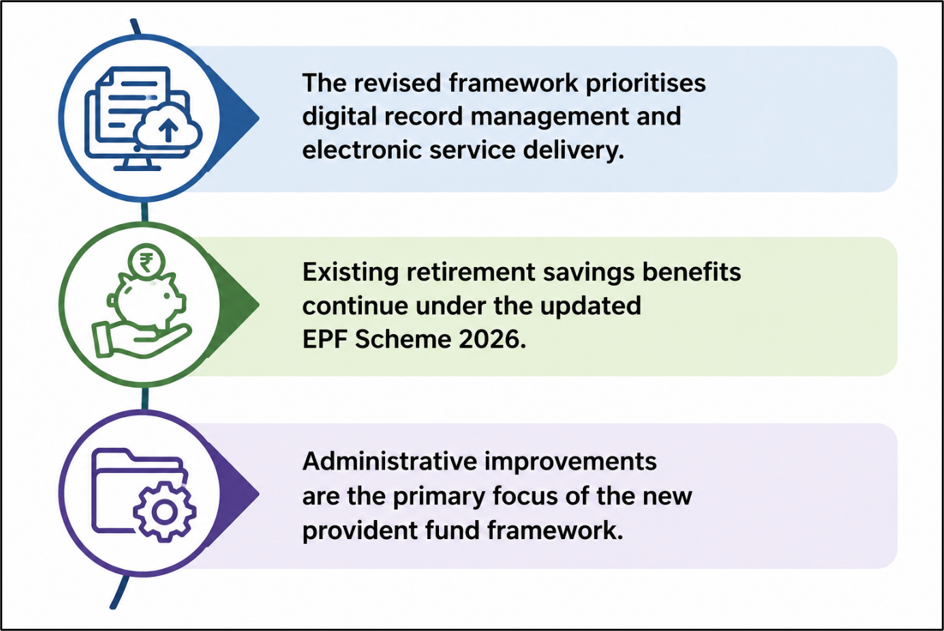
India's provident fund framework has entered a new phase with the notification of the Employees' Provident Fund (EPF) Scheme, 2026, under the Code on Social Security. While the revised scheme replaces the EPF Scheme, 1952, it does not overhaul the benefits available to employees. Instead, it introduces an updated administrative framework designed to support digital operations, improve compliance and simplify record management.
For millions of salaried employees covered under the Employees' Provident Fund Organisation (EPFO), the changes are largely procedural rather than financial.
Source: Analysis by Kalkine
Understanding the EPF Scheme 2026
The EPF Scheme 2026 lays down the rules for administering provident fund accounts under the Social Security Code. It continues to provide retirement savings benefits for eligible employees while aligning operational procedures with today's digital ecosystem.
The revised framework aims to make account management, compliance and service delivery more efficient without changing the fundamental objective of helping employees build long-term retirement savings.
Key Changes Introduced Under the New Scheme
Increased Digital Integration
One of the major updates is the greater use of digital systems across EPF administration. Electronic record maintenance, online account services, digital claim submissions and electronic communication are now embedded more clearly within the framework.
These measures are intended to reduce paperwork and improve accessibility for both employers and EPF subscribers.
Streamlined Administrative Procedures
The revised scheme encourages greater use of technology in day-to-day compliance. Activities such as filing statutory returns, maintaining records and processing claims are expected to become more streamlined through digital platforms.
This approach is aimed at improving operational efficiency while reducing manual processes.
Enhanced Governance for Exempted Establishments
Organisations operating exempted provident fund trusts will be subject to stronger governance standards. The updated framework places greater focus on timely reporting, electronic record maintenance, audits and investment disclosures.
These provisions seek to improve transparency and accountability within exempted provident fund trusts.
What Continues Without Change?
Although the scheme has been updated, several important provisions remain largely the same for employees.
Contribution Structure
Employees continue to contribute the prescribed percentage of eligible wages towards their provident fund, with employers making corresponding contributions as provided under existing regulations.
Interest on Provident Fund Balances
The process for determining annual EPF interest remains unchanged. Interest will continue to be declared through the established approval mechanism followed by the EPFO and the Central Government.
Withdrawal Provisions
Rules governing withdrawals for retirement, specific life events and account transfers continue under the existing framework. The revised scheme does not introduce broad changes to member withdrawal eligibility.
Universal Account Number (UAN)
Subscribers will continue using their Universal Account Number (UAN) as the permanent identifier for managing their EPF accounts across eligible employers.
What Does This Mean for Employees?
For existing EPFO members, there is little immediate impact on day-to-day retirement savings. Current account balances, contribution records and service history remain intact under the revised framework.
Most employees are unlikely to notice significant differences beyond gradual improvements in digital services and administrative efficiency.
Why Digital Administration Is Receiving Greater Attention
As financial services continue shifting towards electronic platforms, the EPF Scheme 2026 reflects this broader transition by placing greater emphasis on digital governance.
Electronic documentation, online services and improved compliance systems are expected to support faster processing, easier account access and more transparent administration over time.
Key Risks to Consider
- Digital platform issues may temporarily affect online service availability.
- Incorrect member information could delay claim processing.
- Non-compliance may result in regulatory action against employers.
- Exempted trusts face additional reporting and governance obligations.
Summary
The EPF Scheme 2026 modernises the administration of India's provident fund system by strengthening digital processes, improving compliance and enhancing governance standards. However, the core features that employees rely on—including contribution structures, interest determination, withdrawal provisions and account continuity—remain largely unchanged. For most subscribers, the revised scheme represents an administrative update rather than a change to retirement benefits.
FAQs
Q: Does the EPF Scheme 2026 change employee contribution rates?
A: No. The revised framework does not alter the existing contribution structure applicable to eligible employees and employers.
Q: Will existing EPF account holders need to open a new account?
A: No. Existing EPF accounts continue under the new framework without requiring subscribers to open fresh accounts.
Q: What is the main objective of the EPF Scheme 2026?
A: The scheme focuses on improving digital administration, compliance and governance while maintaining existing provident fund benefits.