

Highlights
- Business taxpayers cannot change tax regimes as freely as salaried individuals.
- Returning to the new tax regime may restrict future regime changes.
- Understanding the applicable rules can help avoid long-term tax complications.
India's income tax system currently allows eligible taxpayers to choose between two tax structures—the old tax regime and the new tax regime. Although both options continue to exist, the flexibility to switch between them differs depending on the source of income.
Individuals earning only salary or similar income generally have greater flexibility while filing their income tax returns. However, taxpayers carrying on a business or profession are governed by separate provisions that make regime selection a more significant long-term decision.
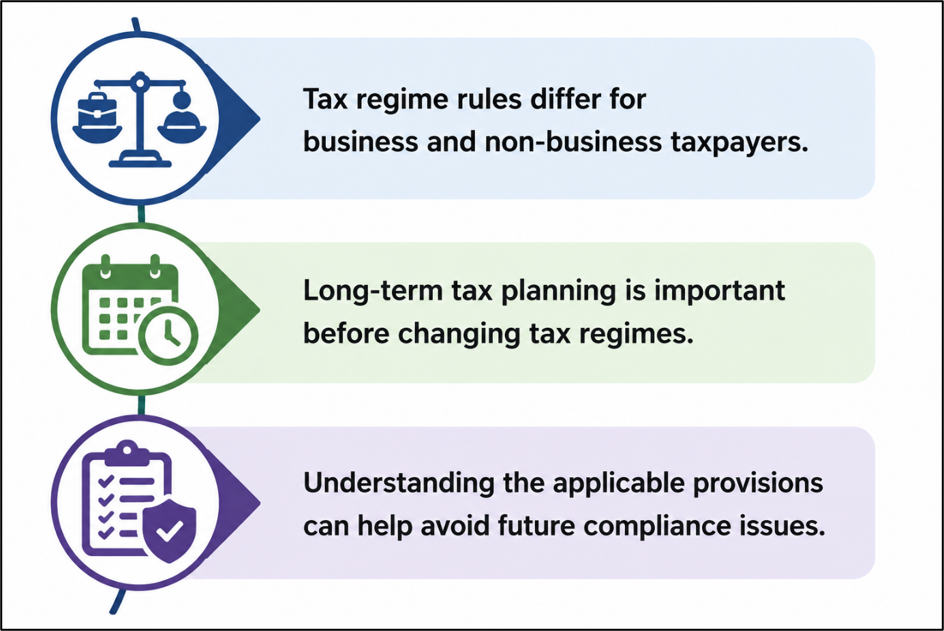
Source: Analysis by Kalkine
Are Business Owners Allowed to Return to the New Tax Regime?
Yes, a taxpayer earning business or professional income can move from the old tax regime to the new tax regime. However, this decision should not be viewed as an annual choice.
For business taxpayers, opting back into the new regime generally exhausts the opportunity to switch again while business income continues. In practical terms, the decision is intended to be permanent unless the taxpayer is no longer covered under the business income category.
Because of this limitation, business owners should carefully evaluate both tax structures before making their selection.
Why Are Business Taxpayers Treated Differently?
Unlike salaried individuals, businesses often claim deductions, depreciation and other tax benefits over multiple financial years. Frequent movement between tax regimes could create inconsistencies in tax calculations and record keeping.
To reduce such complexities, the law places additional restrictions on taxpayers reporting business or professional income.
This framework is designed to maintain continuity in tax treatment rather than allowing yearly changes.
Understanding the Two Tax Regimes
The Old Tax Regime
The old regime allows taxpayers to reduce taxable income through eligible deductions and exemptions available under various provisions of the Income Tax Act.
For taxpayers with significant tax-saving investments or deductible expenses, this regime may continue to be relevant depending on individual circumstances.
The New Tax Regime
The new regime follows a simplified structure with revised tax slabs while limiting the availability of many commonly claimed deductions and exemptions.
Since it has been introduced as the default tax regime, eligible taxpayers are generally covered under it unless they exercise the prescribed option to choose otherwise.
What About Small Businesses Under Presumptive Taxation?
Many small enterprises choose the presumptive taxation scheme because it simplifies tax compliance.
Even in such cases, taxpayers earning business income remain subject to the same tax regime switching provisions. Therefore, moving back to the new regime should be considered carefully because future flexibility may become limited.
What If Business Income Stops?
The restrictions on changing tax regimes are linked to the existence of business or professional income.
If a taxpayer no longer earns income under this category in a future financial year, the rules applicable to non-business taxpayers may become relevant, allowing greater flexibility while selecting a tax regime, subject to prevailing tax provisions.
Points to Review Before Making a Decision
Before deciding between the two tax regimes, business owners may consider several factors, including:
- Availability of eligible deductions.
- Expected taxable income.
- Nature of business expenses.
- Long-term investment plans.
- Future business continuity.
- Overall tax liability under each regime.
Comparing both tax structures before filing returns can help taxpayers make a more informed decision based on their financial position.
Key Risks to Consider
- A regime change may reduce future switching flexibility.
- Choosing the wrong regime could increase tax outgo.
- Missing procedural requirements may affect tax benefits.
- Business deductions differ between the two tax structures.
Summary
Business owners are subject to different tax regime selection rules than salaried taxpayers. Although they may choose to move from the old tax regime to the new one, doing so generally limits their ability to return to the old regime while business income continues. Since the decision can have long-term implications, taxpayers should carefully compare both tax structures before exercising the available option.
FAQs
Q: Can a business owner switch from the old tax regime to the new tax regime?
A: Yes. Eligible taxpayers with business income may choose the new regime in accordance with the prescribed tax provisions.
Q: Can business taxpayers repeatedly change between the two tax regimes?
A: No. Business taxpayers face restrictions that generally prevent repeated switching once they return to the new regime.
Q: Do salaried individuals follow the same switching rules?
A: No. Taxpayers without business or professional income generally enjoy greater flexibility when choosing between the two tax regimes.