

How Smart Tax Planning Can Help You Build Wealth While Reducing Your Tax Liability
Tax planning is an integral part of personal financial management. While paying taxes is a legal responsibility, individuals can significantly reduce their tax burden by utilizing various tax-saving investment and insurance options available under the Indian Income Tax Act. Effective tax planning not only lowers taxable income but also supports long-term financial goals such as retirement planning, wealth creation, and financial protection.
Among the most popular tax-saving avenues available to Indian taxpayers are the National Pension System (NPS), Equity Linked Savings Schemes (ELSS), and Health Insurance. These financial instruments offer a unique combination of tax benefits, investment growth potential, and financial security, making them valuable components of a well-diversified financial plan.
This article explores the tax benefits associated with NPS, ELSS, and Health Insurance and explains how they can help taxpayers optimize both their finances and tax efficiency.
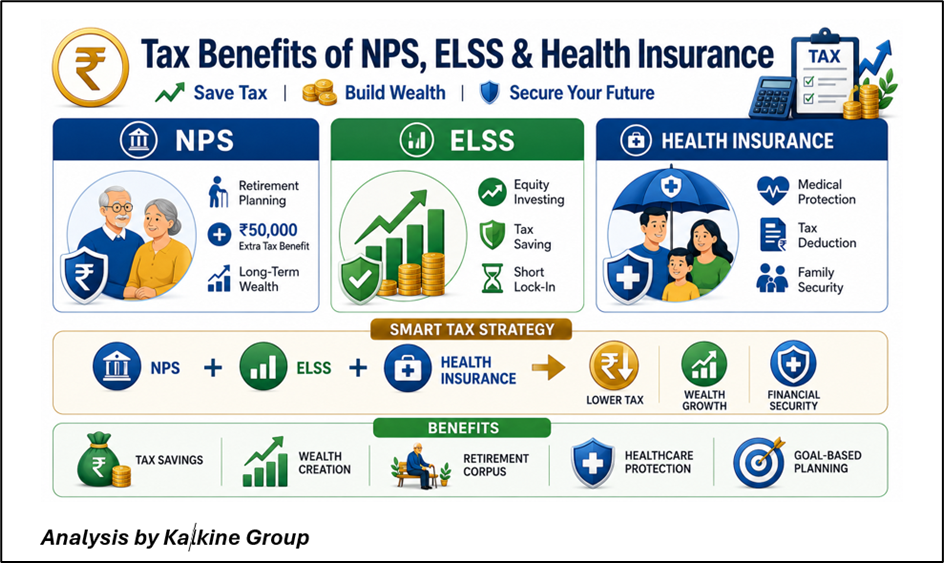
The Importance of Tax-Efficient Financial Planning
Many taxpayers focus solely on reducing taxes during the final months of the financial year. However, effective tax planning should be a year-round activity integrated with broader financial objectives.
A well-structured tax-saving strategy can help individuals:
- Reduce taxable income
- Build long-term wealth
- Create retirement savings
- Protect against medical emergencies
- Improve financial security
- Enhance post-tax investment returns
NPS, ELSS, and Health Insurance are among the most widely used instruments because they combine tax benefits with meaningful financial outcomes.
National Pension System (NPS): Tax Savings with Retirement Security
The National Pension System (NPS) is a government-regulated retirement savings scheme designed to encourage long-term retirement planning. It provides investors with an opportunity to build a retirement corpus while benefiting from attractive tax deductions.
- Tax Benefits Under Section 80CCD(1)- Contributions made to NPS qualify for tax deductions within the overall limit available under Section 80C and related provisions.
Eligible contributions can help reduce taxable income while simultaneously creating retirement wealth.
- Additional Deduction Under Section 80CCD(1B)- One of the most attractive features of NPS is the additional tax deduction available under Section 80CCD(1B).
Taxpayers can claim an additional deduction of up to ₹50,000 over and above the standard deduction limits available under Section 80C.
- Employer Contribution Benefits- For salaried employees, employer contributions to NPS may also qualify for tax benefits subject to applicable provisions and limits.
Why NPS Matters
In addition to tax savings, NPS offers:
- Long-term retirement planning
- Professional fund management
- Diversified asset allocation
- Potential wealth creation through market-linked investments
- Disciplined retirement corpus accumulation
As life expectancy increases and traditional pension structures become less common, NPS has emerged as an important retirement planning tool.
Equity Linked Savings Schemes (ELSS): Tax Savings with Wealth Creation
Equity Linked Savings Schemes (ELSS) are diversified equity mutual funds that qualify for tax benefits under Section 80C of the Income Tax Act.
Unlike many traditional tax-saving instruments, ELSS offers investors exposure to equity markets, providing the potential for long-term capital appreciation.
- Tax Benefits Under Section 80C- Investments in ELSS are eligible for tax deductions within the prescribed Section 80C limit.
- Short Lock-In Period- One of the key advantages of ELSS is its relatively short lock-in period compared to many other tax-saving investments.
Potential for Long-Term Wealth Creation
Because ELSS invests primarily in equities, investors may benefit from:
- Capital appreciation
- Long-term compounding
- Professional fund management
- Diversification across sectors and companies
While market-linked investments involve risk, ELSS has historically been a preferred option for investors seeking both tax efficiency and wealth creation potential.
Why ELSS Is Popular
Investors often choose ELSS because it offers:
- Tax-saving benefits
- Equity market participation
- Potential inflation-beating returns
- Relatively shorter lock-in period
- Goal-oriented wealth creation opportunities
For individuals with long investment horizons, ELSS can serve as both a tax-saving and investment vehicle.
Health Insurance: Tax Savings Through Financial Protection
Health insurance is no longer merely a financial product it has become an essential component of personal financial security. Rising healthcare costs and increasing medical inflation have made adequate health coverage a necessity for individuals and families.
In addition to providing protection against medical emergencies, health insurance also offers valuable tax benefits.
Tax Benefits Under Section 80D- Premiums paid toward eligible health insurance policies qualify for deductions under Section 80D of the Income Tax Act.
Tax benefits may be available for:
- Self
- Spouse
- Dependent children
- Parents
The deduction limits vary depending on factors such as age and the individuals covered under the policy.
Encouraging Financial Preparedness- Health insurance serves a dual purpose:
- Reducing taxable income
- Protecting savings from medical expenses
Without adequate health coverage, unexpected medical costs can significantly disrupt financial plans and force individuals to liquidate investments or incur debt.
Additional Advantages of Health Insurance
- Financial protection during medical emergencies
- Access to quality healthcare
- Reduced out-of-pocket expenses
- Long-term financial stability
- Peace of mind for individuals and families
As healthcare costs continue to rise, health insurance remains one of the most important financial protection tools available.
Combining NPS, ELSS and Health Insurance for Effective Tax Planning
While each of these instruments provides distinct benefits, combining them can create a well-rounded financial strategy.
- NPS Supports Retirement Planning-n NPS helps build a dedicated retirement corpus while offering additional tax benefits.
- ELSS Supports Wealth Creation- ELSS provides market-linked growth potential and tax-saving opportunities.
- Health Insurance Supports Risk Management- Health insurance protects financial stability while reducing taxable income through eligible deductions.
Together, these instruments help taxpayers balance:
- Tax efficiency
- Wealth creation
- Retirement planning
- Financial protection
This integrated approach can significantly strengthen overall financial well-being.
Common Tax Planning Mistakes to Avoid
Many taxpayers make avoidable errors while planning taxes.
Common mistakes include:
- Waiting until the end of the financial year
- Investing solely for tax savings
- Ignoring financial goals
- Underestimating insurance requirements
- Overlooking retirement planning
- Choosing products without understanding risk profiles
Tax-saving investments should always align with broader financial objectives rather than being selected solely for deduction benefits.
Conclusion
Tax planning should be viewed as an opportunity to strengthen long-term financial health rather than merely reduce annual tax liability. Instruments such as the National Pension System (NPS), Equity Linked Savings Schemes (ELSS), and Health Insurance offer taxpayers a powerful combination of tax efficiency, wealth creation, retirement preparedness, and financial protection.
By incorporating these instruments into a comprehensive financial strategy, individuals can not only reduce their taxable income but also build a stronger foundation for future financial security. Thoughtful tax planning, when aligned with personal financial goals, can contribute significantly to long-term wealth creation and financial independence.
Frequently Asked Questions (FAQs)
- What is the additional tax benefit available under NPS?
NPS offers an additional deduction of up to ₹50,000 under Section 80CCD(1B), over and above the deductions available under Section 80C, subject to prevailing tax regulations.
- Why is ELSS considered a popular tax-saving investment?
ELSS combines tax benefits with equity market exposure, offering the potential for long-term wealth creation while qualifying for deductions under Section 80C.
- Can health insurance premiums reduce taxable income?
Yes. Premiums paid for eligible health insurance policies may qualify for tax deductions under Section 80D, subject to applicable conditions and limits.