

Highlights
- Pre-filled tax returns reduce manual work but may not contain every financial detail.
- Verifying tax information before filing can help minimise reporting mistakes.
- Reviewing supporting tax documents may help avoid future compliance issues.
Technology has made income tax filing easier by automatically filling several sections of an Income Tax Return (ITR). Information already available with the tax department is reflected in the return, allowing taxpayers to spend less time entering routine details.
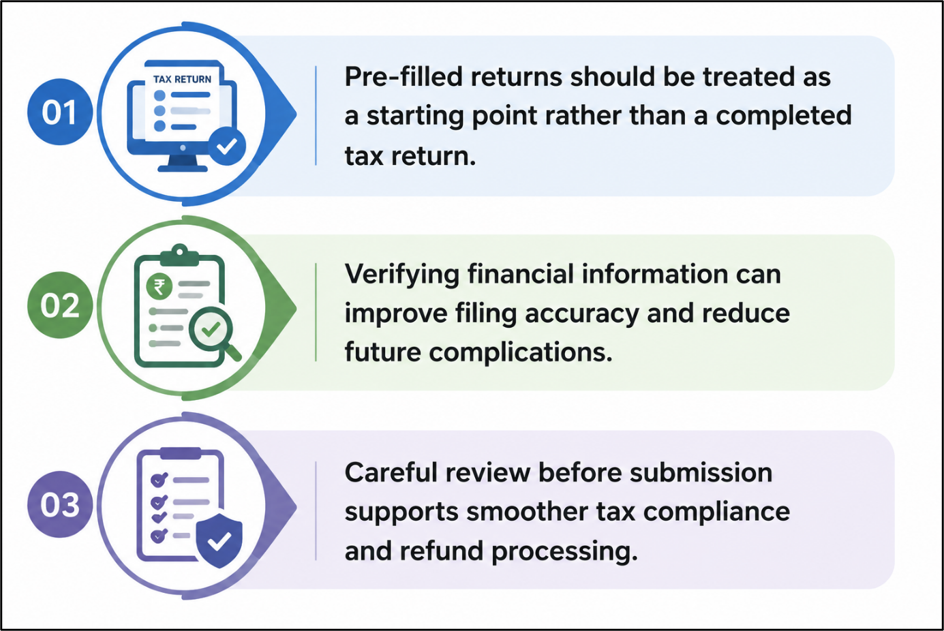
However, a pre-filled return should not be considered a final version of your tax information. Since the data comes from multiple reporting entities, there can be delays, omissions or inconsistencies. For this reason, taxpayers should carefully review every section before submitting their return.
Source: Analysis by Kalkine
What Is a Pre-Filled Income Tax Return?
A pre-filled ITR is a tax return that already contains certain taxpayer information collected from various financial and regulatory sources.
Depending on the applicable return form, the system may automatically display personal details, salary income, tax deducted at source, tax payments, bank account information and selected investment-related transactions.
Although these details simplify the filing process, taxpayers remain responsible for ensuring the information reported is complete and accurate.
Why Errors Can Still Occur
The accuracy of a pre-filled return depends on when employers, banks and other institutions submit their information to the Income Tax Department.
If reporting is delayed or corrections are made after the return has been generated, certain income or tax details may not appear immediately. In some situations, taxpayers are also required to manually disclose information that is not automatically populated.
Therefore, every entry should be verified instead of being accepted without review.
Information That Should Be Checked Carefully
A few minutes spent reviewing financial records can help identify errors before filing. Taxpayers should ensure that income received from all employers, pensions, interest earnings and other taxable sources has been properly included.
Interest and Investment Earnings
Income earned from savings accounts, fixed deposits, recurring deposits or dividends should be matched with personal financial records to confirm that no earnings have been overlooked.
Capital Market Transactions
Anyone who has bought or sold shares, mutual funds or other investments should verify that capital gains or losses have been reported correctly wherever applicable.
Tax Credits
Amounts deducted as TDS or deposited as advance tax should be compared with official tax records to ensure that the available credit matches the taxpayer's records.
Eligible Deductions
Certain deductions may require manual reporting. Taxpayers should verify that all eligible deductions claimed under their selected tax regime have been correctly entered before filing.
Why Supporting Tax Records Matter
Documents such as the Annual Information Statement (AIS) and Form 26AS provide an additional layer of verification.
Comparing these records with the information appearing in the return allows taxpayers to identify discrepancies before submission. Detecting mismatches early can help avoid unnecessary correspondence with the tax authorities later.
Common Filing Mistakes
Many taxpayers assume that a pre-filled return requires little or no review. This can result in avoidable errors.
Some of the common mistakes include:
- Forgetting income earned from multiple sources.
- Missing interest or dividend income.
- Claiming incorrect tax credits.
- Selecting an unsuitable tax regime.
- Leaving out deductions that require manual disclosure.
- Filing the return without reviewing supporting documents.
A careful review can significantly improve the accuracy of the return.
Key Risks to Consider
- Missing income could lead to additional tax liability.
- Incorrect tax credits may delay refund processing.
- Inaccurate reporting can result in compliance queries.
- Filing without verification increases the likelihood of errors.
Summary
A pre-filled Income Tax Return is designed to simplify tax filing, but it should not replace careful verification by the taxpayer. Since information may occasionally be incomplete or require manual updates, reviewing income, tax credits, deductions and supporting records before submission is an important step. Taking time to cross-check the return can improve accuracy and reduce the possibility of future tax-related issues.
FAQs
Q: Does a pre-filled ITR contain every taxable transaction?
A: Not always. Some transactions may require manual reporting or may not appear immediately due to reporting timelines.
Q: Why should taxpayers compare their return with supporting tax records?
A: Reviewing official tax statements helps identify missing income, incorrect tax credits and reporting inconsistencies before filing.
Q: Is the taxpayer responsible if the pre-filled return contains incorrect information?
A: Yes. Taxpayers remain responsible for verifying the accuracy of all information before submitting their income tax return.