

Simplifying Key Tax Concepts for Better Financial Planning and Compliance
Taxation plays a vital role in personal financial management, yet many taxpayers find concepts such as Tax Deducted at Source (TDS), Advance Tax, and Tax Refunds confusing. Whether you are a salaried employee, freelancer, business owner, investor, or professional, understanding these components of the Indian tax system is essential for effective tax planning and compliance.
TDS, Advance Tax, and Tax Refunds are interconnected mechanisms designed to ensure timely tax collection while minimizing the burden of large tax payments at the end of the financial year. A clear understanding of how these concepts work can help taxpayers avoid penalties, improve cash flow management, and ensure accurate tax filing.
This article provides a comprehensive overview of TDS, Advance Tax, and Tax Refunds and explains their significance in India's tax framework.
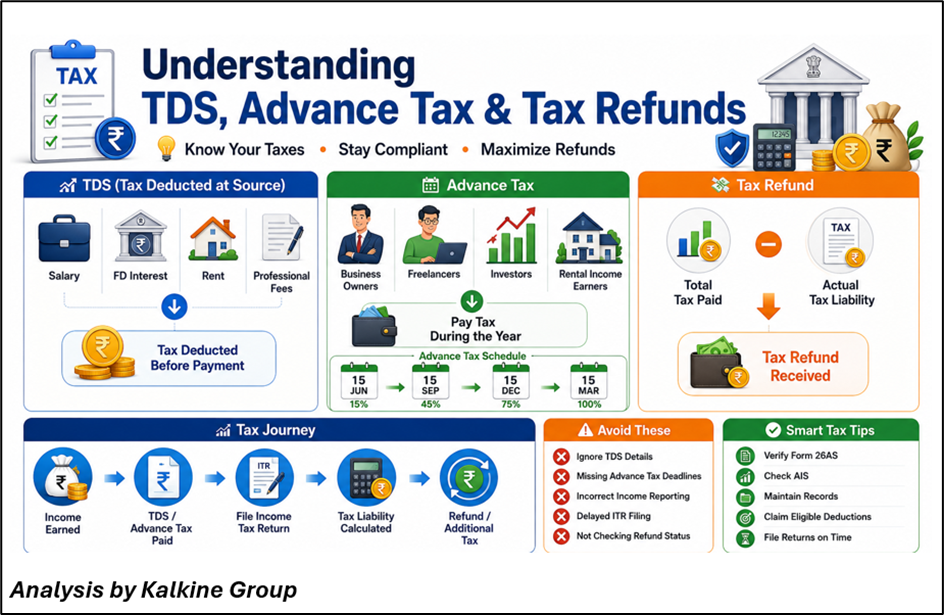
Understanding Tax Deducted at Source (TDS)
Tax Deducted at Source (TDS) is a system through which tax is collected at the source of income generation. Under this mechanism, the payer deducts a specified amount of tax before making certain payments and deposits the deducted amount with the government on behalf of the recipient.
The primary objective of TDS is to ensure a steady flow of tax revenue throughout the year while reducing tax evasion.
TDS may apply to various types of income, including salary, fixed deposit interest, professional fees, commission, rent, contract payments, and certain investment-related earnings. For salaried individuals, employers calculate and deduct TDS based on estimated annual taxable income and remit it to the government.
The amount deducted under TDS serves as a tax credit and can be adjusted against the taxpayer's final income tax liability while filing the income tax return.
Importance of TDS
TDS benefits both the government and taxpayers by distributing tax payments throughout the year. Instead of paying a large amount of tax at the end of the financial year, taxpayers contribute gradually through deductions made at the source.
The system helps:
- Ensure regular tax collection
- Reduce tax evasion
- Improve compliance
- Minimize year-end tax burden
- Facilitate smoother tax administration
Taxpayers should regularly verify TDS credits to ensure that deductions have been correctly deposited and reflected in official records.
Understanding Advance Tax
Advance Tax refers to the payment of income tax during the financial year itself rather than paying the entire amount at the time of filing the income tax return.
The concept follows the principle of "pay as you earn," requiring taxpayers to estimate their annual income and pay taxes in installments as income is earned.
Advance Tax is generally applicable when a taxpayer's estimated tax liability exceeds the prescribed threshold after accounting for TDS and other available tax credits.
Unlike salaried employees whose taxes are largely covered through TDS deductions, Advance Tax is commonly applicable to:
- Business owners
- Self-employed professionals
- Freelancers
- Investors earning capital gains
- Individuals receiving rental income
- Taxpayers with multiple sources of income
The objective of Advance Tax is to distribute tax payments throughout the year and prevent large tax outflows at the time of return filing.
Advance Tax Payment Schedule
Advance Tax is typically paid in four installments during the financial year.
The standard schedule generally includes:
- By 15 June- At least 15% of estimated annual tax liability.
- By 15 September- At least 45% of estimated annual tax liability.
- By 15 December- At least 75% of estimated annual tax liability.
- By 15 March- 100% of estimated annual tax liability.
Timely payment of Advance Tax helps taxpayers avoid interest charges and maintain compliance with tax regulations.
Consequences of Non-Payment of Advance Tax
Failure to pay Advance Tax or paying an amount lower than the required liability may attract interest under applicable provisions of the Income Tax Act.
Such situations may result in:
- Additional interest costs
- Increased tax burden
- Compliance issues
- Reduced financial flexibility
Accurate estimation of income and regular monitoring of tax obligations can help avoid these consequences.
Understanding Tax Refunds
A Tax Refund arises when the amount of tax paid during the financial year exceeds the actual tax liability calculated at the time of filing the income tax return.
This situation commonly occurs when:
- Excess TDS has been deducted
- Advance Tax paid exceeds actual liability
- Eligible deductions reduce taxable income
- Taxpayer's estimated income was higher than actual income
After the income tax return is filed and processed, the Income Tax Department verifies the information and determines whether a refund is due.
If excess tax has been paid, the eligible amount is refunded directly to the taxpayer.
How Tax Refunds Are Calculated
The calculation of a tax refund is relatively straightforward.
Tax Refund = Total Tax Paid – Actual Tax Liability
For example, if a taxpayer has paid ₹1,00,000 through TDS and Advance Tax combined but the final tax liability is calculated at ₹85,000, the excess amount of ₹15,000 may be refunded after processing and verification.
The refund amount depends entirely on the difference between taxes already paid and the final tax obligation.
Common Reasons for Receiving a Tax Refund
Tax refunds may arise due to several factors, including:
- Excess TDS deductions by employers
- Additional tax-saving investments claimed during return filing
- Home loan tax benefits
- Overpayment of Advance Tax
- Incorrect income estimates during the financial year
- Eligible deductions and exemptions reducing taxable income
Proper documentation and accurate return filing help ensure timely processing of refunds.
Best Practices for Effective Tax Management
Managing taxes efficiently requires proactive planning throughout the financial year rather than focusing solely during the return filing season.
Some important practices include:
- Monitor TDS Regularly- Review tax deductions reflected in Form 26AS and the Annual Information Statement (AIS) to ensure accuracy.
- Estimate Income Carefully- Accurate income estimation can help determine whether Advance Tax payments are necessary and prevent underpayment penalties.
- Maintain Financial Records- Keeping records of income, investments, deductions, and tax payments simplifies return filing and reduces errors.
- Claim Eligible Deductions- Utilizing applicable deductions and exemptions can reduce taxable income and improve tax efficiency.
- File Returns on Time- Timely filing not only ensures compliance but also accelerates refund processing.
Common Taxpayer Mistakes to Avoid
Many taxpayers face avoidable issues due to inadequate tax planning or oversight.
Common mistakes include:
- Ignoring TDS mismatches
- Missing Advance Tax deadlines
- Underestimating taxable income
- Delaying income tax return filing
- Failing to verify refund status
- Maintaining incomplete documentation
Avoiding these mistakes can improve tax compliance and reduce administrative complications.
Conclusion
TDS, Advance Tax, and Tax Refunds form the backbone of India's tax collection system and play an important role in ensuring efficient tax administration. While TDS enables tax collection at the source, Advance Tax distributes tax payments throughout the financial year. Tax Refunds provide relief when taxpayers have paid more tax than their actual liability.
Understanding these concepts can help taxpayers plan their finances more effectively, avoid penalties, improve cash flow management, and remain compliant with tax regulations. A proactive approach to tax planning and regular monitoring of tax obligations can contribute significantly to overall financial well-being.
Frequently Asked Questions (FAQs)
- What is the difference between TDS and Advance Tax?
TDS is deducted by the payer before making certain payments, whereas Advance Tax is paid directly by the taxpayer based on estimated income and tax liability during the financial year.
- Who is required to pay Advance Tax?
Individuals whose estimated tax liability exceeds the prescribed threshold after considering TDS and available tax credits may be required to pay Advance Tax in installments.
- Why do taxpayers receive Tax Refunds?
Tax refunds occur when the total tax paid through TDS, Advance Tax, or other tax payments exceeds the actual tax liability calculated while filing the income tax return.