

Highlights
- Married couples can independently choose different tax regimes while filing ITR.
- Tax regime selection depends on individual income sources and tax benefits.
- Salaried taxpayers can switch regimes annually, subject to filing rules.
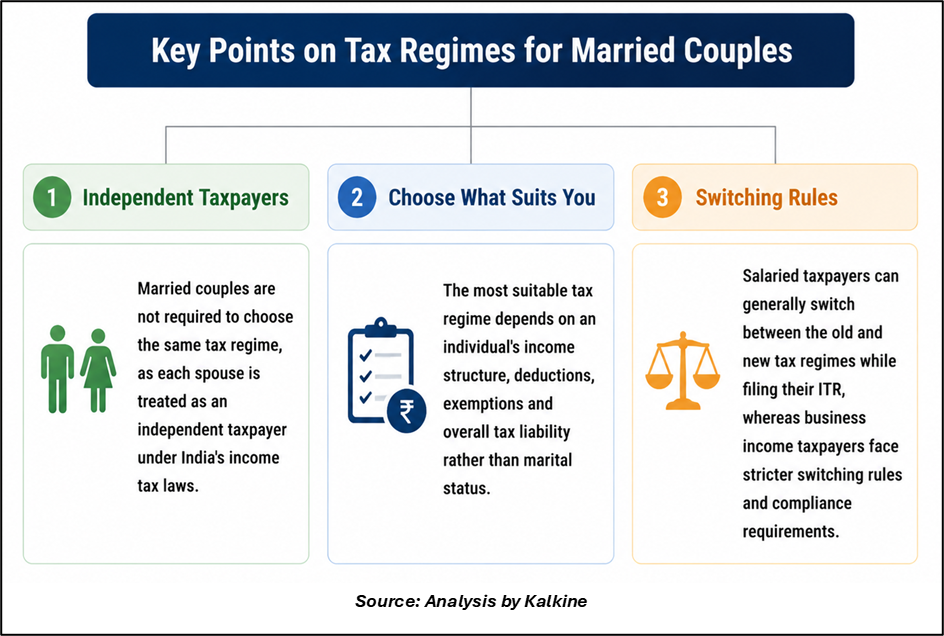
As the income tax filing season progresses, many married taxpayers are seeking clarity on whether spouses are required to select the same tax regime while filing their Income Tax Returns (ITRs). Current income tax provisions do not mandate married couples to opt for the same tax regime. Each spouse is treated as an individual taxpayer and can independently choose the tax regime that best suits their financial situation.
The choice between the old and new tax regimes is determined by factors such as income composition, deductions, exemptions, and tax liability. Therefore, one spouse may find the old tax regime more beneficial, while the other may prefer the new tax regime.
No Requirement for Joint Tax Regime Selection
India's income tax system currently requires individual tax filing rather than joint filing for married couples. Since spouses file separate returns, the tax regime selected by one spouse does not affect the choice available to the other.
For example, a salaried individual claiming deductions under Section 80C, house rent allowance (HRA), and home loan benefits may prefer the old tax regime. Meanwhile, the spouse, who has limited deductions and exemptions, may choose the new tax regime to benefit from lower tax rates.
Flexibility for Salaried Taxpayers
Salaried taxpayers enjoy flexibility when choosing between the old and new tax regimes. Even if a particular regime was declared to the employer for tax deduction at source (TDS) purposes, the taxpayer can switch to the other regime while filing the ITR, provided the return is filed within the prescribed timeline.
This flexibility allows individuals to calculate tax liability under both systems before making the final choice at the time of filing returns.
Different Rules for Business Income Taxpayers
The rules are more restrictive for taxpayers with income from business or profession. Such taxpayers cannot switch freely between tax regimes every year.
According to income tax provisions, individuals with business or professional income who opt out of the new tax regime are required to follow specific conditions and may face limitations on future switching between regimes. Form 10-IEA is required in certain cases for exercising the option.
As a result, married couples where one spouse earns salary income and the other earns business income may have different considerations when selecting their respective tax regimes.
Factors Couples Should Evaluate
While there is no obligation to choose the same tax regime, married couples should evaluate their tax positions individually before filing returns.
Important considerations include:
- Eligibility for deductions and exemptions.
- Housing loan interest benefits.
- Investments qualifying under Section 80C.
- Health insurance deductions.
- Income level and applicable tax slabs.
Tax experts generally recommend calculating tax liability under both regimes before making a final decision.
Growing Discussion Around Joint Tax Filing
The issue of taxation for married couples has recently attracted attention following suggestions for introducing an optional joint filing system in India. Such proposals argue that single-income households may face a relatively higher tax burden compared to dual-income families with similar combined earnings. However, no joint filing framework has been implemented at present, and spouses continue to file individual returns under existing rules.
Key Risks to Consider
- Incorrect regime selection may increase overall tax liability.
- Missing filing deadlines can restrict regime choices.
- Business income taxpayers face limited switching flexibility.
- Overlooking deductions may reduce potential tax savings.
Summary
Married couples are not obligated to select the same tax regime while filing ITRs in India. Each spouse is treated as an individual taxpayer and can independently choose between the old and new tax regimes based on personal income, deductions, and tax liability. Salaried taxpayers can switch regimes annually, while business income taxpayers face specific restrictions and compliance requirements.
FAQs
Q: Is it compulsory for husband and wife to choose the same tax regime?
A: No. Both spouses are separate taxpayers and may independently choose different tax regimes while filing their income tax returns.
Q: Can a salaried taxpayer change the tax regime while filing the ITR?
A: Yes. Salaried individuals can choose a different regime during ITR filing, subject to applicable filing deadlines.
Q: Does selecting a different tax regime affect a spouse’s tax return?
A: No. Each spouse files separately, and one individual's tax regime choice does not impact the other's return.