

Highlights
- Shares remain under pressure despite securing a new multiyear AI-powered transformation agreement in Europe.
• Investors continue to focus on industry-wide concerns surrounding AI disruption, slower technology spending, and global economic uncertainty.
• The stock recently slipped to a fresh 52-week low, reflecting persistent weakness across the IT sector.
New AI Deal Strengthens Global Presence
Tata Consultancy Services (NSE: TCS) recently announced a multiyear transformation and managed services agreement with a major European insurance provider. Under the partnership, the company will leverage its AI and digital capabilities to modernize data centres, improve software lifecycle management, enhance automation, and strengthen end-user computing environments.
The agreement reinforces the company's strategy of positioning itself as a key technology transformation partner for global enterprises. It also highlights growing demand for AI-driven modernization projects as organizations seek greater efficiency, automation, and operational resilience.
While the deal represents a positive business development, the market reaction suggests investors remain focused on broader industry challenges rather than individual contract wins.
Why the Market Is Ignoring Positive Deal Wins
One of the key reasons behind the stock's decline is that investors are increasingly evaluating the long-term impact of artificial intelligence on the traditional IT outsourcing model.
For years, the sector benefited from large-scale workforce-driven services contracts. However, AI-powered automation is changing client requirements and reducing dependence on conventional outsourcing structures. This transition has created uncertainty regarding future revenue growth and profitability across the industry.
As a result, even significant contract announcements have struggled to generate sustained buying interest, with investors demanding clearer evidence that AI investments can translate into meaningful long-term earnings growth.
Industry-Wide Weakness Continues
The stock's weakness is not occurring in isolation. The broader technology sector has witnessed sustained pressure as global clients remain cautious with discretionary technology spending.
Many enterprises continue to delay large transformation projects amid concerns about economic growth, inflation, and geopolitical uncertainty. This has impacted deal conversion timelines and revenue visibility across several segments of the IT services industry.
At the same time, global investors have increasingly shifted capital toward companies directly benefiting from the AI infrastructure boom, reducing interest in traditional outsourcing-focused businesses.
AI Transformation Brings Opportunities and Risks
The company has actively expanded its AI ecosystem through multiple partnerships and digital transformation initiatives. Management continues to position AI as a major growth driver for the next phase of technology services demand.
However, investors are also monitoring the cost of workforce restructuring and operational changes associated with this transition. The company has been recalibrating internal programs, investing in AI capabilities, and adapting its workforce strategy to align with evolving client requirements.
While these initiatives could strengthen competitiveness over the long term, the near-term impact on margins and growth remains a key area of market focus.
Ongoing Operational Challenges Add Pressure
Apart from industry headwinds, the company is also navigating operational and organizational changes. Market participants remain focused on workforce restructuring efforts and ongoing investigations related to workplace issues at one of its facilities.
Although these developments are unlikely to materially impact the company's core business operations, they have contributed to negative sentiment at a time when investors are already cautious toward the sector.
Revenue Visibility Remains Strong
Despite current challenges, the company continues to maintain a diversified global client base across banking, financial services, manufacturing, insurance, retail, and telecommunications sectors.
Large-scale transformation projects, cloud migration initiatives, cybersecurity demand, and AI integration programs continue to provide long-term opportunities. The latest agreement further demonstrates that global enterprises remain willing to invest in technology modernization despite macroeconomic uncertainty.
This supports the view that the company's long-term business fundamentals remain considerably stronger than current market sentiment may suggest.
Technical View Shows Persistent Weakness
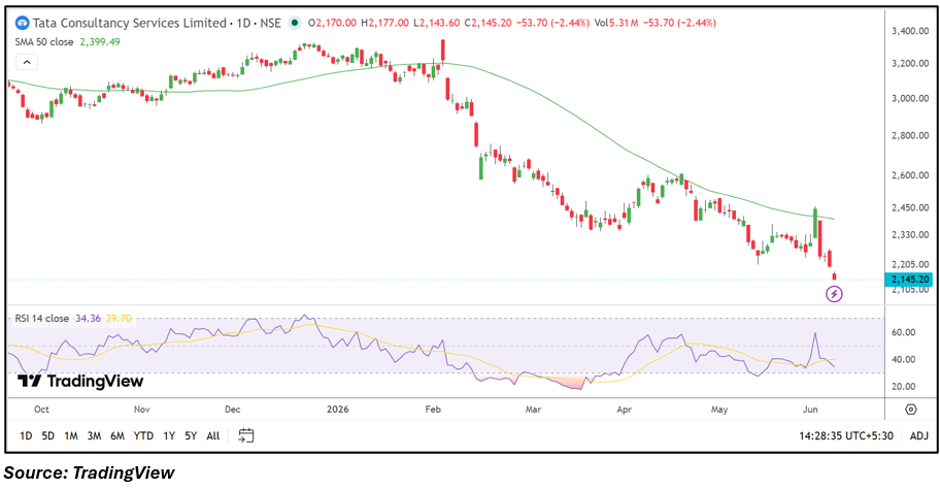
TCS is currently trading near ₹2,144.50, significantly below its 50-day SMA of ₹2,399.49, indicating a firmly bearish technical structure.
The stock recently slipped to a fresh 52-week low, highlighting continued selling pressure. Price action remains below key moving averages, suggesting that sellers continue to dominate the near-term trend.
The 14-day RSI stands at 34.36, reflecting weak momentum while approaching oversold territory. Although the RSI suggests the possibility of short-term stabilization, it does not yet indicate a confirmed reversal.
Key Technical Levels
TCS has immediate support near ₹2,037.28, followed by a stronger support zone around ₹1,930.05.
On the upside, resistance is placed near ₹2,251.73, while a stronger recovery hurdle is visible around ₹2,358.95.
A sustained move above resistance levels could improve sentiment, while a break below support may increase downside risks.
Key Risks
- Slower global technology spending.
• AI-led disruption to traditional outsourcing models.
• Delayed client decision-making on large projects.
• Continued foreign investor outflows from IT stocks.
• Margin pressure from workforce and technology investments.
Summary
TCS continues to win significant global transformation contracts and expand its AI capabilities, but investors remain focused on broader structural challenges facing the IT services industry. Concerns surrounding AI disruption, slower technology spending, workforce restructuring, and sector-wide weakness have overshadowed recent business wins.
While the company's long-term growth opportunities remain intact, the stock is likely to require stronger earnings momentum and clearer evidence of AI-driven revenue expansion before market sentiment improves materially.
FAQs
Why is TCS falling despite winning a major AI deal?
Investors remain concerned about broader industry challenges, including slower IT spending, AI disruption, and uncertain growth visibility.
Is TCS still investing in AI?
Yes. The company continues to expand AI partnerships and digital transformation initiatives globally.
What are the key technical levels to watch?
Support levels are near ₹2,037.28 and ₹1,930.05, while resistance levels are near ₹2,251.73 and ₹2,358.95.