

Highlights
- TCS has partnered with Anthropic to deploy Claude AI across 50,000 employees.
- The collaboration aims to accelerate enterprise AI adoption across key global industries.
- Despite the AI push, TCS shares remain under pressure amid broader concerns around IT spending and sector-wide transformation.
Why Is TCS Expanding Its AI Strategy?
Tata Consultancy Services (NSE: TCS) has announced a strategic partnership with Anthropic to provide Claude AI access to approximately 50,000 employees. The move reflects the company's growing focus on artificial intelligence as enterprises increasingly seek automation, productivity enhancement, and data-driven decision-making solutions.
The initiative is expected to help TCS gain hands-on operational experience with advanced AI models while strengthening its ability to deliver AI-powered transformation programs to global clients. The partnership also positions TCS to compete more effectively in the rapidly evolving enterprise AI market.
How Will the Anthropic Partnership Benefit TCS?
The agreement extends beyond internal AI adoption. TCS and Anthropic plan to jointly develop and deploy AI solutions across industries including financial services, healthcare, life sciences, telecom, aviation, public services, and medtech.
By integrating Claude AI into its service offerings, TCS aims to improve consulting capabilities, accelerate project delivery, and create industry-specific AI solutions. The company believes that real-world experience with generative AI tools will strengthen its ability to support clients navigating complex digital transformation initiatives.
As enterprises continue evaluating AI adoption strategies, TCS is positioning itself as a long-term transformation partner rather than simply a traditional IT outsourcing provider.
Why Is the Market Still Cautious on TCS Shares?
Despite the positive strategic development, TCS shares continue to trade near multi-month lows. Investors remain concerned about slowing global technology spending, margin pressures, workforce restructuring, and uncertainty regarding the pace of AI monetization.
The IT sector is currently undergoing significant change as businesses assess how artificial intelligence may reshape traditional service models. While AI creates new opportunities, investors are also evaluating whether automation could affect demand for certain legacy outsourcing services.
These concerns have limited enthusiasm toward the stock despite several AI-related announcements and new client wins.
Can AI Become a Long-Term Growth Driver?
Artificial intelligence is increasingly becoming a critical investment area for global enterprises. Organizations require support in implementing AI systems, integrating data infrastructure, ensuring governance compliance, and maintaining operational reliability.
TCS already has deep relationships with large multinational clients. The addition of Anthropic's Claude AI platform could help the company secure larger transformation contracts and strengthen its position in high-value consulting engagements.
If adoption accelerates across industries, AI services may become an increasingly important contributor to future revenue growth.
What Does the Technical Setup Suggest?
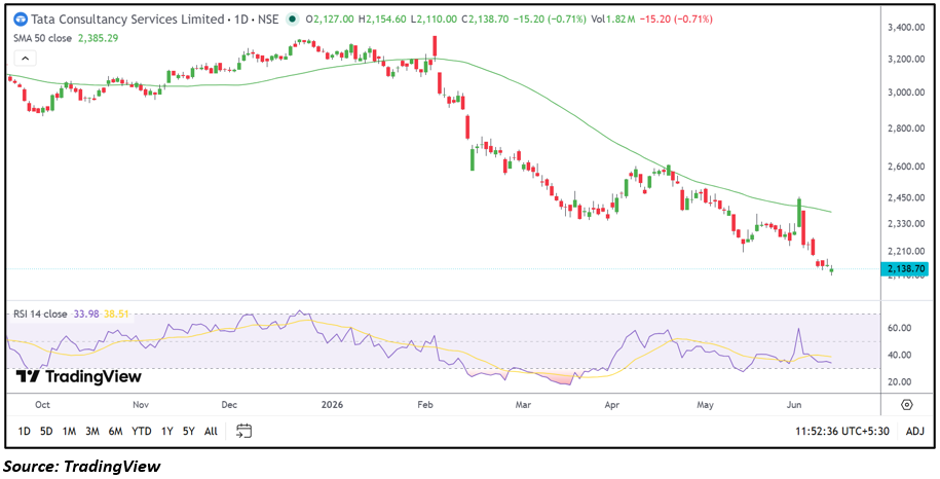
TCS is currently trading near ₹2,139.00, remaining below its 50-day SMA of ₹2,385.29. The broader technical structure continues to reflect weakness, although recent price action suggests the stock is attempting to stabilize after an extended decline.
The stock remains below key moving averages, indicating that investors are still cautious despite improving news flow around AI initiatives and enterprise partnerships.
Is Momentum Improving?
The RSI stands near 33.98, suggesting that momentum remains weak but is approaching oversold territory. While this does not confirm a reversal, it indicates that downside pressure may be moderating compared to earlier stages of the decline.
Market participants will likely watch whether positive developments around AI deployment and client adoption can improve sentiment over the coming quarters.
Key Technical Levels
From a technical perspective, immediate support is located near ₹2,032.05, while a stronger downside support zone is positioned around ₹1,925.10. On the upside, resistance is seen near ₹2,245.95, followed by a higher resistance level around ₹2,352.90. These levels may remain important as investors assess the impact of TCS' AI initiatives and broader sector conditions.
Key Risks
- Slower-than-expected enterprise AI adoption.
- Weak global technology spending trends.
- Margin pressure from ongoing AI investments.
- Increased competition in enterprise AI services.
- Regulatory and governance challenges surrounding AI deployment.
Final Take
The Anthropic partnership represents another important step in TCS' broader AI transformation strategy. By providing Claude AI access to 50,000 employees and collaborating on industry-specific AI solutions, the company is strengthening its position in one of the fastest-growing areas of enterprise technology. While near-term market sentiment remains cautious due to sector-wide challenges, the partnership highlights TCS' commitment to building long-term AI capabilities. Investors will now focus on execution, client adoption, and whether these investments can translate into sustainable revenue growth.
FAQs
Why is TCS deploying Claude AI to 50,000 employees?
TCS is deploying Claude AI to gain operational experience with advanced AI systems and strengthen its ability to deliver AI-led transformation projects for clients.
What is the purpose of the Anthropic partnership?
The partnership aims to accelerate enterprise AI adoption, develop industry-specific AI solutions, and enhance TCS' service offerings across multiple sectors.
Why are TCS shares still under pressure?
Investors remain concerned about slowing IT spending, margin pressures, workforce restructuring, and uncertainty around the pace of AI monetization.
Which industries will benefit from the collaboration?
The partnership targets financial services, healthcare, life sciences, telecom, aviation, public services, and medtech sectors.