

Highlights
- UPL reported strong Q4 FY26 earnings with healthy profit and revenue growth
• The company reduced debt significantly and improved balance sheet strength
• Investors are also tracking Advanta IPO plans and FY27 growth guidance
Overview
UPL Limited (NSE: UPL) remained in focus on May 12, 2026, after the company reported strong quarterly earnings supported by higher margins, improving operational performance, and meaningful debt reduction. Despite the positive financial update, the stock traded lower near ₹650.50 during the session amid broader market volatility and profit booking after recent gains.
The company delivered solid Q4 FY26 numbers, with net profit rising sharply and revenue growth remaining healthy across key segments. Investors also reacted positively to the company’s improving leverage profile and optimistic FY27 guidance, although near-term market sentiment stayed cautious due to volatility in global markets and agrochemical demand trends.
Another major development attracting market attention is the proposed IPO of Advanta Enterprises, UPL’s seed business subsidiary, which could unlock value for shareholders if market conditions remain supportive.
Strong Earnings Support Sentiment
UPL reported strong quarterly performance for Q4 FY26, with net profit increasing significantly compared to the previous year. Revenue growth remained healthy due to better demand conditions, improved pricing, and margin expansion across segments.
The company also highlighted stronger operational efficiency and improved EBITDA performance, which supported overall profitability during the quarter. Investors viewed the results positively because the agrochemical sector had faced margin pressure and inventory normalization challenges over recent quarters.
UPL further projected healthy growth momentum for Q1 FY27, expecting revenue and EBITDA growth to remain strong as business conditions stabilize gradually.
The company additionally announced a dividend payout for the financial year, reflecting improving confidence in cash flow generation and operational recovery.
Debt Reduction Improves Financial Position
One of the biggest positives from the quarterly update was the sharp reduction in debt levels. UPL reduced debt substantially during FY26, helping improve its debt-to-EBITDA ratio and strengthening the company’s overall balance sheet position.
Lower leverage has become an important focus area for investors because the agrochemical industry globally has been dealing with cyclical demand fluctuations, working capital pressure, and higher financing costs over the past year.
The debt improvement has therefore helped improve market confidence regarding UPL’s financial stability and long-term operational flexibility.
A stronger balance sheet may also support future investments in specialty products, biosolutions, and expansion opportunities without significantly increasing financial stress.
Advanta IPO Plans Remain a Key Trigger
Market participants are also closely tracking developments around the planned IPO of Advanta Enterprises. The proposed listing could act as an important value-unlocking event for UPL if investor interest in the seed and agricultural technology business remains strong.
Advanta operates in the seeds and genetics segment, which continues to gain attention due to rising global focus on food security, productivity improvement, and sustainable farming solutions.
Investors believe the IPO may help highlight the value of UPL’s diversified business portfolio beyond traditional crop protection products.
At the same time, broader market conditions and investor appetite for new listings will remain important factors influencing the timing and valuation of the IPO process.
Technical View
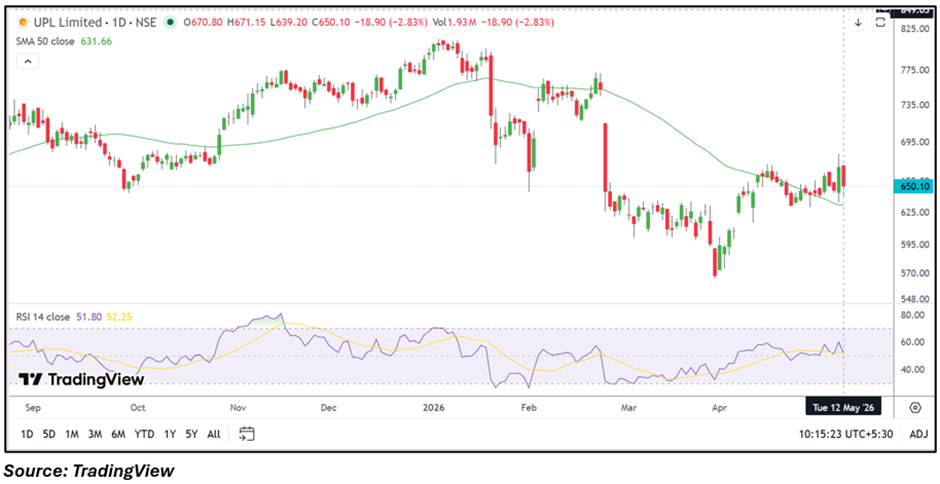
UPL Limited is currently trading near ₹650.50 and remains above its 50-day moving average around ₹631.66, indicating that the medium-term structure remains relatively stable despite recent volatility.
The RSI indicator is hovering near neutral territory, suggesting balanced momentum conditions after the recent pullback from higher levels.
Immediate support is placed around ₹600.00–₹560.00. If the stock moves below this range, additional weakness may emerge in the near term.
On the upside, resistance is seen near ₹700.00–₹750.00. A sustained move above these levels may improve sentiment further and support a stronger recovery phase.
What Investors Are Watching Next
Investors are now focusing on whether UPL can sustain its improving earnings momentum through FY27 amid changing global agricultural demand conditions.
Market participants are also monitoring raw material trends, global crop cycles, inventory normalization across export markets, and developments around the Advanta IPO process.
The company’s ability to maintain margin improvement while continuing debt reduction efforts will likely remain a major factor influencing long-term investor confidence.
Global commodity prices, currency movements, and weather-related agricultural trends may also continue affecting sentiment toward agrochemical companies in the coming quarters.
Key Risks
- Volatility in global agrochemical demand
• Pressure from raw material and input costs
• Delay or weaker sentiment around the Advanta IPO
• Currency fluctuations impacting export-driven business
Summary
UPL Limited (NSE: UPL) delivered a strong quarterly performance supported by profit growth, margin improvement, and meaningful debt reduction. While the stock witnessed some near-term weakness amid volatile market conditions, investors continue tracking the company’s FY27 growth outlook and Advanta IPO plans closely. The improving balance sheet and operational recovery remain key positives for the company moving forward.
FAQs
Why is UPL in focus today?
UPL reported strong Q4 FY26 earnings, reduced debt significantly, and remains in focus due to Advanta IPO plans.
What is the current support zone for UPL?
Immediate support is placed around ₹600.00–₹560.00.
What resistance levels are important for the stock?
Resistance is seen near ₹700.00–₹750.00.
Why is debt reduction important for UPL?
Lower debt improves financial stability, reduces interest burden, and strengthens investor confidence in the company’s long-term outlook.