

Asset allocation is one of the most critical elements of fund management in India. It determines how investment capital is distributed across various asset classes such as equities, debt instruments, commodities, and cash equivalents. A well-designed asset allocation strategy helps fund managers balance growth opportunities with risk management, ensuring consistent performance across different market cycles. With increasing participation in Indian financial markets, investors are placing greater emphasis on disciplined allocation strategies to achieve long-term portfolio stability.
Understanding Asset Allocation in Fund Management
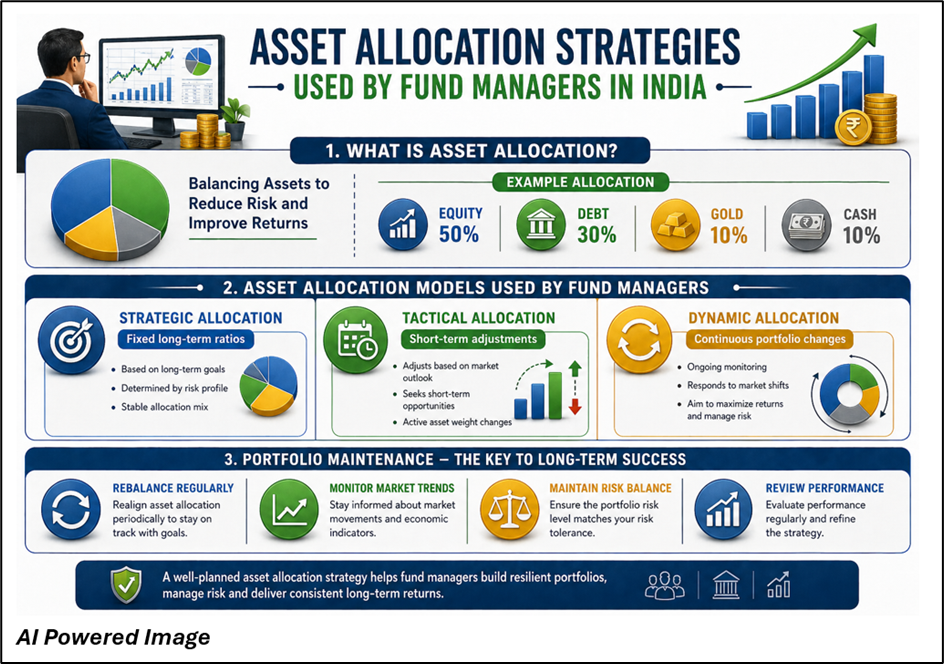
Asset allocation refers to dividing investment capital among different asset categories to optimize risk-adjusted returns. In India, asset management companies (AMCs) design fund strategies based on market outlook, investor objectives, and economic conditions.
Typically, asset allocation involves investments across:
- Equity instruments for capital growth
- Debt securities for income generation
- Money market instruments for liquidity
- Gold or commodities for diversification
- International assets for geographic exposure
The objective is to avoid concentration risk while maintaining growth potential. Portfolio diversification across multiple holdings reduces dependency on individual securities and improves risk control during market volatility.
Different asset classes react differently to economic changes, making balanced allocation essential for stable fund performance.
Types of Asset Allocation Strategies Used in India- Fund managers in India use various asset allocation models depending on investment goals and market conditions.
Strategic Asset Allocation- Strategic allocation involves maintaining a fixed proportion of investments across asset classes over a long period. For example, a balanced fund may allocate:
- 60% to equities
- 30% to debt
- 10% to gold or cash
This approach ensures long-term discipline and prevents emotional investment decisions.
Tactical Asset Allocation- Tactical allocation involves adjusting portfolio weights based on short-term market opportunities. For instance, fund managers may increase equity exposure during economic recovery phases or shift toward debt instruments during market uncertainty.
Dynamic Asset Allocation- Dynamic allocation allows continuous adjustments based on changing market conditions. This flexible strategy helps protect portfolios from sudden volatility and improves adaptability.
Role of Market Conditions in Allocation Decisions
Market cycles significantly influence asset allocation decisions. Factors such as inflation, interest rates, corporate earnings, and global economic trends determine how funds distribute capital.
For example:
- Rising interest rates may increase allocations to debt instruments.
- Economic growth phases may favor higher equity exposure.
- Inflationary periods may increase allocations to gold or commodities.
Commodity investments are often used as diversification tools because they behave differently from equities and bonds during certain market conditions.
Understanding these relationships allows fund managers to maintain portfolio resilience.
Risk Management Through Rebalancing
Portfolio rebalancing is an essential component of asset allocation. Over time, asset values change, altering the original allocation structure.
Rebalancing involves:
- Selling overweight assets
- Buying underweight assets
- Restoring the original allocation targets
Regular rebalancing helps maintain desired risk levels and prevents portfolios from becoming overly concentrated in specific assets.
Effective capital allocation also ensures liquidity availability and supports long-term portfolio growth. Structured allocation strategies enable funds to sustain operations and invest in emerging opportunities.
Growing Importance of Asset Allocation in India
India’s expanding financial markets have increased the importance of asset allocation strategies. With rising retail participation in mutual funds and exchange-traded funds (ETFs), investors now have access to diversified investment vehicles managed by professionals.
Technology-driven analytics and portfolio management tools are enabling fund managers to make data-driven allocation decisions. This shift is improving portfolio efficiency and helping investors achieve better risk-adjusted returns.
Conclusion
Asset allocation remains a cornerstone of fund management in India. By distributing investments across multiple asset classes and adjusting allocations based on market conditions, fund managers can balance risk and growth effectively. A disciplined allocation strategy combined with periodic rebalancing ensures portfolio stability, making asset allocation one of the most important tools in modern investment management.
FAQs
- What is asset allocation in fund management?
Asset allocation refers to distributing investments across different asset classes to balance risk and returns. - Why is rebalancing important in asset allocation?
Rebalancing restores the intended asset mix and prevents excessive exposure to specific investments. - Which asset classes are commonly used in Indian funds?
Common asset classes include equities, debt instruments, commodities, gold, and international securities.