

Diversification is one of the most fundamental principles in fund management and plays a critical role in reducing investment risks. In India’s dynamic financial markets, fund managers rely on diversification to spread investments across different sectors, industries, and asset classes. This approach helps minimize the impact of losses from individual investments while maintaining steady portfolio performance. As market volatility continues to influence investment outcomes, diversification has become a key strategy for achieving balanced growth and financial resilience.
Understanding Diversification in Fund Management
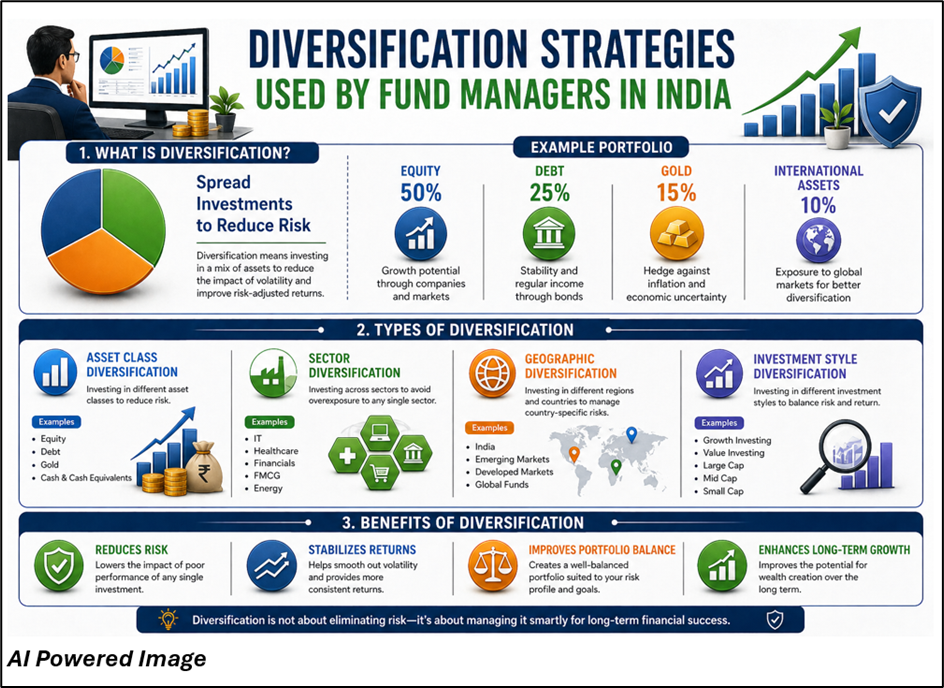
Diversification involves allocating investments across various financial instruments rather than concentrating capital in a single asset or sector. In India, fund managers typically build diversified portfolios that include equities, debt instruments, commodities, and alternative assets.
For example, equity portfolios may include companies from:
- Banking and Financial Services
- Information Technology
- Pharmaceuticals
- Consumer Goods
- Infrastructure and Energy
This sectoral spread helps reduce exposure to risks associated with specific industries. A diversified portfolio can stabilize returns by limiting the influence of individual asset performance, especially during unpredictable market conditions. Diversification has long been considered a core method for managing uncertainty and improving long-term investment outcomes.
Types of Diversification Strategies Used in India
Fund managers in India apply diversification at multiple levels to strengthen portfolio resilience.
Asset Class Diversification- This involves investing across different asset categories such as:
- Equities for capital appreciation
- Debt securities for income stability
- Gold or commodities for inflation protection
- Cash instruments for liquidity management
Different asset classes react differently to economic conditions, allowing portfolios to remain stable during market fluctuations.
Sector Diversification- Sector diversification spreads investments across industries to reduce dependency on one segment. For example, when technology stocks face declines, gains in banking or consumer sectors may offset losses.
Geographic Diversification- Indian fund managers increasingly include international equities and global funds in portfolios. Geographic diversification helps reduce exposure to domestic economic risks and provides access to global growth opportunities.
Concentration vs Diversification in Fund Performance
Fund managers often balance concentration and diversification to optimize returns. Concentrated portfolios may deliver higher returns when a few investments perform strongly, but they also increase exposure to risk.
Diversified portfolios, on the other hand, offer stability by distributing investments across multiple holdings. The effectiveness of diversification depends on how investments are selected and balanced rather than simply increasing the number of holdings. Many modern funds adopt a hybrid approach, combining focused investments with broader diversification strategies to achieve balanced outcomes.
Risk Reduction Through Portfolio Structuring
Diversification reduces several types of investment risks, including:
- Company-specific risks
- Sector-related risks
- Market volatility
- Economic downturn exposure
By combining assets with varying risk levels, fund managers create portfolios that are better equipped to withstand sudden market changes.
Regular monitoring and rebalancing are also essential to maintain diversification effectiveness. Over time, certain investments may grow faster than others, altering the original portfolio balance.
Diversification Trends in India’s Fund Industry
India’s fund management industry has seen increasing adoption of diversified investment products such as:
- Multi-asset funds
- Hybrid funds
- Exchange-Traded Funds (ETFs)
- Thematic and sectoral funds
Commodity investments have also gained attention as diversification tools because they behave differently from traditional asset classes during inflationary periods.
Technology-driven analytics and risk management tools are enabling fund managers to design more sophisticated diversification strategies tailored to investor needs.
Conclusion
Diversification remains a cornerstone of effective fund management in India. By spreading investments across sectors, asset classes, and geographies, fund managers can reduce risk and improve portfolio resilience. As financial markets evolve, disciplined diversification strategies continue to support stable performance and long-term investment success. Investors who understand the value of diversification are better positioned to manage uncertainties and achieve consistent financial outcomes.
FAQs
- What is diversification in fund management?
Diversification involves spreading investments across different assets to reduce risk and stabilize returns. - Why is diversification important in Indian financial markets?
It helps manage volatility and reduces dependence on individual sectors or companies. - Can diversification completely eliminate investment risk?
No, diversification reduces risk but does not eliminate it entirely.