

Fund management plays a crucial role in India’s financial ecosystem, influencing how institutional and retail investors grow wealth while managing risk. Whether managed through mutual funds, portfolio management services (PMS), or alternative investment funds (AIFs), fund management involves allocating capital strategically across asset classes to maximize returns and maintain stability during market fluctuations. With India’s growing participation in financial markets, understanding the fundamentals of fund management has become increasingly important for investors.
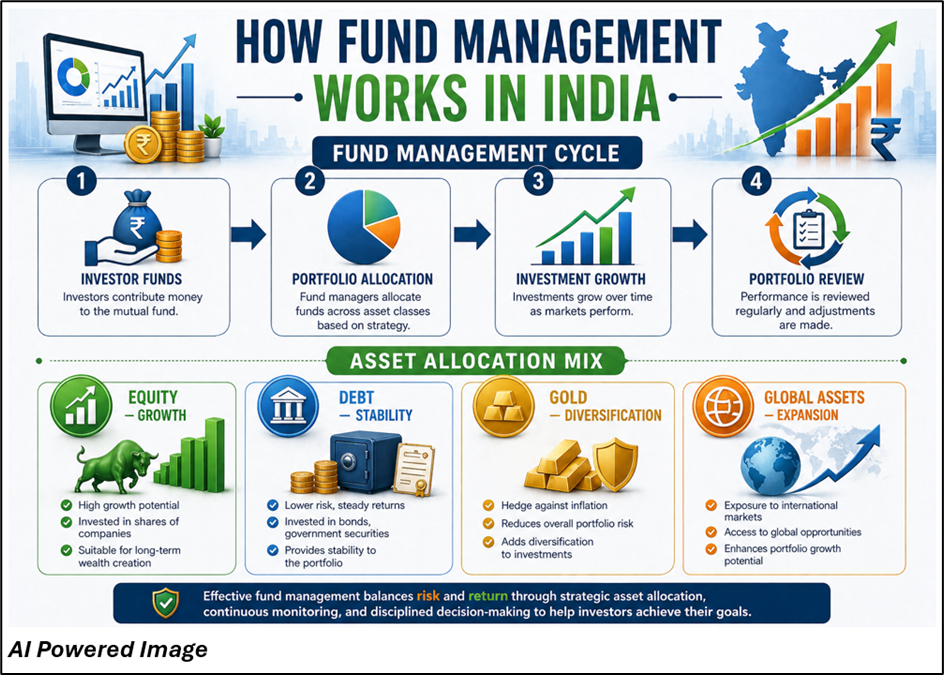
Understanding Fund Management in the Indian Context
Fund management refers to the professional management of investment portfolios that may include equities, debt instruments, commodities, and other financial assets. In India, asset management companies (AMCs) design and operate mutual funds that pool money from investors and invest it across diversified securities.
Indian fund managers typically evaluate:
- Market trends and economic conditions
- Interest rate cycles
- Sector performance
- Corporate earnings growth
- Risk-return balance
Effective fund management involves balancing growth-oriented investments with stability-focused assets. Portfolio construction strategies often depend on diversification principles and capital allocation discipline, which help reduce risk while enhancing long-term performance potential.
Importance of Asset Allocation in Fund Management
Asset allocation forms the foundation of successful fund management. In India, fund managers distribute investments across asset classes such as:
- Equities for capital appreciation
- Debt securities for income stability
- Money market instruments for liquidity
- Commodities or gold for diversification
- International assets for global exposure
This balanced allocation reduces reliance on any single investment type. For example, during periods of equity market volatility, debt instruments can provide relative stability.
Asset allocation strategies vary based on market outlook and investment objectives. Growth-oriented funds may allocate more capital to equities, while conservative funds emphasize fixed-income securities.
Diversification and Risk Management Strategies
Diversification is one of the most widely used strategies in fund management. It involves spreading investments across sectors, industries, and asset classes to reduce exposure to individual risks.
For instance, Indian equity funds may diversify across:
- Banking and financial services
- Information technology
- Pharmaceuticals
- Infrastructure
- Consumer goods
This diversified approach reduces volatility and enhances the potential for consistent returns. Diversification remains a key mechanism for managing uncertainty and stabilizing fund performance across varying market cycles.
Risk management techniques also include:
- Portfolio rebalancing
- Hedging strategies
- Liquidity management
- Continuous performance monitoring
Such practices help fund managers protect investor capital during adverse market conditions.
Role of Capital Allocation in Fund Growth
Capital allocation determines how funds distribute earnings and reinvest profits to generate long-term value. In India, fund managers continuously evaluate market opportunities to decide whether to increase exposure to specific sectors or reduce positions in underperforming assets.
Strategic capital allocation typically involves:
- Maintaining liquidity reserves
- Reinvesting profits into growth opportunities
- Adjusting investment weights based on performance
- Managing operational costs efficiently
Structured capital allocation practices support both operational efficiency and long-term portfolio expansion.
Emerging Trends in Fund Management in India
India’s fund management industry is evolving rapidly due to technological advancements and increased investor participation.
Key trends include:
- Growth in passive funds such as index funds and ETFs
- Increasing use of data analytics and artificial intelligence
- Expansion of thematic and sector-specific funds
- Rising interest in environmental, social, and governance (ESG) investing
Additionally, commodity-based strategies are gaining attention as funds seek diversification benefits from asset classes that behave differently from equities and bonds.
These developments are shaping the future of fund management in India, enabling investors to access more sophisticated investment solutions.
Conclusion
Fund management in India has evolved into a sophisticated discipline that integrates asset allocation, diversification, and risk management strategies. As financial markets expand and investor participation increases, structured fund management practices remain essential for achieving stable returns and managing uncertainty. By adopting disciplined capital allocation and diversified investment approaches, fund managers can enhance portfolio resilience while capturing growth opportunities across sectors.
FAQs
- What is fund management and why is it important?
Fund management involves professionally managing investments across asset classes to optimize returns while controlling risks. - How does diversification improve fund performance?
Diversification spreads investments across sectors and asset classes, reducing dependence on any single investment. - What are common types of funds in India?
Common funds include equity funds, debt funds, hybrid funds, index funds, and sectoral funds.